Question
A bar magnet makes 40 oscillations per minute in an oscillation magnetometer. An identical magnet is demagnetized completely and is placed over the magnet in the magnetometer. Find the time taken for 40 oscillations by this combination. Neglect any induced magnetism.
Answer

$\gamma_1=40$ oscillations/minute$\text{B}=25\mu\text{T}$
M of second magnet $=1.6\text{A-m}^2$
$\text{d}=20\text{cm}=0.2\text{m}$
  1. For north facing north.
$\gamma=\frac{1}{2\pi}\sqrt{\frac{\text{MB}_\text{H}}{\text{I}}}$
$\gamma=\frac{1}{2\pi}\sqrt{\frac{\text{M}(\text{B}_\text{H}-\text{B})}{\text{I}}}$
$\text{B}=\frac{\mu_0}{4\pi}\frac{\text{m}}{\text{d}^3}=\frac{10^{-7}\times1.6}{8\times10^{-3}}=20\mu\text{T}$
$\frac{\gamma_1}{\gamma_2}=\sqrt{\frac{\text{B}}{\text{B}_\text{H}-\text{B}}}\Rightarrow\frac{40}{\gamma _2}=\sqrt{\frac{25}{5}}$
$\Rightarrow\gamma_2=\frac{40}{\sqrt{5}}=17.88\approx \text{osci/min}$
  1. For north pole facing south.
$\gamma_1 =\frac{1}{2\pi}\sqrt{\frac{\text{MB}_\text{H}}{\text{I}}}$
$\gamma_2=\frac{1}{2\pi}\sqrt{\frac{\text{M} (\text{B} _\text{H}-\text{B}}{\text{I}}}$
$\frac{\gamma_1}{\gamma_2}=\sqrt{\frac{\text{B}}{\text{B}_\text{H}-\text{B}}}\Rightarrow\frac{40}{\gamma_2}=\sqrt{\frac{25}{45}}$
$\Rightarrow\gamma_2=\frac{40}{\sqrt{\big(\frac{25}{45}\big)}}=53.66\approx54\text{ osci/min}$

Need a full question paper?

Generate a complete, print-ready paper with questions like this in minutes — across 16+ boards, with answer keys.

Start Generating Free

Similar questions

The plate current in a triode value is maximum when the potential of the grid is:
  1. Positive.
  2. Zero.
  3. Negative.
  4. Non-positive.
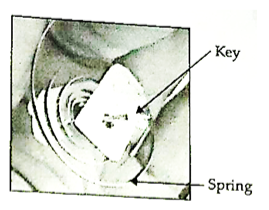
Clockwork refers to the inner workings of mechanical clock or watch (where it is known as "movement") and different types of toys which work using a series of gears driven by a spring. Clockwork device is completely mechanical and its essential parts are:
- A key (or crown) which you wind to add energy
- A spiral spring in which the energy is stored
- A set of gears through which the spring's energy is released. The gears control how quickly (or slowly) a clockwork machine can do things. Such as in mechanical clock/watch the mechanism is the set of hands that sweep around the dial to tell the time. In a clockwork car toy, the gears drive the wheels.
Winding the clockwork with the key means tightening a sturdy metal spring, called the mainspring. It is the process of storing potential energy. Clockwork springs are usually twists of thick steel, so tightening them (forcing the spring to occupy a much smaller space) is actually quite hard work. With each turn of the key, fingers do work and potential energy is stored in the spring. The amount of energy stored depends on the size and tension of the spring. Harder a spring is to turn and longer it is wound, the more energy it stores.
Image
While the spring uncoils, the potential energy is converted into kinetic energy through gears, cams, cranks and shafts which allow wheels to move faster or slower. In an ancient clock, gears transform the speed of a rotating shaft so that it drives the second hand at one speed, the minute hand at $\frac{1}{60}$ of that speed, and the hour hand at $\frac{1}{3600}$ of that speed. Clockwork toy cars often use gears to make themselves race along at surprising speed.

1. What is the meaning of movement of old age mechanical clocks?
(a) The pendulum of the clock
(b) The gears which move the hands of the clock
(c) A spring and combination of gears which move the hands of the clock
(d) The hands of the clock
2. What type of energy is stored in the spring while winding it?
(a) Potential  (b) Heat  (c) Both kinetic and potential  (d) Kinetic
3. When the spring of a clockwork uncoils
(a) Kinetic energy is converted into potential energy
(b) Potential energy is converted into kinetic
(c) Potential energy is converted into heat, light and sound energy
(d) Kinetic energy is converted into heat, light and sound energy
OR
In clockwork devices, ________ transform the speed of a rotating ________ to drive wheels slower or faster.
(a) Shaft, spring  (b) shaft, gear  (c) Gear, Shaft  (d) Spring, gear
4. More energy is stored in a spring if the
(a) Spring is larger, harder and wound fur a longer time
(b) Spring is smaller, harder and wound for a shorter time
(c) Spring is larger, harder and wound for a

While watering a distant plant, a gardener partially water than in fresh closes the exit hole of the pipe by putting his finger on it. Explain why this results in the water stream goirig to a larger distance.
A kid of mass M stands at the edge of a platform of radius R which can be freely rotated about its axis. The moment of inertia of the platform is I. The system is at rest when a friend throws a ball of mass m and the kid catches it. If the velocity of the ball is v horizontally along the tangent to the edge of the platform when it was caught by the kid, find the angular speed of the platform after the event.
A plate current of 10mA is obtained when 60 volts are applied across a diode tube. Assuming the Langmuir-Child equation $\text{i}_\text{p}\propto\text{V}_\text{p}^{\frac{3}{2}}$ to hold, find the dynamic resistance $\text{r}_\text{p}$ in this operating condition.
If a mosquito is dipped into water and released, it is not able to fly till it is dry again. Explain.
Read the passage given below and answer the following questions from 1 to 5. Satellites in a circular orbits around the earth in the equatorial plane with T = 24 hours are called Geostationary Satellites. Clearly, since the earth rotates with the same period, the satellite would appear fixed from any point on earth. It takes very powerful rockets to throw up a satellite to such large heights above the earth but this has been done in view of the several benefits of many practical applications. Thus radio waves broadcast from an antenna can be received at points far away where the direct wave fails to reach on account of the curvature of the earth. Waves used in television broadcast or other forms of communication have much higher frequencies and thus cannot be received beyond the line of sight. A Geostationery satellite, appearing fixed above the broadcasting station can however receive these signals and broadcast them back to a wide area on earth. The INSAT group of satellites sent up by India is one such group of geostationary satellites widely used for telecommunications in India. Another class of satellites is called the Polar satellites. These are low altitude (500 to 800 km) satellites, but they go around the poles of the earth in a north-south direction whereas the earth rotates around its axis in an east-west direction. Since its time period is around 100 minutes it crosses any altitude many times a day. However, since its height h above the earth is about 500-800 km, a camera fixed on it can view only small strips of the earth in one orbit. Adjacent strips are viewed in the next orbit, so that in effect the whole earth can be viewed strip by strip during the entire day. These satellites can view polar and equatorial regions. at close distances with good resolution. Information gathered from such satellites is extremely useful for remote sensing, meterology as well as for environmental studies of the earth.
  1. Time period of geospatial satellite is:
  1. 24 hours
  2. 48 hours
  3. 72 hours
  4. None of these
  1. Polar satellites are approximately revolving at height of
  1. 500 to 800km
  2. 1500 to 2000km
  3. 3000 to 4000km
  4. None of these
  1. Which satellite used to view polar and equatorial regions?
  1. Write note on polar satellites
  1. Write a note on geostationary satellite. Give its applications.
The weight Mg of an extended body is generally shown in a diagram to act through the centre of mass. Does it mean that the earth does not attract other particles?
A container contains water upto a height of 20cm and there is a point source at the centre of the bottom of the container. A rubber ring of radius r floats centrally on the water. The ceiling of the room is 2.0m above the water surface.
  1. Find the radius of the shadow of the ring formed on the ceiling if r = 15cm.
  2. Find the maximum value of r for which the shadow of the ring is formed on the ceiling. Refractive index of water $\frac{4}{3}.$
A slide projector has to project a 35mm slide (35mm × 23mm) on a 2m × 2m screen at a distance of 10m from the lens. What should be the focal length of the lens in the projector?