Question
A bar magnet takes $\frac{\pi}{10}$ second to complete one oscillation in an oscillation magnetometer. The moment of inertia of the magnet about the axis of rotation is 1.2 × 10⁻⁴ kg-m2 and the earth's horizontal magnetic field is $30\mu \text{T}.$ Find the magnetic moment of the magnet.

Answer

We know: $\text{v}=\frac{1}{2\pi}\sqrt{\frac}{\text{mB}_\text{H}}{\text{I}}$

For like poles tied together

M = M1 - M2

For unlike poles M' = M1 + M2

$\frac{\text{v}_1}{\text{v}_2}=\sqrt{\frac{\text{M}_1-\text{M}_2}{\text{M} _1-\text{M}_2}}\Rightarrow\Big(\frac{10}{2}\Big)^2$

$=\frac{\text{M}_1-\text{M}_2}{\text{M}_1+\text{M}_2}\Rightarrow25=\frac{\text{M}_1-\text{M}_2}{\text{M}_1+\text{M}_2}$

$\Rightarrow\frac{26}{24}=\frac{2\text{M}_1}{2\text{M}_2}\Rightarrow\frac{\text{M}_1}{\text{M}_2}=\frac{13}{12}$

Need a full question paper?

Generate a complete, print-ready paper with questions like this in minutes — across 16+ boards, with answer keys.

Start Generating Free

Similar questions

A diode value is connected to a battery and a load resistance. The filament is heated, so that a constant current is obtained in the circuit. As the cathode continuously emits electrons, does it become more and more positively charged?
Read the passage given below and answer the following questions from 1 to 5.
LAW OF ORBIT: The orbit of every planet is an ellipse around the sun with sun at one of the two foci of ellipse.
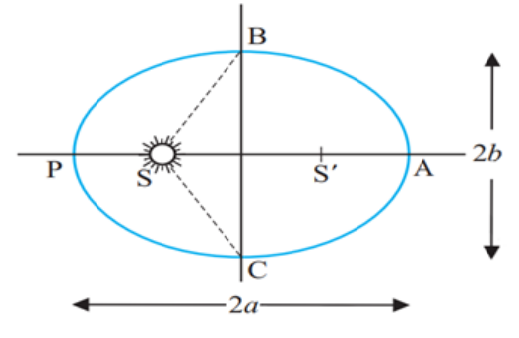
LAW OF AREAS: The line that joins a planet to the sun sweeps out equal areas in equal intervals of time. Area covered by the planet while revolving around the sun will be equal in equal intervals of time. This means the rate of change of area with time is constant.
LAW OF PERIOD: According to this law the square of time period of a planet is directly proportional to the cube of the semi-major axis of its orbit.
Suppose earth is revolving around the sun then the square of the time period (time taken to complete one revolution around sun) is directly proportional to the cube of the semi major axis.
It is known as Law of Periods as it is dependent on the time period of planets. Answer the following.
  1. Keplers second law is knows as:
  1. Law of period
  2. Law of area
  3. Law of gravity
  4. None of these
  1. Keplers third law is knows as:
  1. Law of period
  2. Law of area
  3. Law of gravity
  4. None of these
  1. The velocity of a planet is constant throughout its elliptical trajectory in an orbit.
  1. True
  2. False
  3. None of these
  1. State Kepler’s second law of planetary motion.
  1. Two objects of masses 5kg and 10 kg separated by distance 10m. What is gravitational force between them?
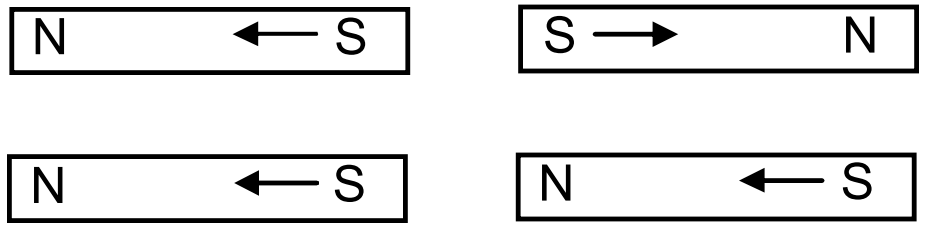
A magnetic dipole of magnetic moment 0.72A-m2 is placed horizontally with the north pole pointing towards bsouth. Find the position of the neutral point if the horizontal component of the earth's magnetic field is $18\mu\text{T.}$
Read the passage given below and answer the following questions from 1 to 5.

In physics, we can classify quantities as scalars or vectors. Basically, the difference is that a direction is associated with a vector but not with a scalar. A scalar quantity is a quantity with magnitude only. It is specified completely by a single number, along with the proper unit. Examples are: the distance between two points, mass of an object, the temperature of a body and the time at which a certain event happened. The rules for combining scalars are the rules of ordinary algebra. Scalars can be added, subtracted, multiplied and divided just as the ordinary numbers. A vector quantity is a quantity that has both a magnitude and a direction and obeys the triangle law of addition or equivalently the parallelogram law of addition. So, a vector is specified by giving its magnitude by a number and its direction. Some physical quantities that are represented by vectors are displacement, velocity, acceleration and force. Answer the following

  1. Force is example of:
  1. Scalar
  2. Vector
  3. Tensor
  4. None of these
  1. Mass of an object is:
  1. Scalar
  2. Vector
  3. Tensor
  4. None of these
  1. Define scalar quantity and vector quantity
  1. Can we add vectors like ordinary algebra? If not then how vectors are added?
  1. Differentiate between scalar and vectors
A kid of mass M stands at the edge of a platform of radius R which can be freely rotated about its axis. The moment of inertia of the platform is I. The system is at rest when a friend throws a ball of mass m and the kid catches it. If the velocity of the ball is v horizontally along the tangent to the edge of the platform when it was caught by the kid, find the angular speed of the platform after the event.
Two heavy spheres each of mass 100 kg and radius 0.10 m are placed 1.0m apart on a horizontal table. What is the gravitational force and potential at the mid point of the line joining the centres of the spheres? Is an object placed at that point in equilibrium? If so, is the equilibrium stable or unstable?
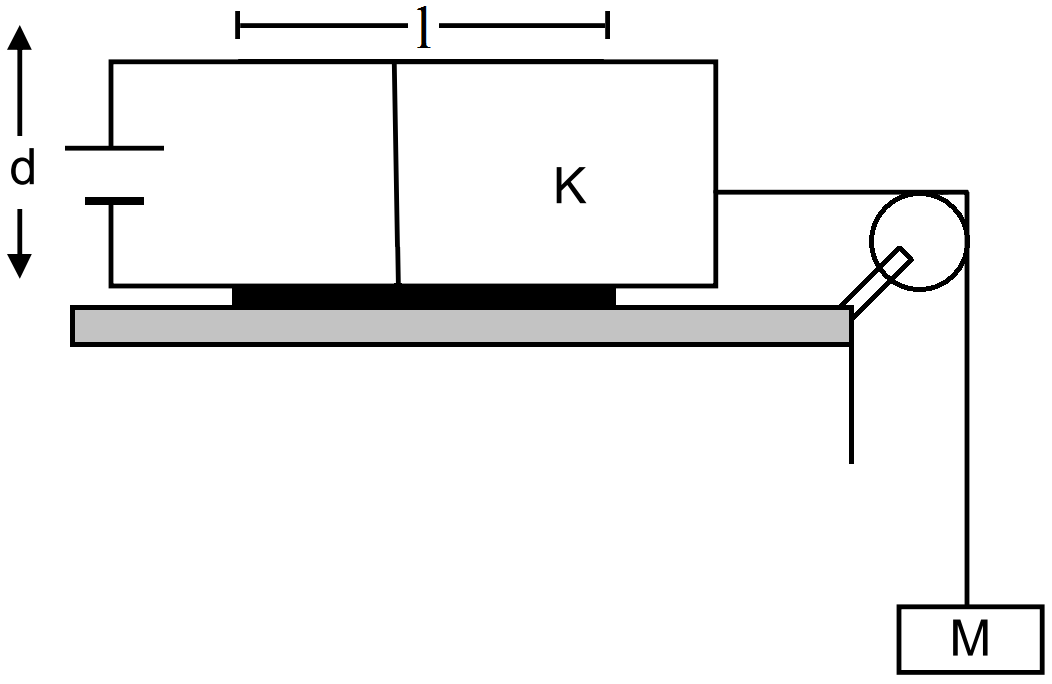
Consider the situation shown in figure. The width of each plate is b. The capacitor plates are rigidly clamped in the laboratory and connected to a battery of emf $\in.$ All surfaces are frictionless. Calculate the value of M for which the dielectric slab will stay in equilibrium.

Read the passage given below and answer the following questions from 1 to 5.

PE of Spring

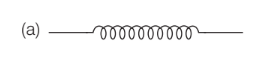
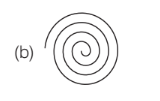
There are many types of spring. Important among these are helical and spiral springs as shown in figure.

Usually, we assume that the springs are massless. Therefore, work done is stored in the spring in the form of elastic potential energy of the spring. Thus, potential energy of a spring is the energy associated with the state of compression or expansion of an elastic spring.
 

  1. The potential energy of a body is increases in which of the following cases?
  1. If work is done by conservative force
  2. If work is done against conservative force
  3. If work is done by non-conservative force
  4. If work is done against non- conservative force
  1. The potential energy, i.e. U (x) can be assumed zero when:
  1. x = 0
  2. gravitational force is constant
  3. infinite distance from the gravitational source
  4. All of the above
  1. The ratio of spring constants of two springs is 2 : 3. What is the ratio of their potential energy, if they are stretched by the same force?
  1. 2 : 3
  2. 3 : 2
  3. 4 : 9
  4. 9 : 4
  1. The potential energy of a spring increases by 15 J when stretched by 3cm. If it is stretched by 4cm, the increase in potential energy is:
  1. 27 J
  2. 30 J
  3. 33 J
  4. 36 J
  1. The potential energy of a spring when stretched through a distance x is 10 J. What is the amount of work done on the same spring to stretch it through an additional distance x?
  1. 10 J
  2. 20 J
  3. 30 J
  4. 40 J
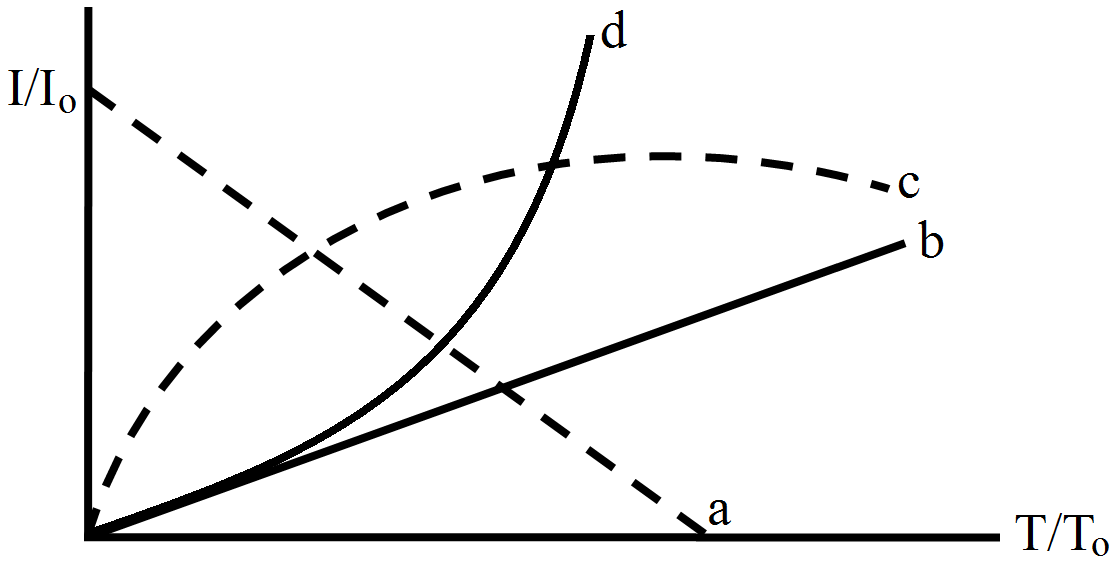
Let i0 be the thermionic current from a metal surface when the absolute temperature of the surface is T0. The temperature is slowly increased and the thermionic current is measured as a function of temperature. Which of the following plots may represent the variation in $\Big(\frac{\text{i}}{\text{i}_0}\Big)$ against $\Big(\frac{\text{T}}{\text{T}_0}\Big)?$