Question
A batsman deflects a ball by an angle of 45° without changing its initial speed which is equal to 54km/h. What is the impulse imparted to the ball? (Mass of the ball is 0.15 kg)
Answer

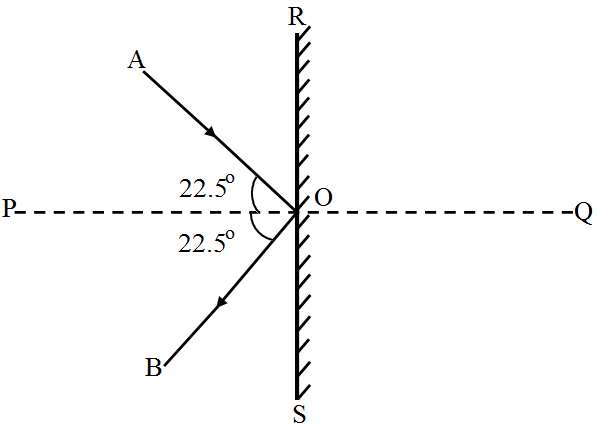
The given situation can be represented as shown in the following figure.

Where,
AO = Incident path of the ball
OB = Path followed by the ball after deflection
$\angle\text{AOB}$ = Angle between the incident and deflected paths of the ball = 45°
$\angle\text{AOP}=\angle\text{BOP}=22.5^\circ=\theta$
Initial and final velocities of the ball = v
Horizontal component of the initial velocity = $\text{v}\cos\theta$ along RO
Vertical component of the initial velocity = $\text{v}\sin\theta$ along PO
Horizontal component of the final velocity = $\text{v}\cos\theta$ along OS
Vertical component of the final velocity = $\text{v}\cos\theta$ along OP
The horizontal components of velocities suffer no change. The vertical components of velocities are in the opposite directions.
$\therefore$ Impulse imparted to the ball = Change in the linear momentum of the ball
$=\text{mv}\cos\theta-(-\text{mv}\cos\theta)=2\text{mv}\cos\theta$
Mass of the ball, m = 0.15kg
Velocity of the ball, v = 54km/h = 15m/s
$\therefore$ Impulse $2\times0.15\times15\cos22.5^\circ=4.16\text{kgm/s}$

Need a full question paper?

Generate a complete, print-ready paper with questions like this in minutes — across 16+ boards, with answer keys.

Start Generating Free

Similar questions

The volume of a glass vessel is 1000 cc at 20°C. What volume of mercury should be poured into it at this temperature so that the volume of the remaining space does not change with temperature? Coefficients of cubical expansion of mercury and glass are 1.8 × 10-4 °C and 9·0 × 10-6 °C-1 respectively.
Define co-efficient of linear expansion coefficient of areal expansion and coefficient of volume expansion and obtain mutual relation between them.
k transparent slabs are arranged one over another. The refractive indices of the slabs are $\mu_1,\mu_2,\mu_3, \ ...\mu_{\text{k}}$ and the thicknesses are t1, t2, t3, ... tk . An object is seen through this combination with nearly perpendicular light. Find the equivalent refractive index of the system which will allow the image to be formed at the same place.
For the harmonic travelling wave $\text{y}=2\cos2\pi(10\text{t}-0.0080\text{x}+3.5)$ where x and y are in cm and t is second. What is the phase difference between the oscillatory motion at two points separated by a distance of:
What is the phase difference between the oscillation of a particle located at x = 100cm at t = T and t = 5s?
How much energy is radiated per minute from the filament of incandescent lamp at 3000K if the surface area is 10-4m2 and its emissivity is 0.4? Stefan's constant
 = 5.67 × 10-8 Wm-2K-4.
Write the dimensions and derived units in M.K.S. unit system of the following quantities :
(i) Force, (ii) Power, (iii) Pressure, (iv) Stress, (v) Strain, (vi) Coefficient of elasticity, (vii) Relative density (viii) Gravitational constant.
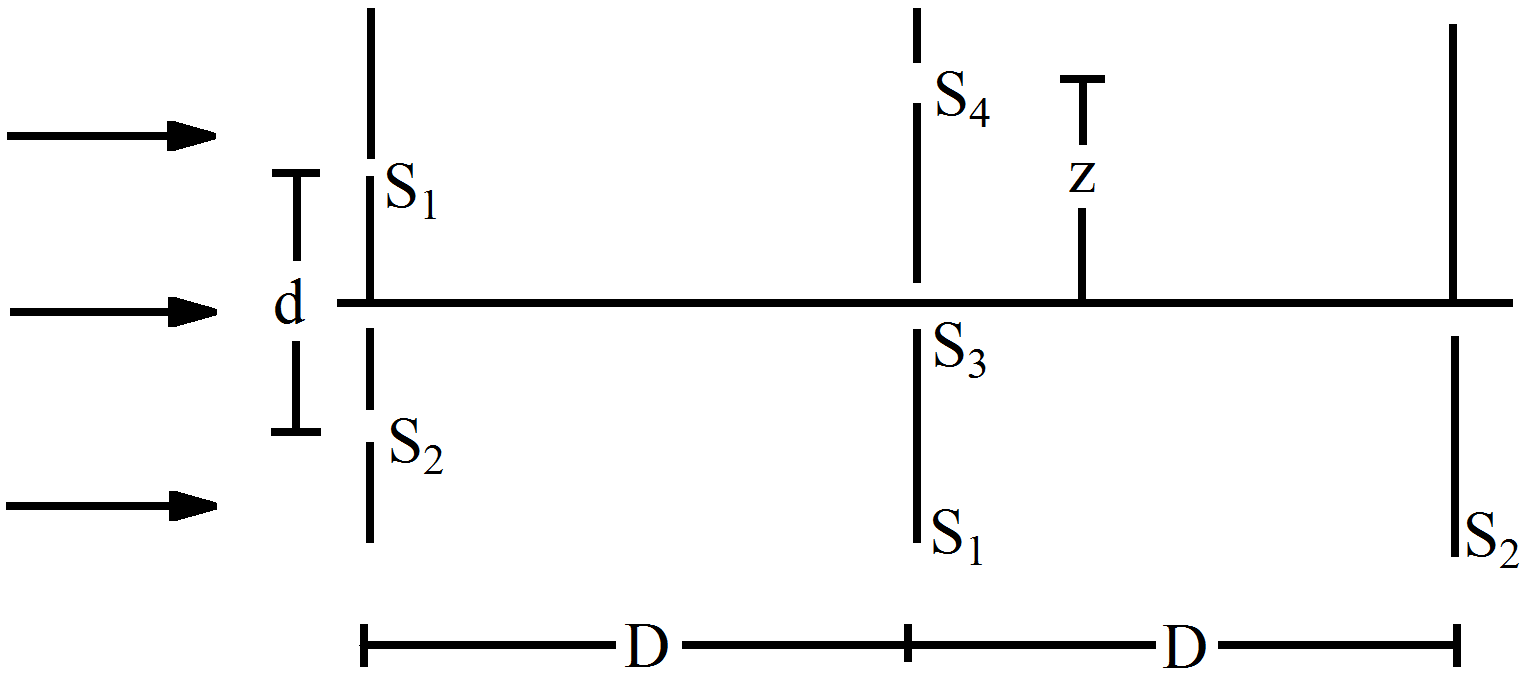
Consider the situation shown in figure (17-E6). The two slits S1 and S2 p laced symmetrically around the central line are illuminated by a monochromatic light of wavelength $\lambda.$ The separation between the slits is d. The light transmitted by the slits falls on a screen E1 placed at a distance D from the slits. The slit S3 is at the central line and the slit S4 is at a distance z from S3. Another

screen $\sum_2$ is placed a further distance D away from $\sum_1$. Find the ratio of the maximum to minimum intensity observed on $\sum_2$, if z is equal to,

  1. $\text{z}=\frac{\lambda\text{D}}{2\text{d}}$

  2. $\frac{\lambda\text{D}}{\text{d}}$

  3. $\frac{\lambda\text{D}}{4\text{d}}$

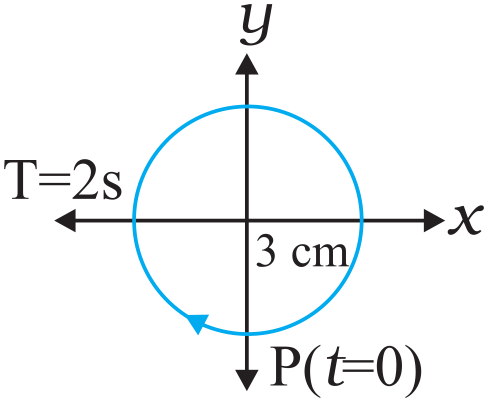
Figures correspond to two circular motions. The radius of the circle, the period of revolution, the initial position, and the sense of revolution (i.e. clockwise or anti-clockwise) are indicated on each figure.

Obtain the corresponding simple harmonic motions of the x-projection of the radius vector of the revolving particle P, in each case.
An adiabatic vessel of total volume V is divided into two equal parts by a conducting separator. The separator is fixed in this position. The part on the left contains one mole of an ideal gas (U = 1.5nRT) and the part on the right contains two moles of the same gas. Initially, the pressure on each side is p. The system is left for sufficient time so that a steady state is reached. Find,
  1. The work done by the gas in the left part during the process.
  2. The temperature on the two sides in the beginning.
  3. The final common temperature reached by the gases.
  4. The heat given to the gas in the right part.
  5. The increase in the internal energy of the gas in the left part.
An aircraft executes a horizontal loop at a speed of 720km/h with its wings banked at 15°. What is the radius of the loop?