Question
A batsman deflects a ball by an angle of 45° without changing its initial speed which is equal to 54km/h. What is the impulse imparted to the ball? (Mass of the ball is 0.15 kg)
Answer

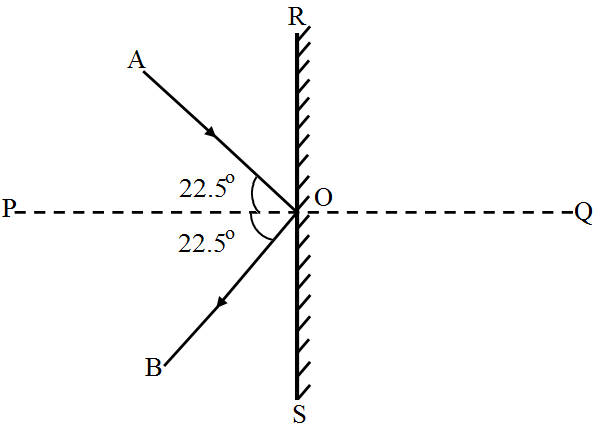
The given situation can be represented as shown in the following figure.

Where,
AO = Incident path of the ball
OB = Path followed by the ball after deflection
$\angle\text{AOB}$ = Angle between the incident and deflected paths of the ball = 45°
$\angle\text{AOP}=\angle\text{BOP}=22.5^\circ=\theta$
Initial and final velocities of the ball = v
Horizontal component of the initial velocity = $\text{v}\cos\theta$ along RO
Vertical component of the initial velocity = $\text{v}\sin\theta$ along PO
Horizontal component of the final velocity = $\text{v}\cos\theta$ along OS
Vertical component of the final velocity = $\text{v}\cos\theta$ along OP
The horizontal components of velocities suffer no change. The vertical components of velocities are in the opposite directions.
$\therefore$ Impulse imparted to the ball = Change in the linear momentum of the ball
$=\text{mv}\cos\theta-(-\text{mv}\cos\theta)=2\text{mv}\cos\theta$
Mass of the ball, m = 0.15kg
Velocity of the ball, v = 54km/h = 15m/s
$\therefore$ Impulse $2\times0.15\times15\cos22.5^\circ=4.16\text{kgm/s}$

Need a full question paper?

Generate a complete, print-ready paper with questions like this in minutes — across 16+ boards, with answer keys.

Start Generating Free

Similar questions

A block of mass 15kg is placed on a long trolley. The coefficient of static friction between the block and the trolley is 0.18. The trolley accelerates from rest with 0.5ms-2 for 20s and then moves with uniform velocity. Discuss the motion of the block as viewed by (a) a stationary observer on the ground, (b) an observer moving with the trolley.
Two bodies with masses 10kg and 12kg are connected by a light inextensible string passing over a smooth fixed pulley. Find:
  1. the velocity at the end of 3s,
  2. the distance covered in 3s,
  3. if, at the end of 3 s the string is cut, find the distance moved by the bodies in the next 6s.
Consider an ideal gas with following distribution of speeds.
Speed m/s
200
400
600
800
1000
% of molecules
10
20
40
20
10
If all the molecules with speed 1000m/s escape from the system, calculate new Vrms and hence T.
An electron and a proton are detected in a cosmic ray experiment, the first with kinetic energy 10keV, and the second with 100keV. Which is faster, the electron or the proton? Obtain the ratio of their speeds. (electron mass = 9.11 × 10⁻³¹kg, proton mass = 1.67 × 10⁻²⁷kg, 1eV = 1.60 × 10⁻¹⁹J).
A train starts from a station P with a uniform acceleration a, for some distance and then goes with the uniform retardation a1 for some more distance to come to rest at the station Q. The distance between the stations P and Q is 4km and the train takes 4 minutes to complete this journey. If the accelerations are in km per min2.
Show that $\frac{1}{\text{a}_1}+\frac{1}{\text{a}_2}=2.$
Two particles each of mass m and speed v travel in opposite direction along parallel lines, separated by a distance d. Show that vector angular momentum of the two particles system is same whatever be the point about which angular momentum is taken.
When a body slides down from rest along a smooth inclined plane making an angle of 45° with the horizontal, it takes time T. When the same body slides down from rest along a rough inclined plane making the same angle and through the same distance, it is seen to take time pT, where p is some number greater than 1. Calculate the co-efficient of friction between the body and the rough plane.
In an experiment on photoelectric effect, the stopping potential is measured for monochromatic light beams corresponding to different wavelengths. The data collected are 11s follows:

wavelength (nm) 350 400 450 500 550
stopping potential(V): 1.45 1.00 0.66 0.38 0.16

Plot the stopping potential against inverse of wavelength $\big(\frac{1}{\lambda}\big) $ on a graph paper and find

  1. The Planck constant,
  2. The work function of the emitter and.
  3. The threshold wavelength.
Liquid is flowing steadily through a pipe. Assume that the volume of the liquid flowing out per second depends on (a) the coefficient of viscosity of the liquid $(\eta)$(b) the radius of the pipe (r) and (c) the pressure gradient along the pipe (pressure gradient is drop in pressure per unit length of the pipe, and is equal to P/ l, where P is the difference between the ends of the pipe and I is the length of the pipe). The dimensions of viscosity is [ML-1T-1). Deduce by the method of dimensions, the formula for the volume of the liquid flowing out per second.
The manual of a car instructs the owner to inflate the tyres to a pressure of 200k Pa:
  1. What is the recommended gauge pressure?
  2. What is the recommended absolute pressure?
  3. If, after the required inflation of the tyres, the car is driven to a mountain peak, where the atmospheric pressure is 10% below that at sea level. What will the tire gauge read?