MCQ
A batsman deflects a ball by an angle of $45^o$ without changing its initial speed which is equal to $54\; km/h$. What is the impulse imparted to the ball in $kg\;m/s$? (Mass of the ball is $0.15 \;kg.)$
  • A
    $6.8$
  • B
    $8.32$
  • C
    $2.8$
  • $4.16$

Answer

Correct option: D.
$4.16$
d
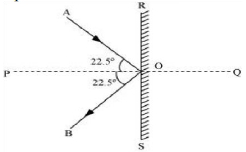
The given situation can be represented as shown in the following figure

Where, $AO =$ Incident path of the ball

$OB =$ Path followed by the ball after deflection

$\angle AOB =$ Angle between the incident and deflected paths of the ball $=45^{\circ}$

$\angle AOP =\angle BOP =22.5^{\circ}=\theta$

Initial and final velocities of the ball $=v$

Horizontal component of the initial velocity $=v \cos \theta$ along $RO$

Vertical component of the initial velocity $=v \sin \theta$ along $PO$

Horizontal component of the final velocity $=v \cos \theta$ along $OS$

Vertical component of the final velocity $=v \sin \theta$ along $OP$

The horizontal components of velocities suffer no change. The vertical components of velocities are in the opposite directions.

$\therefore$ Impulse imparted to the ball $=$ Change in the linear momentum of the ball $=m v \cos \theta-(-m v \cos \theta)$ $=2 m v \cos \theta$

Mass of the ball, $m=0.15\, kg$

Velocity of the ball, $v=54 \,km / h =15 \,m / s$

$\therefore \text { Impulse }=2 \times 0.15 \times 15 \cos 22.5^{\circ}=4.16\, kg\, m / s$
Need a full question paper?

Generate a complete, print-ready paper with questions like this in minutes — across 16+ boards, with answer keys.

Start Generating Free

Similar questions

An object is moving through the liquid. The viscous damping force acting on it is proportional to the velocity. Then dimension of constant of proportionality is
The torque of force $\vec F =  - 2\hat i + 2\hat j + 3\hat k$ acting on a point $\vec r = \hat i - 2\hat j + \hat k$ about origin will be
A body of mass $2\,kg$ is initially at rest. It starts moving unidirectionally under the influence of a source of constant power P. Its displacement in $4\,s$ is $\frac{1}{3} \alpha^2 \sqrt{ P } m$. The value of $\alpha$ will be $.............$
If $x=5 \sin \left(\pi t+\frac{\pi}{3}\right) \mathrm{m}$ represents the motion of a particle executing simple harmonic motion, the amplitude and time period of motion, respectively, are
A particle performs uniform circular motion with an angular momentum $L.$  If the angular frequency of the particle is doubled and kinetic energy is halved, its angular momentum becomes
Give force $=\frac{\alpha}{\text{Density}+\beta^3}$
What are the dimensions of $\alpha,\beta$
Two cars moving in opposite directions approach each other with speed of $22\, m s^{-1}$ and $16.5 \, m s^{-1}$ respectively. The driver of the first car blows a horn having a frequency $400 \,Hz.$ The frequency heard by the driver of the second car is ..... $Hz$ (velocity of sound is $340 \, m s^{-1}$)
Which of the following forces cannot be a resultant of $5\, N$ and $7\, N$ force...........$N$
The force on a particle as the function of displacement x (in $x-$ direction) is given by $F = 10 + 0.5x$ The work done corresponding to displacement of particle from $x = 0$ to $x = 2$ unit is
One end of string of length $l$ is connected to a particle of mass $'m'$ and the other end is connected to a small peg on a smooth horizontal table. If the particle moves in circle with speed $'v',$ the net force on the particle (directed towards centre) will be ($T$ represents the tension in the string)