MCQ
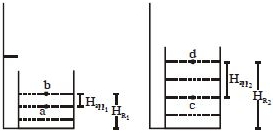
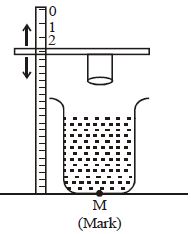
A beaker containing liquid is placed on a table, underneath a microscope which can be moved along a vertical scale. The microscope is focused, through the liquid onto a mark on the table when the reading on the scale is $a$ .

It is next focused on the upper surface of the liquid and the reading is $b$. More liquid is added and the observations are repeated, the corresponding readings are $c$ and $d$. The refractive index of the liquid is
  • $\frac{{b - d}}{{d - c - b + a}}$
  • B
    $\frac{{b - d}}{{d - c - b + a}}$
  • C
    $\frac{{d - c - b + a}}{{b - d}}$
  • D
    $\frac{{b - d}}{{a + b  - c - d}}$

Answer

Correct option: A.
$\frac{{b - d}}{{d - c - b + a}}$
a
$\mathrm{H}_{\mathrm{epp}_{1}}=\frac{\mathrm{H}_{\mathrm{R}_{1}}}{\mu}=\mathrm{b}-\mathrm{a}$

$\mathrm{H}_{\mathrm{R}_{1}}=\mu(\mathrm{b}-\mathrm{a})$           .......$(1)$

$\mathrm{H}_{\mathrm{app}_{2}}=\frac{\mathrm{H}_{\mathrm{R}_{2}}}{\mu}=\mathrm{d}-\mathrm{c}$

$\mathrm{H}_{\mathrm{R}_{2}}=\mu(\mathrm{d}-\mathrm{c})$          .......$(2)$

But $\mathrm{H}_{\mathrm{R}_{2}}-\mathrm{H}_{\mathrm{R}_{1}}=\mathrm{d}-\mathrm{b}$        ........$(3)$

$\mu[\mathrm{b}-\mathrm{a}-\mathrm{d}+\mathrm{c}]=\mathrm{d}-\mathrm{b}$

$\boxed{\mu  = \frac{{{\text{d}} - {\text{b}}}}{{{\text{b}} - {\text{a}} - {\text{d}} + {\text{c}}}}}$ or $\boxed{\mu  = \frac{{{\text{b}} - {\text{a}}}}{{{\text{d}} - {\text{c}} + {\text{a}} - {\text{b}}}}}$

Need a full question paper?

Generate a complete, print-ready paper with questions like this in minutes — across 16+ boards, with answer keys.

Start Generating Free

Similar questions

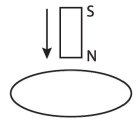
Assertion $(A):$ The bar magnet falling vertically along the axis of the horizontal coil will be having acceleration less than $g$.

Reason $(R):$ Clockwise current induced in the coil.

The wavelength of an $X-$ray beam is $10 \, \mathring A$. The mass of a fictitious particle having the same energy as that of the $X-$ray photons is $\frac{ x }{3} h \,kg$. The value of $x$ is ....... . $(h =$ Planck's constant $)$
If $F_o$ and $F_e$ are the focal length of the objective and eye-piece respectively of a telescope, then its magnifying power will be
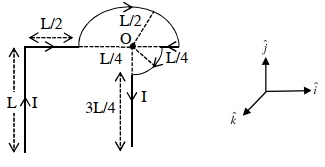
Which one of the following options represents the magnetic field $\vec{B}$ at $O$ due to the current flowing in the given wire segments lying on the $x y$ plane?
The wavelength of ${K_\alpha }$ line for an element of atomic number $43$ is $\lambda$. Then the wavelength of ${K_\alpha }$ line for an element of atomic number $29$ is
An electron is moving along positive $x$-axis.Auniform electric field exists towards negative $y$-axis. What should be the direction of magnetic field of suitable magnitude so that net force of electron is zero
A plane electromagnetic wave travelling along the $X$-direction has a wavelength of $3\ mm$ . The variation in the electric field occurs in the $Y$-direction with an amplitude $66\  Vm^{-1}$. The equations for the electric and magnetic fields as a function of $x$ and $t$ are respectively :-
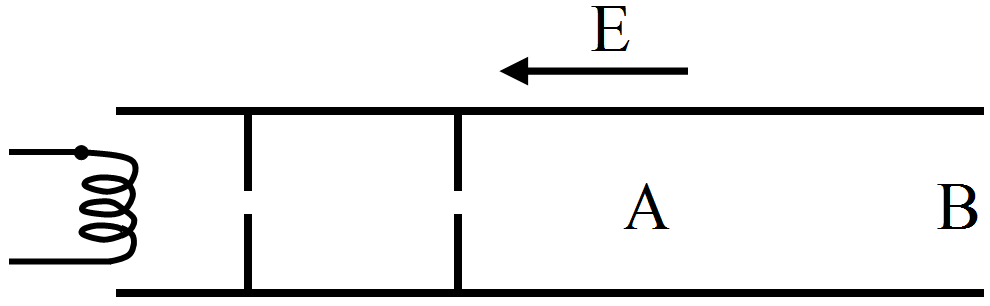
Electrons are emitted by a hot filament and are accelerated by an electric field, as shown in the figure. The two stops at the left ensure that the electron beam has a uniform cross-section.
In the circuit shown below, if the potential at point $A$ is taken to be zero, the potential at point $B$ is .............. $V$
As the temperature of a metallic resistor is increased, the product of its resistivity and conductivity: