MCQ
A beam of electrons and protons move parallel to each other in the same direction, then they
  • Attract each other
  • B
    Repel each other
  • C
    No relation
  • D
    Neither attract nor repel

Answer

Correct option: A.
Attract each other
 Attract each other

Need a full question paper?

Generate a complete, print-ready paper with questions like this in minutes — across 16+ boards, with answer keys.

Start Generating Free

Similar questions

Let $\rho (r)\, = \frac{Q}{{\pi {R^4}}}\,r$ be the volume charge density distribution for a solid sphere of radius $R$ and total charge $Q$. For a point $'p'$ inside the sphere at distance $r_1$ from the centre of the sphere, the magnitude of electric field is
$20\%$ of main current passes through the galvanometer. If the resistance of the galvanometer is $G$ , then the resistance of the shunt will be
The electric field due to a dipole at a distance $r$ on its axis is
Charge on α -particle is
The dimensions of surface charge density is:
A wire $100\,cm$ long and $2.0\,mm$ diameter has a resistance of $0.7\, ohm$, the electrical resistivity of the material is  ...........$ \times {10^{ - 6}}\,ohm \times m$
A plot of the number of neutrons $(N)$ against the number of protons ( $P$ )of stable nuclei exhibits upward deviation from linearity for atomic number, $Z>20$. For an unstable nucleus having $N / P$ ratio less than $1$ , the possible mode($s$) of decay is(are)

($A$) $\beta^{-}$-decay ( $\beta$ emission)

($B$) orbital or $K$-electron sasture

($C$) neutron emission

($D$) $\beta^{+}$-decay (positron emission)
Light wave travel in vacuum along the $x$-axis, which of the-following may represent the wave front
In Young's double slit experiment, carried out with light of wavelength $5000$ $A$, the distance between the slits is $0.3 \mathrm{~mm}$ and the screen is at $200 \mathrm{~cm}$ from the slits. The central maximum is at $x=0 \mathrm{~cm}$. The value of $\mathrm{x}$ for third maxima is ............. $\mathrm{mm}$.
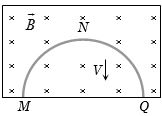
A thin semicircular conducting ring of radius $R$ is falling with its plane vertical in a horizontal magnetic induction $B$. At the position $MNQ$, the speed of the ring is $V$ and the potential difference developed across the ring is