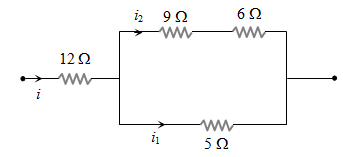
Question

A biconvex lens forms a real image of an object placed perpendicular to its principal axis. Suppose the radii of curvature of the lens tend to infinity. Then the image would

(a) Disappear

(b) Remain as real image still

(c) Be virtual and of the same size as the object

(d) Suffer from aberrations

Answer

(c) Be virtual and of the same size as the object

Need a full question paper?

Generate a complete, print-ready paper with questions like this in minutes — across 16+ boards, with answer keys.

Start Generating Free

Similar questions

In the following circuit, 5W resistor develops 45 J/s due to current flowing through it. The power developed per second across 12 W resistor is

(a) 16 W

(b) 192 W

(c) 36 W  

(d) 64 W

The splitting of line into groups under the effect of electric or magnetic field is called

(a) Zeeman's effect

(b) Bohr's effect

(c) Heisenberg's effect

(d) Magnetic effect

According to Einstein's photoelectric equation, the graph of K.E. of the photoelectron emitted from the metal versus the frequency of the incident radiation gives a straight line graph, whose slope:

Two metal spheres of capacitance   and  carry some charges. They are put in contact and then separated. The final charges  and   on them will satisfy

(a)

(b)  

(c)  

(d)  

The equivalent resistance of the arrangement of resistances shown in adjoining figure between the points A and B is

(a) 6 ohm

(b) 8 ohm

(c) 16 ohm

(d) 24 ohm

The energy band diagrams for three semiconductor samples of silicon are as shown. We can then assert that

(a) Sample X is undoped while samples Y and Z have been doped with a third group and a fifth group impurity respectively

(b) Sample X is undoped while both samples Y and Z have been doped with a fifth group impurity

(c) Sample X has been doped with equal amounts of third and fifth group impurities while samples Y and Z are undoped

(d) Sample X is undoped while samples Y and Z have been doped with a fifth group and a third group impurity respectively

When a potential difference V is applied across a conductor at a temperature T, the drift velocity of electrons is proportional to:

A double convex thin lens made of glass of refractive index 1.6 has radii of curvature 15 cm each.  The focal length of this lens when immersed in a liquid of refractive index 1.63 is

(a) – 407 cm

(b) 250 cm

(c) 125 cm

(d) 25 cm

The current flowing in two coaxial coils in the same direction. On increasing the distance between the two, the electric current will

(a)  Increase

(b)  Decrease

(c)  Remain unchanged

(d)  The information is incomplete

An ice cube is suspended in vacuum in a gravity free hall. As the ice melts it.
  1. Will retain its cubical shape.
  2. Will change its shape to spherical.
  3. Will fall down on the floor of the hall.
  4. Will fly up.