MCQ
A binary liquid solution is prepared by mixing $n-$ heptaneand ethanol. Which one of the following statements is correct regarding the behaviour of the solution ?
  • A
    The solution is non-ideal, showing $-ve$ deviation from Raoult's Law.
  • The solution is non-ideal, showing $+ve$ deviation from Raoult's Law.
  • C
    $n-$ heptane shows $+ve$ deviation while ethanol shows $-ve$ deviation from Raoult's Law.
  • D
    The solution formed is an ideal solution .
Answer

Correct option: B.
The solution is non-ideal, showing $+ve$ deviation from Raoult's Law.
b
For this solutis intermon intermon intermon intermolecular interactions between $n$ heptane and ettanolare weaker than $n$ -heptane $-n-$, heptane & ethanol. Ethanol interactions hence the solution of $n$ -heptane and ettanolis non-ideal and shows positive deviation from Raoult’s

Need a full question paper?

Generate a complete, print-ready paper with questions like this in minutes — across 16+ boards, with answer keys.

Start Generating Free

Similar questions

$EAN$ of $Mg$ is ... in $[Mg(EDTA)]^{2-}$
Which of the following cannot be dissolved in alcohol?
Hexamethylene tetramine is used as
The product formed in the reaction of $SOCl _2$ with white phosphorous is:
$AgN{O_3}$ does not give precipitate with $CHC{l_3}$ because
The freezing point of diluted milk sample is found to be $-\,0.2\,^oC,$ while it should have been $\,0.5\,^oC,$ for pure milk. How much water been added to pure milk to make the diluted sample?
On heating glucose with Fehling's solution we get a precipitate whose colour is
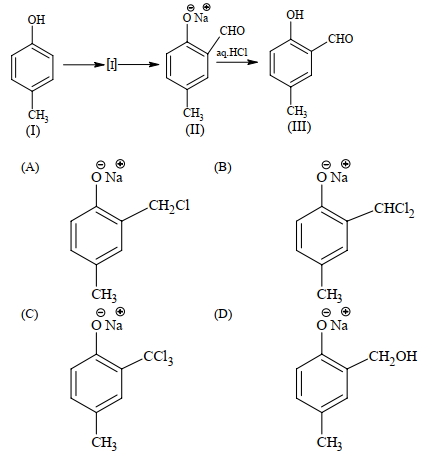
Reimer-Tiemann reaction introduces an aldehyde group, on to the aromatic ring of phenol, ortho to the hydroxyl group. This reaction involves electrophilic aromatic substitution. This is a general method for the synthesis of substituted salicyladehydes as depicted below.

$Image$

$1.$ Which one of the following reagents is used in the above reaction?

$(A)$ aq. $\mathrm{NaOH}+\mathrm{CH}_3 \mathrm{Cl}$

$(B)$ aq. $\mathrm{NaOH}+\mathrm{CH}_2 \mathrm{Cl}_2$

$(C)$ aq. $\mathrm{NaOH}+\mathrm{CHCl}_3$

$(D)$ aq. $\mathrm{NaOH}+\mathrm{CCl}_4$

$2.$ The electrophile in this reaction is

$(A)$ : $\mathrm{CHCl}$ $(B)$ ${ }^{+} \mathrm{CHCl}_2$

$(C)$ $\mathrm{CCl}_2$ $(D)$. $\mathrm{CCl}_3$

$3.$ The structure of the intermediate $I$ is

$Image$

Give the answer question $1, 2$ and $3.$

Most unstable resonating structure of phenol is
Aniline in a set of reactions yielded a product $D$.The structure of product $D$ would be

image$\mathop {\xrightarrow{{NaN{O_2}}}}\limits_{HCl} A\,\,\xrightarrow{{CuCN}}B\,\,\mathop {\xrightarrow{{{H_2}}}}\limits_{Ni} C\,\,\xrightarrow{{HN{O_2}}}D$