Question
A bird while flying takes a left turn, where does it get the centripetal force from?

Answer

The centripetal wings of bird w.r.t to air and thus the bird turns toward left.

Need a full question paper?

Generate a complete, print-ready paper with questions like this in minutes — across 16+ boards, with answer keys.

Start Generating Free

Similar questions

The needle of a dip circle shows an apparent dip of 45° in a particular position and 53° when the circle is rotated through 90°. Find the true dip.
Read the passage given below and answer the following questions from 1 to 5. Earth’s Satellite: Earth satellites are objects which revolve around the earth. Their motion is very similar to the motion of planets around the Sun. In particular, their orbits around the earth are circular or elliptic. Moon is the only natural satellite of the earth with a near circular orbit with a time period of approximately $27.3$ days which is also roughly equal to the rotational period of the moon about its own axis. Also, the speed that a satellite needs to be travelling to break free of a planet or moon’s gravity well and leave it without further propulsion is known as escape velocity. For example, a spacecraft leaving the surface of earth needs to be going 7 miles per second or nearly 25000 miles per hour to leave without falling back to the surface or falling into orbit.
  1. Gas escapes from the surface of a planet because it acquires an escape velocity. The escape velocity will depend on which of the following factors?
  1. Mass of the planet
  2. Mass of the particle escaping
  3. Temperature of the planet
  4. None of the above
  1. The escape velocity of a satellite from the earth is ve If the radius of earth contracts to $(\frac{1}{4})$ th of its value, keeping the mass of the earth constant, escape velocity will be:
  1. doubled
  2. halved
  3. tripled
  4. unaltered
  1. The ratio of escape velocity at earth $(v_e)$ to the escape velocity at a planet $(v_p)$, whose radius and mean density are twice as that of earth is:
  1. $1:2\sqrt{2}$
  2. 1 : 4
  3. $1:\sqrt{2}$
  4. 1 : 2
  1. A satellite S is moving in an elliptical orbit around the earth. The mass of the satellite is very small as compared to the mass of the earth, then:
  1. the angular momentum of S about the centre of the earth changes in direction, but its magnitude remains constant
  2. the total mechanical energy of S varies periodically with time
  3. the linear momentum of S remains constant in magnitude
  4. the acceleration of S is always directed towards the centre of the earth
  1. The orbital velocity of an artificial satellite in a circular orbit just above the earth’s surface is vo The orbital velocity of a satellite orbiting at an altitude of half of the radius, is:
  1. $\frac{3}{2}\text{v}_\circ$
  2. $\frac{2}{3}\text{v}_\circ$
  3. $\sqrt{\frac{3}{2}\text{v}_\circ}$
  4. $\sqrt\frac{2}{3}\text{v}_\circ$
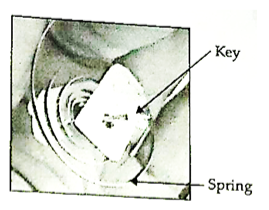
Clockwork refers to the inner workings of mechanical clock or watch (where it is known as "movement") and different types of toys which work using a series of gears driven by a spring. Clockwork device is completely mechanical and its essential parts are:
- A key (or crown) which you wind to add energy
- A spiral spring in which the energy is stored
- A set of gears through which the spring's energy is released. The gears control how quickly (or slowly) a clockwork machine can do things. Such as in mechanical clock/watch the mechanism is the set of hands that sweep around the dial to tell the time. In a clockwork car toy, the gears drive the wheels.
Winding the clockwork with the key means tightening a sturdy metal spring, called the mainspring. It is the process of storing potential energy. Clockwork springs are usually twists of thick steel, so tightening them (forcing the spring to occupy a much smaller space) is actually quite hard work. With each turn of the key, fingers do work and potential energy is stored in the spring. The amount of energy stored depends on the size and tension of the spring. Harder a spring is to turn and longer it is wound, the more energy it stores.
Image
While the spring uncoils, the potential energy is converted into kinetic energy through gears, cams, cranks and shafts which allow wheels to move faster or slower. In an ancient clock, gears transform the speed of a rotating shaft so that it drives the second hand at one speed, the minute hand at $\frac{1}{60}$ of that speed, and the hour hand at $\frac{1}{3600}$ of that speed. Clockwork toy cars often use gears to make themselves race along at surprising speed.

1. What is the meaning of movement of old age mechanical clocks?
(a) The pendulum of the clock
(b) The gears which move the hands of the clock
(c) A spring and combination of gears which move the hands of the clock
(d) The hands of the clock
2. What type of energy is stored in the spring while winding it?
(a) Potential  (b) Heat  (c) Both kinetic and potential  (d) Kinetic
3. When the spring of a clockwork uncoils
(a) Kinetic energy is converted into potential energy
(b) Potential energy is converted into kinetic
(c) Potential energy is converted into heat, light and sound energy
(d) Kinetic energy is converted into heat, light and sound energy
OR
In clockwork devices, ________ transform the speed of a rotating ________ to drive wheels slower or faster.
(a) Shaft, spring  (b) shaft, gear  (c) Gear, Shaft  (d) Spring, gear
4. More energy is stored in a spring if the
(a) Spring is larger, harder and wound fur a longer time
(b) Spring is smaller, harder and wound for a shorter time
(c) Spring is larger, harder and wound for a

Read the passage given below and answer the following questions from (i) to (v). Motion in a Straight Line If the position of an object is continuously changing w.r.t. its surrounding, then it is said to be in the state of motion. Thus, motion can be defined as a change in position of an object with time. It is common to everything in the universe. In the given figure, let P, Q and R represent the position of a car at different instants of time.
  1. With reference to the given figure, the position coordinates of points P and R are:
  1. $P = (+ 360,0,0); R = (-120,0,0)$
  2. $P = (-360,0,0); R = (+120,0,0)$
  3. $P = (0, + 360,0); R = (-120,0,0)$
  4. $P = (0,0, + 360); R = (0,0 -120)$
  1. Displacement of an object can be:
  1. Positive
  2. Negative
  3. Zero
  4. All of the above
  1. The displacement of a car in moving from O to P and its displacement in moving from P to Q are:
  1. $+ 360m and -120m$
  2. $-120m and + 360m$
  3. $+ 360m and + 120m$
  4. $+ 360m and - 600m$
  1. If the car goes from O to P and returns back to O, the displacement of the journey is:
  1. zero
  2. $720m$
  3. $420m$
  4. $340m$
  1. The path length of journey from O to P and back to O is:
  1. $0m$
  2. $720m$
  3. $360m$
  4. $480m$
When you push your bicycle up on an incline the potential energy of the bicyle and yourself increases. Where does this energy come from?
Find the acceleration due to gravity of the moon at a point 1000 km above the moon's surface. The mass of the moon is $7.4 \times 10^{22} \mathrm{~kg}$ and its radius is 1740 km .
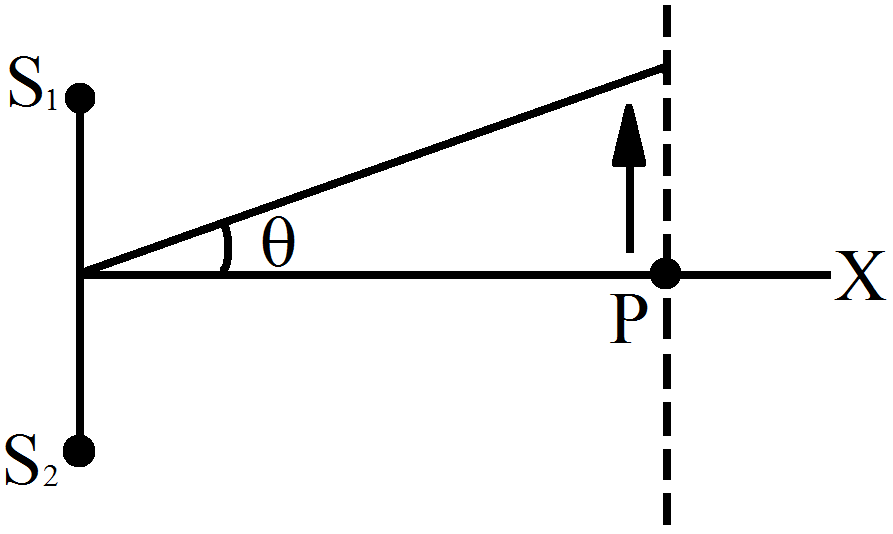
Two speakers $S_1$ and $S_2$, driven by the same amplifier, are placed at $y = 1.0m$ and $y = -1.0m$ figure, The speakers vibrate in phase at $600Hz$. A man stands at a point on the X-axis at a very large distance from the origin and starts moving parallel to the Y-axis. The speed of sound in air is $330m/s$.
  1. At what angle $\theta$ will the intensity of sound drop to a minimum for the first time?
  2. At what angle will he hear a maximum of sound intensity for the first time?
  3. If he continues to walk along the line, how many more maxima can he hear?
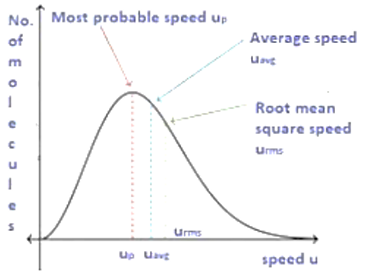
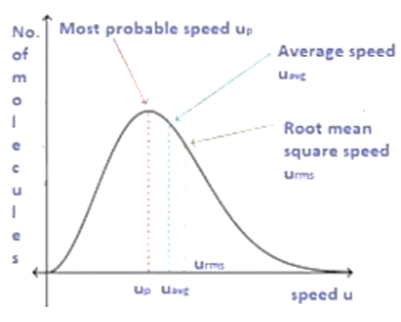
Root mean square velocity (RMS value)is the square root of the mean of squares of the velocity of individual gas molecules and the Average velocity is the arithmetic mean of the velocities of different molecules of a gas at a given temperature.
Image
1. Moon has no atmosphere because:
(a) the escape velocity of the moon’s surface is more than the r.m.s velocity of all molecules
(b) it is far away from the surface of the earth
(c) the r.m.s. velocity of all the gas molecules is more than the escape velocity of the moon’s surface
(d) its surface temperature is $10^{\circ} C$
2. For an ideal gas, $\frac{C_P}{C_V}$ is
(a) $\leq 1$    (b) none of these    (c) $>1$    (d) $<1$
3. The root means square velocity of hydrogen is $\sqrt{5}$ times that of nitrogen. If $T$ is the temperature of the gas then:
(a) $T\left(H_2\right)=T\left(N_2\right)$    (b) $T \left( H _2\right)< T \left( N _2\right)$
(c) $T \left( H _2\right) \neq T \left( N _2\right)$    (d) $T \left( H _2\right)> T \left( N _2\right)$
4. Suppose the temperature of the gas is tripled and $N _2$ molecules dissociate into an atom. Then what will be the rms speed of atom:
(a) $v_0 \sqrt{2}$    (b) $v_0 \sqrt{6}$    (c) $v_0 \sqrt{3}$    (d) $v_0$
OR
The velocities of the molecules are $v , 2 v , 3 v , 4 v \& 5 v$. The RMS speed will be:
(a) 11 v    (b) $v (12)^{11}$   (c) v    (d) $v (11)^{12}$
Read the passage given below and answer the following questions from 1 to 5. Centre of Mass:
The centre of mass of a body or a system of bodies is the point which moves as though all of the mass were concentrated there and all external forces were applied to it. Hence, a point at which the entire mass of the body or system of bodies is supposed to be concentrated is known as the centre of mass. If a system consists of more than one particles (or bodies) and net external force on the system in a particular direction is zero with centre of mass at rest. Then, the centre of mass will not move along that direction. Even though some particles of the system may move along that direction.
  1. The centre of mass of a system of two particles divides, the distance between them:
  1. in inverse ratio of square of masses of particles
  2. in direct ratio of square of masses of particles
  3. in inverse ratio of masses of particles
  4. in direct ratio of masses of particles
  1. Two bodies of masses 1kg and 2 kg are lying in xy-plane at ( -1, 2 ) and ( 2, 4 ) respectively. What are the coordinates of the centre of mass?
  1. $\big(1,\frac{10}{3}\big)$
  2. (1, 10)
  3. (0, 1)
  4. None of these
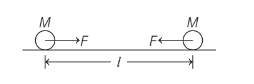
  1. Two balls of same masses start moving towards each other due to gravitational attraction, if the initial distance between them is l. Then, they meet at:
  1. $\frac{\text{ l}}{2}$
  2. l
  3. $\frac{\text{ l}}{3}$
  4. $\frac{\text{ l}}{4}$
  1. All the particles of a body are situated at a distance R from the origin. The distance of centre of mass of the body from the origin is:
  1. $=\text{R}$
  2. $\leq\text{R}$
  3. $>\text{R}$
  4. $\geq\text{R}$
  1. Two particles A and B initially at rest move towards each other under a mutual force of attraction. At the instant, when the speed of A is v and the speed of B is 2v, the speed of centre of mass of the system is:
  1. zero
  2. v
  3. 1. 5v
  4. 3v