Question
A bird while flying takes a left turn, where does it get the centripetal force from?

Answer

Get the step-by-step solution for this question inside the Vidyadip app.

Get the answer in the app

Need a full question paper?

Generate a complete, print-ready paper with questions like this in minutes — across 16+ boards, with answer keys.

Start Generating Free

Similar questions

LASER: Electromagnetic radiation is a natural phenomenon found in almost all areas of daily life, from radio waves to sunlight to x-rays. Laser radiation - like all light - is also a form of electromagnetic radiation. Electromagnetic radiation that has a wavelength between 380 nm and 780 nm is visible to the human eye and is commonly referred to as light. At wavelengths longer than 780 nm, optical radiation is termed infrared (IR) and is invisible to the eye. At wavelengths shorter than 380 nm, optical radiation is termed ultraviolet (UV) and is also invisible to the eye. The term laser light refers to a much broader range of the electromagnetic spectrum that just the visible spectrum, anything between 150 nm up to 11000 nm (i.e., from the UV up to the far IR). The term laser is an acronym which stands for light amplification by stimulated emission of radiation. Einstein explained the stimulated emission. In an atom, electron may move to higher energy level by absorbing a photon. When the electron comes back to the lower energy level it releases the same photon. This is called spontaneous emission. This may also so happen that the excited electron absorbs another photon, releases two photons and returns to the lower energy state. This is known as stimulated emission.
Laser emission is therefore a light emission whose energy is used, in lithotripsy, for targeting and ablating the tone inside human body organ.
Apart from medical usage, laser is used for optical disk drive, printer, barcode reader etc.
(i) What is the full form of LASER?
(a) light amplification by simultaneous emission of radiation
(b) light amplified by synchronous emission of radiation
(c) light amplified by stimulated emission of radiation
(d) light amplification by stimulated emission of radiation

(ii) The stimulated emission is the process of
(a) absorption of two photon when electron moves from lower to higher energy level
(b) release of two photons by absorbing one photon when electron comes back from higher to lower energy level
(c) release of a photon when electron comes back from higher to lower energy level
(d) absorption of a photon when electron moves from lower to higher energy level

(iii) What is the range of amplitude of LASER?
(a) 150 nm - 400 nm
(b) 700 nm - 11000 nm
(c) Both 150 nm - 400 nm and 700 nm 11000 nm
(d) 800 nm - 12000 nm
OR
LASER is used in
(a) Ionization
(b) Transmitting Satellite signal
(c) Optical disk drive
(d) Radio communication

(iv) Lithotripsy is
(a) Laboratory application
(b) An industrial application
(c) A medical application
(d) Process control application 
Three capacitors each of capacitance 9 pF are connected in series.
(a) What is the total capacitance of the combination?
(b) What is the potential difference across each capacitor if the combination is connected to a 120 V supply? S
Bohr's model explains the spectral lines of hydrogen atomic emission spectrum. While the electron of the atom remains in the ground state, its energy is unchanged. When the atom absorbs one or more quanta of energy, the electrons moves from the ground state orbit to an excited state orbit that is further away.

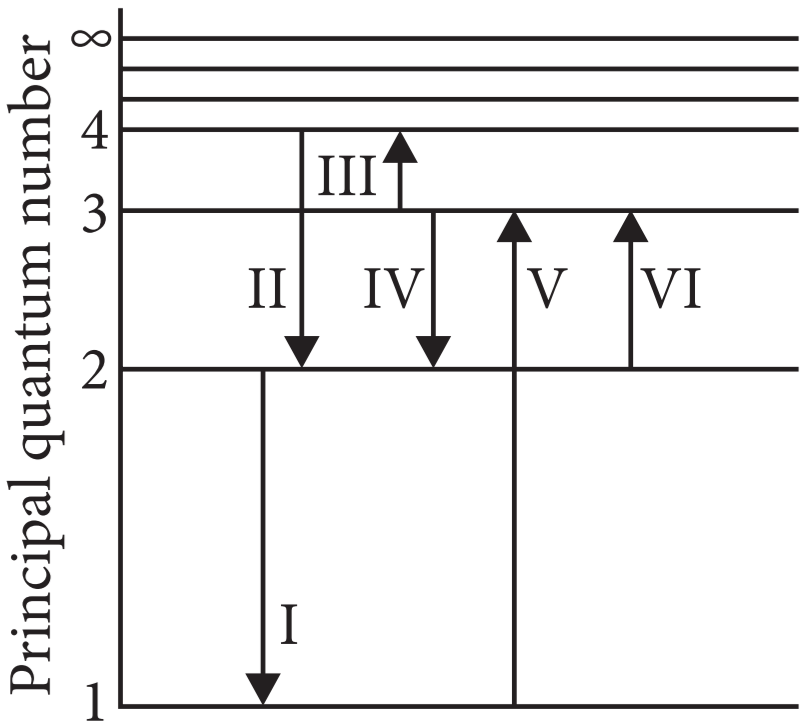
The given figure shows an energy level diagram of the hydrogen atom. Several transitions are marked as I, II, III and so on. The diagram is only indicative and not to scale.
  1. In which transition is a Balmer series photon absorbed?
  1. II
  2. III
  3. IV
  4. VI
  1. The wavelength of the radiation involved in transition II is
  1. 291nm
  2. 364nm
  3. 487nm
  4. 652nm
  1. Which transition will occur when a hydrogen atom is irradiated with radiation of wavelength 103nm?
  1. I
  2. II
  3. IV
  4. V
  1. The electron in a hydrogen atom makes a transition from n = n1 to n = n2 state. The time period of the electron in the initial state is eight times that in the final state. The possible values of n1 and n2 are.
  1. n1 = 4,n2 = 2
  2. n1 = 8,n2 = 2
  3. n1 = 8,n2 = 3
  4. n1 = 6,n2 = 2
  1. The Balmer series for the H-atom can be observed
  1. If we measure the frequencies of light emitted when an excited atom falls to the ground state.
  2. If we measure the frequencies of light emitted due to transitions between excited states and the first excited state.
  3. In any transition in a H-atom.
  4. None of these.
In tug of war, the team that exerts a larger tangential force on the ground wins. Consider the period in which a team is dragging the opposite team by applying a larger tangential force on the ground. List which of the following works are positive, which are negative and which are zero?
  1. Work by the winning team on the losing team.
  2. Work by the losing team on the winning team.
  3. Work by the ground on the winning team.
  4. Work by the ground on the losing team.
  5. Total external work on the two teams.
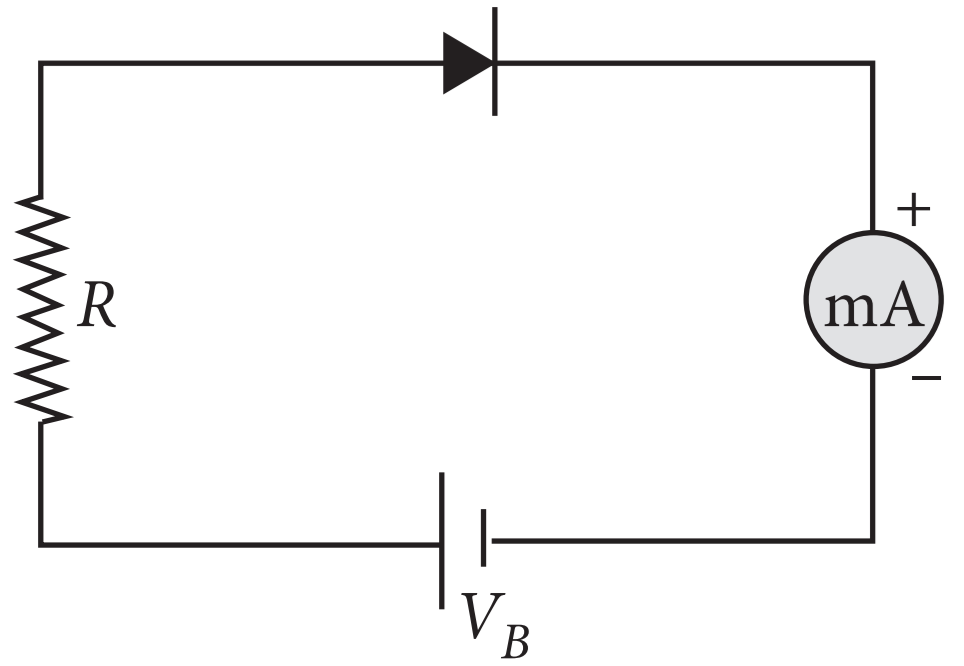
A silicon p-n junction diode is connected to a resistor Rand a battery of voltage VB through milliammeter (mA) as shown in figure. The knee voltage for this junction diode is VN = 0.7V. The p-n junction diode requires a minimum current of 1mA to attain a value higher than the knee point on the I-V characteristics of this junction diode. Assuming that the voltage Vacross the junction is independent of the current above the knee point. A p-n junction is the basic building block of many semiconductordevices like diodes. Important process occurring during the formation of a p-n junction are diffusion and drift. ln an n-type semiconductor concentration of electrons is more as compared to holes. ln a p-type semiconductor concentration of holes is more as compared to electrons.

  1. If V= 5V, the maximum value of R so that the voltage V is above the knee point voltage is:
  1. $40\text{k}\Omega$
  2. $4.3\text{k}\Omega$
  3. $5.0\text{k}\Omega$
  4. $5.7\text{k}\Omega$
  1. If VB = 5V, the value of R in order to establish a current to 6mA in the circuit is:
  1. $833\Omega$
  2. $717\Omega$
  3. $950\Omega$
  4. $733\Omega$
  1. If VB = 6V, the power dissipated in the resistor R, when a current of 6mA flows in the circuit is:
  1. 30.2mW
  2. 30.8mW
  3. 31.2mW
  4. 31.8mW
  1. When the diode is reverse biased with a voltage of 6V and Vbi = 0.63V. Calculate the total potential.
  1. 9.27V
  2. 6.63V
  3. 5.27V
  4. 0.63V
  1. Which of the below mentioned statement is false regarding a p-n junction diode?
  1. Diodes are uncontrolled devices.
  2. Diodes are rectifying devices.
  3. Diodes are unidirectional devices.
  4. Diodes have three terminals.
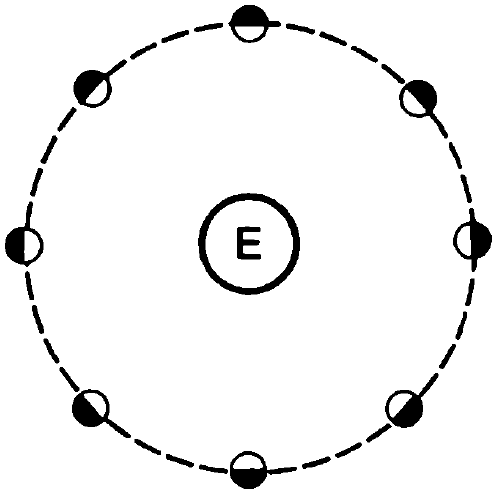
The moon rotates about the earth in such a way that only one hemisphere of the moon faces the earth. Can we ever see the ''other face'' of the moon from the earth? Can a person on the moon ever see all the faces of the earth?

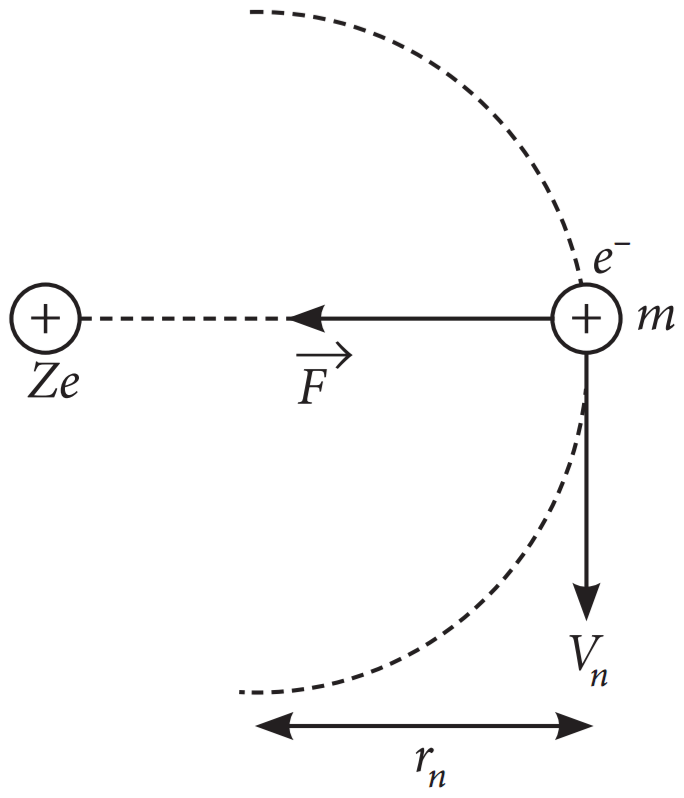
Hydrogen is the simplest atom of nature. There is one proton in its nucleus and an electron moves around the nucleus in a circular orbit. According to Niels Bohr, this electron moves in a stationary orbit. When this electron is in the stationary orbit, it emits no electromagnetic radiation.The angular momentum of the electron is quantized, i.e., ⁣$\text{mvr}=\big(\frac{\text{nh}}{2\pi}\big)$ where m = mass of the electron, v = velocity of the electron in the orbit, r = radius of the orbit and n = 1, 2, 3, .... When transition takes place from Kth orbit to Jth orbit, energy photon is emitted. If the wavelength of the emitted photon is $\lambda$ we find that $\frac{1}{\lambda}=\text{R}\bigg[\frac{1}{\text{J}^2}-\frac{1}{\text{K}^2}\bigg]$where find that On a different planet, the hydrogen atom's structure was somewhat different from ours. The angular momentum of electron was $\text{P}=2\text{n}\Big(\frac{\text{h}}{2\pi}\Big)$ i.e., an even multiple of $\Big(\frac{\text{h}}{2\pi}\Big)$.

  1. The minimum permissible radius of the orbit will be.
  1. $\frac{2\in_0\text{h}^2}{\text{m}\pi\text{e}^2}$
  2. $\frac{4\in_0\text{h}^2}{\text{m}\pi\text{e}^2}$
  3. $\frac{\in_0\text{h}^2}{\text{m}\pi\text{e}^2}$
  4. $\frac{\in_0\text{h}^2}{\text{2m}\pi\text{e}^2}$
  1. In our world, the velocity of electron is v0 when the hydrogen atom is in the ground state. The velocity of electron in this state on the other planet should be.
  1. $\text{v}_0$
  2. $\frac{\text{v}_0}{2}$
  3. $\frac{\text{v}_0}{4}$
  4. $\frac{\text{v}_0}{8}$
  1. In our world, the ionization potential energy of a hydrogen atom is 13.6eV. On the other planet, this ionization potential energy will be.
  1. 13.6eV
  2. 3.4eV
  3. 1.5eV
  4. 0.85eV
  1. Check the correctness of the following statements about the Bohr model of hydrogen atom.
  1. The acceleration of the electron in n = 2 orbit is more than that in n = 1 orbit.
  2. The angular momentum of the electron in n = 2 orbit is more than that in n = 1 orbit.
  3. The kinetic energy of the electron in n = 2 orbit is less than that in n = 1 orbit.
  1. Only (III) and (I) are correct
  2. Only (III) and (I) are correct
  3. Only (II) and (III) are correct.
  4. All the statements are correct.
  1. In Bohr's model of hydrogen atom, let PE represent potential energy and TE the total energy. In going to a higher orbit.
  1. PE increases, TE decreases
  2. PE decreases, TE increases
  3. PE increases, TE increases
  4. PE decreases, TE decreases
Define self-inductance and write its S.I. unit. Find the self inductance for a solenoid of N turns, length $l$ and radius $r$.
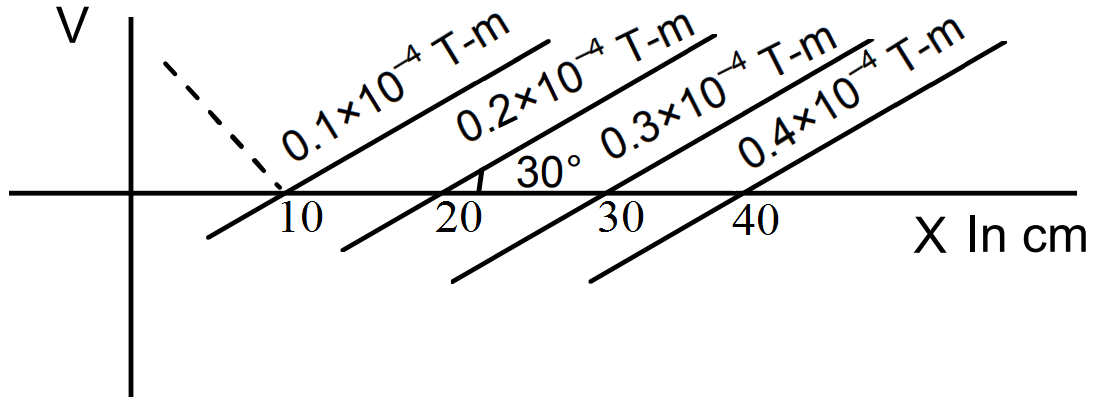
Figure shows some of the quipotential surfaces of the magnetic scalar potential. Fmd the magnetic field B at a point in the region.

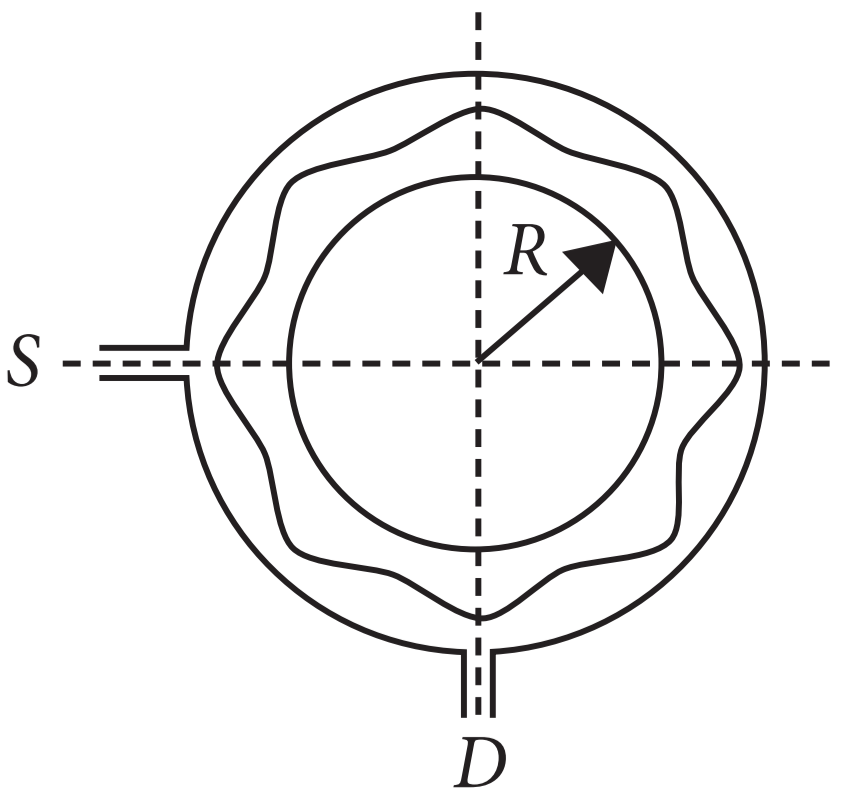
A narrow tube is bent in the form of a circle of radius R, as shown in figure. Two small holes S and D are made in the tube at the positions at right angle to each other. A source placed at S generates a wave of intensity I0 which is equally divided into two parts: one part travels along the longer path, while the other travels along the shorter path. Both the waves meet at point Dwhere a detector is place

  1. If a maxima is formed at a detector, then the magnitude of wavelength $\lambda$ of the wave produced is given by:
  1. $\pi\text{R}$
  2. $\frac{\pi\text{R}}{2}$
  3. $\frac{\pi\text{R}}{4}$
  4. All of these.
  1. If the in tensity ratio of two coherent sources used in Young's double slit experiment is 49 : 1, then the ratio between the maximum and minimum intensities in the interference pattern is:
  1. 1 : 9
  2. 9 : 16
  3. 25 : 16
  4. 16 : 9
  1. The maximum intensity produced at D is given by:
  1. 4I0
  2. 2I0
  3. I0
  4. 3I0
  1. ln a Young's double slit experiment, the intensity at a point where the path difference is $\frac{\lambda}{6}$ ($\lambda$ - wavelength of the light) is I. If I0 denotes the maximum intensity, then I/I0 is equal to:
  1. $\frac{1}{2}$
  2. $\frac{\sqrt3}{2}$
  3. $\frac{1}{\sqrt2}$
  4. $\frac{3}{4}$
  1. Two identical light waves, propagating in the same direction, have a phase differenced. After they superpose the intensity of the resulting wave will be proportional to:
  1. $\cos\delta$
  2. $\cos\Big(\frac{\delta}{2}\Big)$
  3. $\cos^2\Big(\frac{\delta}{2}\Big)$
  4. $\cos^2\delta$