MCQ
A black body has maximum wavelength ${\lambda _m}$ at temperature $2000\; K$. Its corresponding wavelength at temperature $3000 \;K$ will be
  • A
    $\frac{3}{2}{\lambda _m}$
  • $\frac{2}{3}{\lambda _m}$
  • C
    $\frac{4}{9}{\lambda _m}$
  • D
    $\frac{9}{4}{\lambda _m}$

Answer

Correct option: B.
$\frac{2}{3}{\lambda _m}$
b
(b)${\lambda _{{m_2}}} = \frac{{{T_1}}}{{{T_2}}} \times {\lambda _{{m_1}}}$$ = \frac{{2000}}{{3000}} \times {\lambda _{{m_1}}} = \frac{2}{3}{\lambda _{{m_1}}} = \frac{2}{3}{\lambda _m}$

Need a full question paper?

Generate a complete, print-ready paper with questions like this in minutes — across 16+ boards, with answer keys.

Start Generating Free

Similar questions

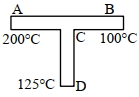
A rod $C D$ of thermal resistance $10.0\; {KW}^{-1}$ is joined at the middle of an identical rod ${AB}$ as shown in figure, The end $A, B$ and $D$ are maintained at $200^{\circ} {C}, 100^{\circ} {C}$ and $125^{\circ} {C}$ respectively. The heat current in ${CD}$ is ${P}$ watt. The value of ${P}$ is ... .
Electric conduction takes place in a discharge tube due to the movement of:
  1. Positive ions.
  2. Negative ions.
  3. Electrons.
  4. Protons.
A ball is dropped from the roof of a tower of height $h$. The total distance covered by it in the last second of its motion is equal to the distance covered by it in first three seconds. The value of $h$ in meter is  $(g = 10\,m/s^2)$
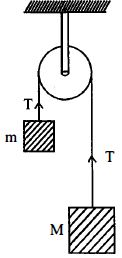
Two blocks of masses $m$ and $M$ are connected by means of a metal wire of cross-sectional area $A$ passing over a frictionless fixed pulley as shown in the figure. The system is then released. If $M = 2\, m$, then the stress produced in the wire is
The upper end of a wire of radius 4mm and length 100cm is clamped and its other end is twisted through an angle of 30°. Then, angle of shear is:
Which of the following statements is true regarding the molecular kinetic theory of gases?
The time dependence of the position of a particle of mass $m = 2$ is given by $\vec r\,(t)\, = \,2t\,\hat i\, - 3{t^2}\hat j$ Its angular momentum with respect to the origin at time $t = 2$ is
A travelling wave is described by the equation $y(x, t)=[0.05 \sin (8 x-4 t] \;m$

The velocity of the wave is $.....ms ^{-1}$ [all the quantities are in SI unit]

A car is moving with a uniform speed on a level road. Inside the car there is a balloon filled with helium and attached to a piece of string tied to the floor. The string is observed to be vertical. The car now takes a left turn maintaining the speed on the level road. The balloon in the car will
Which of the following can be used to describe how fast an object is moving along with the direction of motion at a given instant of time?