A black body is at a temperature $300 K$ . It emits energy at a rate, which is proportional to
AIIMS 2002, Easy
Download our app for free and get started
(d) Temperature of a black body $\mathrm{T}=300 \mathrm{K} .$ Stefan's law of radiation states that rate of energy emitted per unit area by the black body
$E \propto T^{4} \propto(300)^{4}$

Download our appand get started for free
Experience the future of education. Simply download our apps or reach out to us for more information. Let's shape the future of learning together!No signup needed.*
Similar Questions
- 1The rate of loss of heat from a body cooling under conditions of forced convection is proportional to its $(A)$ heat capacity $(B)$ surface area $(C)$ absolute temperature $(D)$ excess of temperature over that of surrounding : state ifView Solution
- 2$Assertion :$ Woolen clothes keep the body warm in winterView Solution
$Reason :$ Air is a bad conductor of heat. - 3A black body at a temperature of ${227^o}C$ radiates heat energy at the rate of $5 cal/cm^2-sec$. At a temperature of ${727^o}C$, the rate of heat radiated per unit area in $cal/cm^2$ will beView Solution
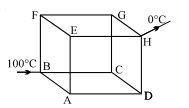
- 4Twelve conducting rods form the riders of a uniform cube of side $'l'.$ If in steady state, $B$ and $H$ ends of the rod are at $100^o C$ and $0^o C$. Find the temperature of the junction $'A'$ ....... $^oC$View Solution
- 5A container with $1 kg$ of water in it is kept in sunlight, which causes the water to get warmer than the surroundings. The average energy per unit time per unit area received due to the sunlight is $700 Wm ^{-2}$ and it is absorbed by the water over an effective area of $0.05 m ^2$. Assuming that the heat loss from the water to the surroundings is governed by Newton's law of cooling, the difference (in ${ }^{\circ} C$ ) in the temperature of water and the surroundings after a long time will be. . . . . . . . (Ignore effect of the container, and take constant for Newton's law of cooling $=0.001 s ^{-1}$, Heat capacity of water $\left.=4200 J kg ^{-1} K ^{-1}\right)$View Solution
- 6If between wavelength $\lambda $and $\lambda + d\lambda $, ${e_\lambda }$and ${a_\lambda }$ be the emissive and absorptive powers of a body and ${E_\lambda }$ be the emissive power of a perfectly black body, then according to Kirchoff's law, which is trueView Solution
- 7View SolutionAn ideal black body at room temperature is thrown into a furnace. It is observed that
- 8View SolutionA sphere and a cube of same material and same volume are heated upto same temperature and allowed to cool in the same surroundings. The ratio of the amounts of radiations emitted will be
- 9If the radius of a star is $R$ and it acts as a black body, what would be the temperature of the star, in which the rate of energy production is Q? ( $\sigma$ stands for Stefan's constant.)View Solution
- 10Two rods having thermal conductivity in the ratio of $5 : 3$ having equal lengths and equal cross-sectional area are joined by face to face. If the temperature of the free end of the first rod is $100°C$ and free end of the second rod is $20°C$ . Then temperature of the junction is...... $^oC$View Solution