A black body is heated from ${27^o}C$ to ${127^o}C$. The ratio of their energies of radiations emitted will be
AIIMS 2001, Medium


Download our appand get started for free
Experience the future of education. Simply download our apps or reach out to us for more information. Let's shape the future of learning together!No signup needed.*
Similar Questions
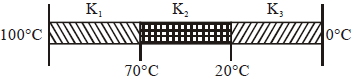
- 1Three rods of identical cross-section and lengths are made of three different materials of thermal conductivity $K _{1}, K _{2},$ and $K _{3}$, respectively. They are joined together at their ends to make a long rod (see figure). One end of the long rod is maintained at $100^{\circ} C$ and the ther at $0^{\circ} C$ (see figure). If the joints of the rod are at $70^{\circ} C$ and $20^{\circ} C$ in steady state and there is no loss of energy from the surface of the rod, the correct relationship between $K _{1}, K _{2}$ and $K _{3}$ isView Solution
- 2View SolutionWhich of the following factors affect the thermal conductivity of a rod?
- 3Three stars $A, B, C$ have surface temperatures $T _{A} ,T _{B}, T _{C}$ respectively. Star $A$ appears bluish, star $B$ appears reddish and star $C$ yellowish. Hence,View Solution
- 4A slab consists of two parallel layers of two different materials of same thickness having thermal conductivities $K_1$ and $K_2$ . The equivalent conductivity of the combination isView Solution
- 5View SolutionThe rates of cooling of two different liquids put in exactly similar calorimeters and kept in identical surroundings are the same if
- 6Temperature of water at the surface of lake is $ - {20^o}C$ Then temperature of water just below the lower surface of ice layer is ...... $^oC$View Solution
- 7A slab consists of two parallel layers of two different materials of same thickness having thermal conductivities $K_1$ and $K_2$ . The equivalent conductivity of the combination isView Solution
- 8A solid sphere of radius $R$ and a hollow sphere of inner radius $r$ and outer radius $R$ made of copper are heated to the same temperature and are allowed to cool in the same environment. Then, choose the $CORRECT$ statementView Solution
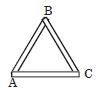
- 9Three rods $AB, BC$ and $AC$ having thermal resistances of $10\, units, \,10 \,units$ and $20 \,units,$ respectively, are connected as shown in the figure. Ends $A$ and $C$ are maintained at constant temperatures of $100^o C$ and $0^o C,$ respectively. The rate at which the heat is crossing junction $B$ is ........ $ \mathrm{units}$View Solution
- 10$A$ wall is made up of two layers $A$ and $B$ . The thickness of the two layers is the same, but materials are different. The thermal conductivity of $A$ is double than that of $B$ . In thermal equilibrium the temperature difference between the two ends is ${36^o}C$. Then the difference of temperature at the two surfaces of $A$ will be ....... $^oC$View Solution