MCQ
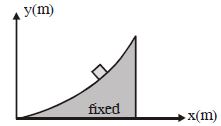
A block is kept on a fixed smooth wedge whose vertical section is a curve $y = \frac{{{x^2}}}{{\sqrt 3 }}$ as shown in figure where $x$ represents horizontal direction and $y$ represents vertical direction. When released from a point where $y = \frac{1}{{4\sqrt 3 }}$ , what will be its acceleration ? $(g \,= 10\, m/s^2)$ ....... $m/s^2$
  • A
    $2.5$
  • B
    $5\sqrt 3 $
  • $5$
  • D
    Can’t be determined

Answer

Correct option: C.
$5$
c
$\frac{d y}{d x}=\tan \theta=\frac{2 x}{\sqrt{3}} \Rightarrow \tan \theta=\frac{2}{\sqrt{3}} \cdot \frac{1}{2}=\frac{1}{\sqrt{3}}$

acceleration along wedge

$=g \sin \theta=10 \cdot \frac{1}{2}=5 \mathrm{m} / \mathrm{s}^{2}$

Need a full question paper?

Generate a complete, print-ready paper with questions like this in minutes — across 16+ boards, with answer keys.

Start Generating Free

Similar questions

An astronaut of mass $m$ is working on a satellite or biting the earth at a distance $h$ from the earth's surface. The radius of the earth is $R$, while its mass is $M$. The gravitational pull $F_G$ on the astronaut is
A body of mass $2$ kg is moving on the ground comes to rest after some time. The coefficient of kinetic friction between the body and the ground is $0.2$. The retardation in the body is ...... $m/s^2$ 
Which of the following quantities is zero, when a uniform object is being supported at its centre of gravity?
The position of a projectile launched from the origin at $t = 0$ is given by $\vec r = \left( {40\hat i + 50\hat j} \right)\,m$ at $t = 2\,s$. If the projectile was launched at an angle $\theta$ from the horizontal, then $\theta$ is (take $g = 10\, ms^{-2}$)
The mass and volume of a body are found to be $(5.00 ± 0.05)\,kg$ and $(1.00 ± 0.05)\,m^3$ respectively. Then the maximum possible percentage error in its density is .......... $\%$
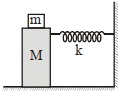
In the given figure, a mass $M$ is attached to a horizontal spring which is fixed on one side to a rigid support. The spring constant of the spring is $k$. The mass oscillates on a frictionless surface with time period $T$ and amplitude $A$. When the mass is in equilibrium position, as shown in the figure, another mass $m$ is gently fixed upon it. The new amplitude of oscillation will be
A particle is moving in a circular path of radius $r$ under the action of a force $F$. If at an instant velocity of particle is $v$, and speed of particle is increasing, then
A gas is expanded isothermally from volume V1 to V2 at a constant temperature T, the work done by the gas in this expansion is:
Three moles of an ideal gas $\left( {{C_P} = \frac{7}{2}R} \right)$ at pressure ${P_A}$ and temperature ${T_A}0$ is isothermally expanded to twice its initial volume. It is then compressed at constant pressure to its original volume. Finally the gas is compressed at constant volume to its original pressure ${P_A}.$ The correct $P-V$ and $P-T$ diagrams indicating the process are
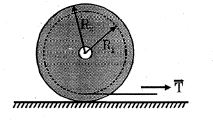
A spool consists a cylinder of radius $R_1$ wraped with thread and its end caps have radius $R_2$ as shown in the end view illustrated in figure. The mass of the spool, including the thread, is $m$ , and its moment of inertia about an axis through its center is $I$ . The spool is placed on a rough horizontal surface so that it rolls without  slipping. When a force $\vec T$ acting to the right is applied to the free end of the thread. Friction force exerted by the surface on the spool is given by