MCQ
A block of $200\, g$ mass moves with a uniform speed in a horizontal circular groove, with vertical side walls of radius $20\, cm$. If the block takes $40\, s$ to complete one round, the normal force by the side walls of the groove is
  • A
    $0.0314\, N$
  • B
    $9.859 \times 10^{-2}\, N$
  • C
    $6.28 \times 10^{-3}\, N$
  • $9.859 \times 10^{-4}\, N$

Answer

Correct option: D.
$9.859 \times 10^{-4}\, N$
d
$N = m \omega^{2} R$

$N = m \left[\frac{4 \pi^{2}}{ T ^{2}}\right] R$

Given $m =0.2 kg , T =40 S , R =0.2 m$

$N =9.859 \times 10^{-4} N$

Need a full question paper?

Generate a complete, print-ready paper with questions like this in minutes — across 16+ boards, with answer keys.

Start Generating Free

Similar questions

If $g$ is the acceleration due to gravity on the earth's surface, the gain in the potential energy of an object of mass $m$ raised from the surface of earth to a height equal to the radius $R$ of the earth is:
A sudden drop in the mercury level by $10 \,mm$ or more is a sign of ..........
A car travels half the distance with constant velocity of $40\, kmph$ and the remaining half with a constant velocity of $60 \,kmph$. The average velocity of the car in $kmph$ is
If net force on a system is zero then
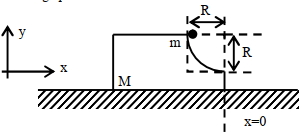
A block of mass $M$ has a circular cut with a frictionless surface as shown. The block rests on the horizontal frictionless surface of a fixed table. Initially the right edge of the block is at $x=0$, in a co-ordinate system fixed to the table. A point mass $m$ is released from rest at the topmost point of the path as shown and it slides down. When the mass loses contact with the block, its position is $\mathrm{x}$ and the velocity is $\mathrm{v}$. At that instant, which of the following options is/are correct?

(image)

$[A]$ The $x$ component of displacement of the center of mass of the block $M$ is : $-\frac{m R}{M+m}$.

[$B$] The position of the point mass is : $x=-\sqrt{2} \frac{\mathrm{mR}}{\mathrm{M}+\mathrm{m}}$.

[$C$] The velocity of the point mass $m$ is : $v=\sqrt{\frac{2 g R}{1+\frac{m}{M}}}$.

[$D$] The velocity of the block $M$ is: $V=-\frac{m}{M} \sqrt{2 g R}$.

A car is negotiating a curved road of radius $R$. The road is banked at an angle $\theta .$ The coefficient of friction between the tyres of the car and the road is $\mu _s.$ The maximum safe velocity on this road is
A transverse wave is represented by the equation $y = {y_0}\sin \frac{{2\pi }}{\lambda }(vt - x)$ For what value of  $\lambda$, the maximum particle velocity equal to two times the wave velocity
The resistance $R=V / I$ where $V=(100 \pm 5)\;V$ and $I=(10 \pm 0.2) \;A$. Find the percentage error in $R .$
A wire suspended vertically from one of its ends is stretched by attaching a weight of $200N$ to the lower end. The weight stretches the wire by $1\ mm.$ Then the elastic energy stored in the wire is:
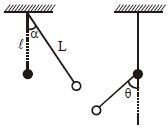
A simple pendulum consisting of a mass $M$ attached to a string of length $L$ is released from rest at an angle $\alpha$. $A$ pin is located at a distance $l$ below the pivot point. When the pendulum swings down, the string hits the pin as shown in the figure. The maximum angle $\theta$ which string makes with the vertical after hitting the pin is :-