MCQ
A block of mass $10\, kg$ moving at $10\,m/s$ is released to slide on rough surface having  coefficient of friction $0.2.$ It will stop by travelling distance ........ $m$
  • A
    $20$
  • $25$
  • C
    $30$
  • D
    $35$

Answer

Correct option: B.
$25$
b
$S=\frac{V^{2}}{2 \mu g}=\frac{10^{2}}{2 \times 0.2 \times 10}=25 \mathrm{m}$

Need a full question paper?

Generate a complete, print-ready paper with questions like this in minutes — across 16+ boards, with answer keys.
Start Generating Free

Similar questions

A stone of mass $900 \mathrm{~g}$ is tied to a string and moved in a vertical circle of radius $1 \mathrm{~m}$ making $10\  \mathrm{rpm}$. The tension in the string, when the stone is at the lowest point is (if $\pi^2=9.8$ and $g=9.8 \mathrm{~m} / \mathrm{s}^2$ )
In $1913,$ Niels Bohr gave theory on the basis of:
At constant volume the specific heat of a gas is $\frac{{3R}}{2}$, then the value of $'\gamma '$ will be .... 
If $g \propto \frac{1}{{{R^3}}}$ (instead of $\frac{1}{{{R^2}}}),$ then the relation between time period of a satellite near earth's surface and radius $R$ will be
A uniform heavy rod of weight $10\, {kg} {ms}^{-2}$, crosssectional area $100\, {cm}^{2}$ and length $20\, {cm}$ is hanging from a fixed support. Young modulus of the material of the rod is $2 \times 10^{11} \,{Nm}^{-2}$. Neglecting the lateral contraction, find the elongation of rod due to its own weight. (In $\times 10^{-10} {m}$)
A body of mass $m$ hangs at one end of a string of length l, the other end of which is fixed. It is given a horizontal velocity so that the string would just reach where it makes an angle of ${60^°}$ with the vertical. The tension in the string at mean position is
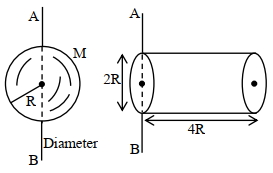
Ratio of radius of gyration of a hollow sphere to that of a solid cylinder of equal mass, for moment of Inertia about their diameter axis $A B$ as shown in figure is $\sqrt{\frac{8}{x}}$. The value of $x$ is:
A particle is dropped from a tower. It is found that it travels $55m$ in the last second of its journey. Then height of the tower is $(g = 10\ m/s^2g = 10\ m/s^2)?$
A body of mass $m$ is accelerated uniformly from rest to a speed $v$ in a time $T$ . The instantaneous power delivered to the body as a function of time is given by
$10\, gm$ of ice at $0°C$ is mixed with $100 \,gm $ of water at $50°C.$ What is the resultant temperature of mixture........ $^oC$