MCQ
A block of mass $10 \,kg$. moving with acceleration $2 \,m / s ^2$ on horizontal rough surface is shown in figure The value of coefficient of kinetic friction is ...........
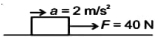
  • $0.2$
  • B
    $0.4$
  • C
    $0.5$
  • D
    $0.1$

Answer

Correct option: A.
$0.2$
a
(a)

$a=2\,m / s ^2$

$g=9.8\,m / s ^2$

$Friction force = \mu g$

$=\mu \times 10 \times 9.8$

$=98\,\mu$

Net force $=$ External force $=$ friction force

$m \times a =40-98\,\mu$

$2 \times 10 =40-98\,\mu$

$98 \mu =40-20$

$=20$

$\mu=\frac{20}{98}=\frac{10}{49}=0.20$

Need a full question paper?

Generate a complete, print-ready paper with questions like this in minutes — across 16+ boards, with answer keys.

Start Generating Free

Similar questions

If a force of constant magnitude acts in direction perpendicular to the motion of a particle, then its
A body of mass $\mathrm{m}$ is kept on a rough horizontal surface (coefficient of friction $=\mu$ ) A horizontal force is applied on the body, but it does not move. The resultant of normal reaction and the frictional force acting on the object is given by $\mathrm{F},$ where $\mathrm{F}$ is
A container of volume $1{m^3}$is divided into two equal compartments by a partition. One of these compartments contains an ideal gas at $300 K$. The other compartment is vacuum. The whole system is thermally isolated from its surroundings. The partition is removed and the gas expands to occupy the whole volume of the container. Its temperature now would be ..... $K$
The ratio of principal molar heat capacities of a gas is maximum for:
An electric kettle (rated accurately at $2.5\, kW$) is used to heat $3\, kg$ of water from $15\,^oC$ to boiling point. It takes $9.5$ minute. Then, the amount of heat that has been lost is
Newton's law of cooling is used in laboratory for the determination of the
A body rotating with uniform angular acceleration covers $100 \pi$ (radian) in the first $5 \,s$ after the start. Its angular speed at the end of $5 \,s$ (in radian/s) is .........$\pi$
If the root mean square velocity of hydrogen molecule at a given temperature and pressure is $2 \mathrm{~km} / \mathrm{s}$, the root mean square velocity of oxygen at the same condition in $\mathrm{km} / \mathrm{s}$ is :
In a dilute gas at pressure $P$ and temperature $T$, the mean time between successive collisions of a molecule varies with $T$ as
The unit of specific resistance is