Question
A block of mass $2.0kg$ moving at $2.0m/s$ collides head on with another block of equal mass kept at rest.
  1. Find the maximum possible loss in kinetic energy due to the collision.
  2. If the actual loss in kinetic energy is half of this maximum, find the coefficient of restitution.
Answer

Mass of block $=2 \mathrm{~kg}$ and speed $=2 \mathrm{~m} / \mathrm{s}$ Mass of $2^{\text {nd }}$ block $=2 \mathrm{~kg}$. Let final velocity of $2^{\text {nd }}$ block $=\mathrm{v}$
a. Using law of conservation of momentum.
$2 \times 2=(2+2) \mathrm{v}$
$\Rightarrow \mathrm{v}=1 \mathrm{~m} / \mathrm{s}$
$\therefore$ Loss in K.E. in inelastic collision
$=\Big(\frac{1}{2}\Big)\times2\times(2)^2\text{v}-\Big(\frac{1}{2}\Big)(2+2)\times(1)^2$
$=4-2=2\text{J}$
b.$\text{Actual loss}=\frac{\text{Maximum loss}}{2}=1\text{J}$ $=\Big(\frac{1}{2}\Big)2\times(2)^2-
\Big(\frac{1}2{}\Big)2\times\text{v}_1^2+\Big(\frac{1}2{}\Big)\times2\times\text{v}_2^2=1$
$\Rightarrow4-\big(\text{v}_1^2+\text{v}^2_2\big)=1$
$\Rightarrow4-\frac{(1+\text{e}^2)\times4}{2}=1$
$\Rightarrow2(1+\text{e}^2)=3$
$\Rightarrow1+\text{e}^2=\frac{3}{2}$
$\Rightarrow\text{e}^2=\frac{1}{2}$
$\Rightarrow\text{e}=\frac{1}{\sqrt2}$

Need a full question paper?

Generate a complete, print-ready paper with questions like this in minutes — across 16+ boards, with answer keys.

Start Generating Free

Similar questions

A simple pendulum of length I is suspended through the ceiling of an elevator. Find the time period of small oscillations if the elevator,
  1. Is going up with an acceleration $a_0$
  2. Is going down with an acceleration $a_0$.
  3. Is moving with a uniform velocity.
A stream of water flowing horizontally with a speed of $15ms^{-1}$ gushes out of a tube of cross-sectional area $10^{-2}m^2$, and hits a vertical wall nearby. What is the force exerted on the wall by the impact of water, assuming it does not rebound?
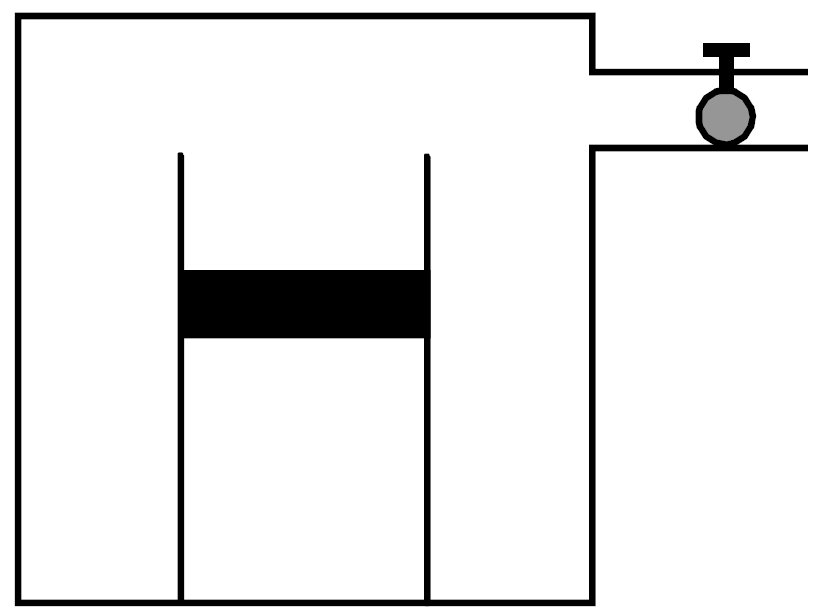
An ideal gas is kept in a long cylindrical vessel fitted with a frictionless piston of cross-sectional area $10cm^2$ and weight $1kg$ (figure.) The vessel itself is kept in a big chamber containing air at atmospheric pressure $100kPa$. The length of the gas column is $20cm$. If the chamber is now completely evacuated by an exhaust pump, what will be the length of the gas column? Assume the temperature to remain constant throughout the process.
A rectangular box lies on a rough inclined surface. The coefficient of friction between the surface and the box is $\mu$. Let the mass of the box be m.
  1. At what angle of inclination $\theta$ of the plane to the horizontal will the box just start to slide down the plane?
  2. What is the force acting on the box down the plane, if the angle of inclination of the plane is increased to a $\theta>$?
  3. What is the force needed to be applied upwards along the plane to make the box either remain stationary or just move up with uniform speed?
  4. What is the force needed to be applied upwards along the plane to make the box move up the plane with acceleration a?
If a drop of liquid breaks into smaller droplets, it results in lowering of temperature of the droplets. Let a drop of radius R, break into N small droplets each of radius r. Estimate the drop in temperature.
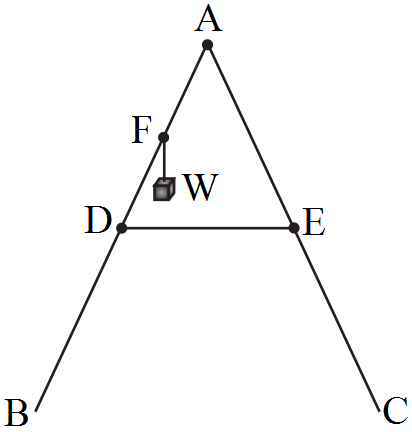
As shown in the two sides of a step ladder BA and CA are $1.6m$ long and hinged at A. A rope DE, $0.5m$ is tied half way up. A weight $40kg$ is suspended from a point F, 1.2m from B along the ladder BA. Assuming the floor to be frictionless and neglecting the weight of the ladder, find the tension in the rope and forces exerted by the floor on the ladder. (Take $g = 9.8m/s^2$) (Hint: Consider the equilibrium of each side of the ladder separately).
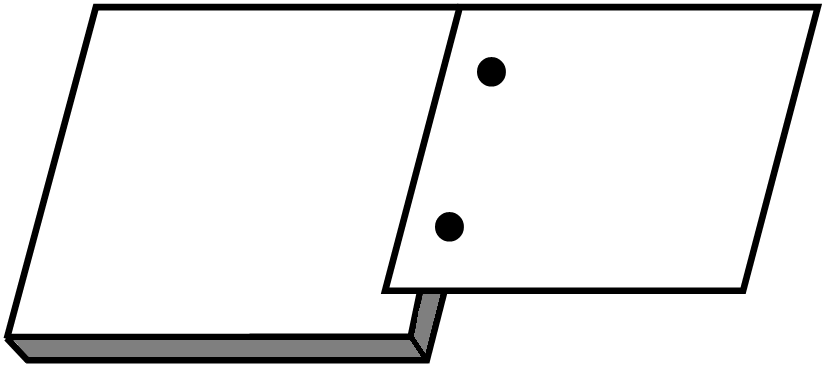
Two long metallic strips are joined together by two rivets each of radius $0.1cm$ (see Fig.).

 Each rivet can withstand a maximum shearing stress of $3.0 \times 10^8Nm^{-2}$. Calculate the maximum tangential force a strip can exert.
A mass m is placed on a platform from a height 'h'. The platform is attached to a spring whose other end is fixed to the ground. Find the compression in the spring, if the spring constant is k.
A train passes a station A at $40kmh^{-1}$ and maintains its speed for 7km and is then uniformly retarded, stopping at B which is 8.5km from A. A second train starts from A at the instant the first train passes and being accelerated some part of the journey and uniformly retarded for the rest, stops at B at the same times as the first train. Calculate the maximum speed of the second train, use only the graphical method.
Consider that an ideal gas ( $n$ moles) is expanding in a process given by $P=f(V)$, which passes through a point $\left(V_0\right.$, $\left.P_0\right)$. Show that the gas is absorbing heat at $\left(P_0, V_0\right)$ if the slope of the curve $P=f(V)$ is larger than the slope of the adiabat passing through $\left(\mathrm{P}_0, \mathrm{~V}_0\right)$.