Question
A block of mass 2kg placed on a long frictionless horizontal table is pulled horizontally by a constant force F. It is found to move 10m in the first two seconds. Find the magnitude of F.

Answer

m = 2kg S = 10m Let, acceleration = a, Initial velocity u = 0.$\text{S = ut}+\frac{1}{2}\text{at}^2$
$\Rightarrow10=\frac{1}{2}\text{a}(2^2)$
$\Rightarrow10=2\text{a}$
$\Rightarrow\text{a}=5\text{m/s}^2$
Force: F = ma = 2 × 5 = 10N

Need a full question paper?

Generate a complete, print-ready paper with questions like this in minutes — across 16+ boards, with answer keys.
Start Generating Free

Similar questions

Electrons are emitted from a photosensitive surface when it is illuminated by green light but electron emission does not take place by yellow light. Will the electrons be emitted when the surface is illuminated by (i) red light, and (ii) blue light?
What kind of ferromagnetic material is used for coating magnetic tapes in a cassette player or for building memory stores in a modern computer?
How does the maximum kinetic energy of electrons emitted vary with the work function of the metal?Maximum kinetic energy $E_k = h_ν – W$ Clearly, smaller the work function $W,$ greater is the $E_k$ This means that when work function of a metal increases, maximum kinetic energy of photoelectrons decreases.
What is lens? State their types and draw their diagram.
A point charge produces an electric field of magnitude $5.0NC^{-1}$ at a distance of $40\ cm$ from it. What is the magnitude of the charge?
Two large glass plates are placed vertically and parallel to each other inside a tank of water with separation between the plates equal to $1\ mm.$ Find the rise of water in the space between the plates. Surface tension of water $= 0.075N/m.$
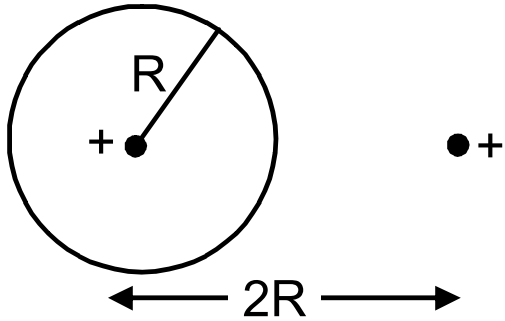
Find the flux of the electric field through a spherical surface of radius $R$ due to a charge of $10^{-7}C$ at the centre and another equal charge at a point $2R$ away from the centre.
A thin spherical shell of radius R lying on a rough horizontal surface is hit sharply and horizontally by a cue. Where should it be hit so that the shell does not slip on the surface?
An electron enters with a velocity $v = v_0$ i into a cubical region $($faces parallel to coordinate planes$)$ in which there are uniform electric and magnetic fields. The orbit of the electron is found to spiral down inside the cube in plane parallel to the $x-y$ plane. Suggest a configuration of fields $E$ and $B$ that can lead to it.
Metallic (nonferromagnetic) and nonmetallic particles in a solid waste may be separated as follows. The waste is allowed to slide down an incline over permanent magnets. The metallic particles slow down as compared to the norunetallic ones and hence are separated. Discuss the role of eddy currents in the process.