Question
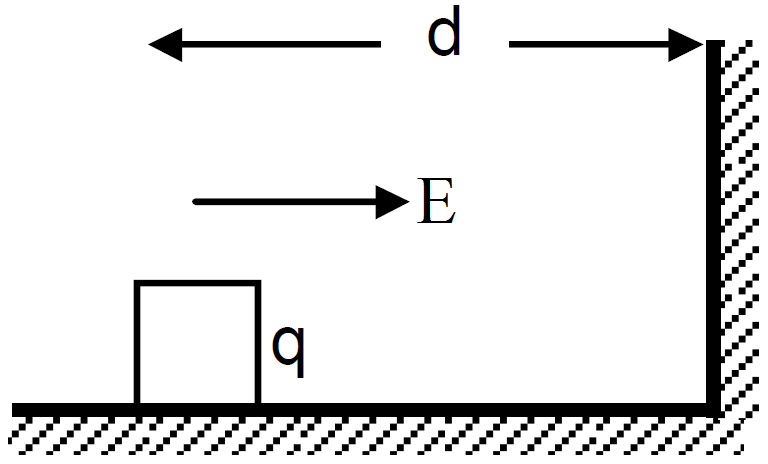
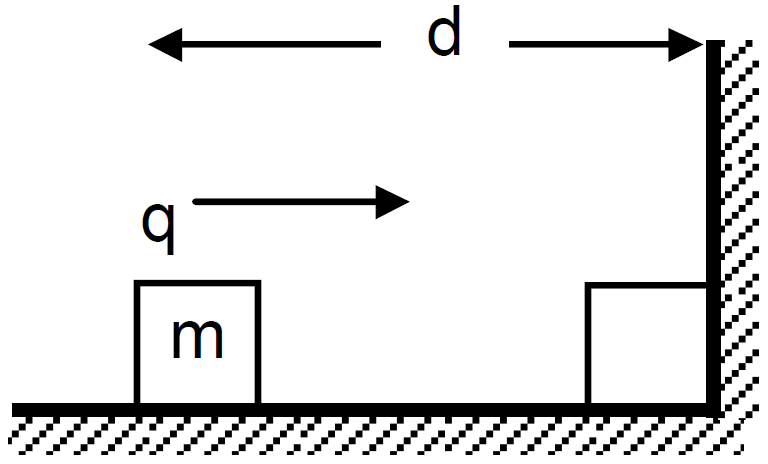
A block of mass m containing a net positive charge q is placed on a smooth horizontal table which terminates in a vertical wall as shown in figure. The distance of the block from the wall is d. A horizontal electric field E towards right is switched on. Assuming elastic collisions (if any) find the time period of the resulting oscillatory motion. Is it a simple harmonic motion?
Answer

The block does not undergo. SHM since here the acceleration is not proportional to displacement and not always opposite to displacement. When the block is going towards the wall the acceleration is along displacement and when going away from it the displacement is opposite to acceleration. Time taken to go towards the wall is the time taken to goes away from it till velocity is: $\text{d}=\text{ut}+\Big(\frac{1}{2}\Big)\text{at}^2$
$\Rightarrow\text{d}=\frac{1}{2}\times\frac{\text{qE}}{\text{m}}\times\text{t}^2$
$\Rightarrow\text{t}^2=\frac{2\text{dm}}{\text{qE}}$
$\Rightarrow\text{t}=\sqrt{\frac{2\text{md}}{\text{qE}}}$
$\therefore\ $Total time taken for to reach the wall and com back (Time period)
$=2\text{t}=2\sqrt{\frac{2\text{md}}{\text{qE}}}$
$=\sqrt{\frac{2\text{md}}{\text{qE}}}$

Need a full question paper?

Generate a complete, print-ready paper with questions like this in minutes — across 16+ boards, with answer keys.

Start Generating Free

Similar questions

A circular racetrack of radius 300 m is banked at an angle of 15°. If the coefficient of friction between the wheels of a race-car and the road is 0.2, what is the (a) optimum speed of the racecar to avoid wear and tear on its tyres, and (b) maximum permissible speed to avoid slipping ?
The angle between vector $\vec{\text{A}}$ and $\vec{\text{B}}$ is 60°. What is the ratio of $\vec{\text{A}}.\vec{\text{B}}$ and $|\vec{\text{A}}\times\vec{\text{B}}|.$
A cube of ice floats partly in water and partly in K. oil Find the ratio of the volume of ice immersed in water to that in K.oil. Specific gravity of K. oil is $0.8$ and that of ice is $0.9$.
In what ways are the gas thermometers superior to mercury thermometers?
It is claimed that two cesium clocks, if allowed to run for 100 years, free from any disturbance, may differ by only about 0.02s. What does this imply for the accuracy of the standard cesium clock in measuring a time-interval of 1s?
Define gravitational potential energy. Give its SI unit.
What is the value of escape velocity from the surface of $(i)$ earth, $(ii)$ moon?
A gas thermometer measures the temperature from the variation of pressure of a sample of gas. If the pressure measured at the melting point of lead is 2.20 times the pressure measured at the triple point of water, find the melting point of lead.
If the total mechanical energy of a particle is zero, is its linear momentum necessarily zero? Is it necessarily non-zero?
Balmer series was observed and analysed before the other series. Can you suggest a reason for such an order?