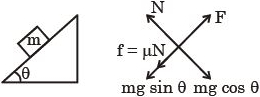
A block of mass $m$ is lying on an inclined plane. The coefficient of friction between the plane and the block is $\mu$. The force $(F_1)$ required to move the block up the inclined plane will be
Easy
Download our app for free and get started
$F=f+\mathbf{m g} \sin \theta=\operatorname{mg}(\mu \cos \theta+\sin \theta)$

Download our appand get started for free
Experience the future of education. Simply download our apps or reach out to us for more information. Let's shape the future of learning together!No signup needed.*
Similar Questions
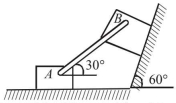
- 1In figure, two blocks are separated by a uniform strut attached to each block with frictionless pins. Block $A$ weighs $400\,N$, block $B$ weighs $300\,N$, and the strut $A B$ weigh $200\,N$. If $\mu=0.25$ under $B$, determine the minimum coefficient of friction under $A$ to prevent motion.View Solution
- 2On the horizontal surface of a truck a block of mass $1 \;kg$ is placed $(\mu=0.6)$ and truck is moving with acceleration $5\; m / sec ^2$ then the frictional force on the block will beView Solution
- 3A body of $5 \,kg$ weight kept on a rough inclined plane of angle $30^{\circ}$ starts sliding with a constant velocity. Then the coefficient of friction is (assume $g=10 \,ms ^{-2}$ )View Solution
- 4A mass is supported on a frictionless horizontal surface. It is attached to a string and rotates about a fixed centre at an angular velocity ${\omega _0}$. If the length of the string and angular velocity are doubled, the tension in the string which was initially ${T_0}$ is nowView Solution
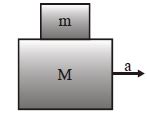
- 5A block of mass $m$ is placed on the top of another block of mass $M$ as shown in the figure. The coefficient of friction between them is $\mu $. What is the maximum acceleration with which the block $M$ may move so that m also moves along with it ?View Solution
- 6A cyclist moves in a circular track of radius $100$ m. If the coefficient of friction is $0.2$, then the maximum velocity with which the cyclist can take the turn with leaning inwards is ...... $m/s$View Solution
- 7The time taken by an object to slide down $45^{\circ}$ rough inclined plane is $n$ times as it takes to slide down a perfectly smooth $45^{\circ}$ incline plane. The coefficient of kinetic friction between the object and the incline plane isView Solution
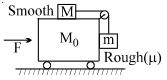
- 8Imagine $a$ situation in which the horizontal surface of block $M_0$ is smooth and its vertical surface is rough with $a$ coefficient of friction $\mu$ In above problem, choose the correct value $(s)$ of F which the blocks $M$ and $m$ remain stationary with respect to $M_0$View Solution
- 9Find the maximum velocity for skidding for a car moved on a circular track of radius $100\, m$. The coefficient of friction between the road and tyre is $0.2$ ....... $m/s$View Solution
- 10View SolutionA motor cycle driver doubles its velocity when he is having a turn. The force exerted outwardly will be