Question
A block of mass M is pulled along a horizontal surface by applying a force at an angle with horizontal. Coefficient of friction between block and surface is u. If the block travels with uniform velocity, find the work done by this applied force during ú displacement d of the block.
Answer

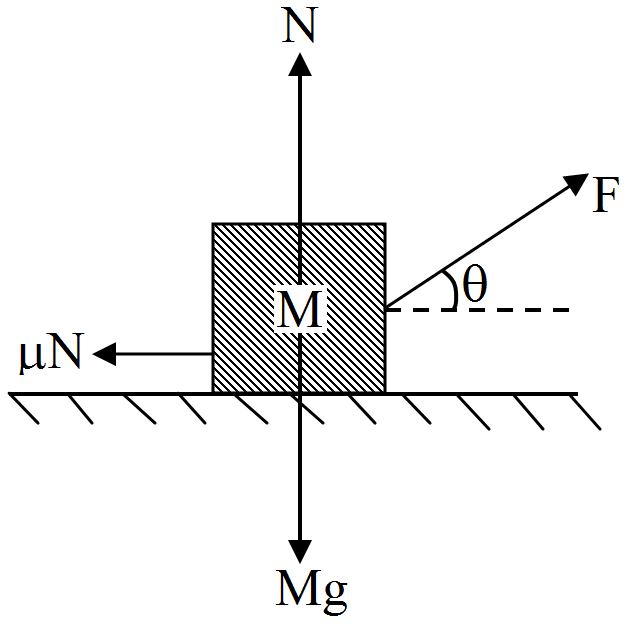
The forces acting on the block are shown in Figure. As the block moves with uniform velocity the forces add up to zero.

$\therefore\text{F}\cos\theta=\mu\text{N}\cdots\text{(i)}$

$\text{F}\sin\theta+\text{N}=\text{mg}\cdots\text{(ii)}$

Eliminating N from equation (i) and (ii),

$\text{F}\cos\theta=\mu(\text{Mg}-\text{F}\sin\theta)$

$\text{F}=\frac{\mu\text{Mg}}{\cos\theta+\mu\sin\theta}$

Work done by this force during a displacement d

$\text{W}=\text{F}.\text{d}\cos\theta=\frac{\mu\text{Mgd}\cos\theta}{\cos\theta+\mu\sin\theta}$

Need a full question paper?

Generate a complete, print-ready paper with questions like this in minutes — across 16+ boards, with answer keys.

Start Generating Free

Similar questions

One end of a rod of length 20cm is inserted in a furnace at 800K The sides of the rod are covered with an insulating material and the other end emits radiation like a blackbody. The temperature of this end is 750K in the steady state. The temperature of the surrounding air is 300K. Assuming radiation to be the only important mode of energy transfer between the surrounding and the open end of the rod, find the thermal conductivity of the rod. Stefan constant $\sigma=6.0\times10^{-8}\text{Wm}^{-2}\text{K}^{-4}.$
A magnifying glass is a converging lens placed close to the eye. A farsighted person uses spectacles having converging lenses. Compare the functions of a converging lens used as a magnifying glass and as spectacles.
A simple pendulum is suspended from the ceiling of a car taking a turn of radius 10m at a speed of 36km/ h. Find the angle made by the string of the pendulum with the vertical if this angle does not change during the turn. Take g= 10m/s2.
The length of a brass rod is found to be smaller less on a hot summer day than on a cold winter day as measured by the same aluminium scale. Do we conclude that brass shrinks on heating?
Find the temperature at which the speed of sound in oxygen will be the same as that in nitrogen at 20°C. Given that molar masses of oxygen and nitrogen are 32 and 28 respectively. Both gases are assumed to be ideal.
Aman stands on a weighing machine placed on a horizontal platform. The machine reads 50kg. By means of a suitable mechanism, the platform is made to execute harmonic vibrations up and down with a frequency of two vibrations per second. What will be the effect on the reading of the weighing machine? The amplitude of vibrations of platform is 5cm. Take, g = 10ms-2.
Two identical ball bearings in contact witheach other and resting on a frictionless table are hit head-on by another ball bearing of the same mass moving initially with a speed V. If the collision is elastic, which of the following (Fig.) is a possible result after collision?
Find the angular velocity for an object to experience weightlessness at the equator of earth. Under this condition, also find the duration of a day.
The distance of the Sun from the Earth is 1.496 × 10¹¹ m (i.e., 1 A.U.). If the angular diameter of the Sun is 2000”, find the diameter of the Sun.
A wheel rotating at a speed of 600rpm (revolutions per minute) about its axis is brought to rest by applying a constant torque for 10 seconds. Find the angular deceleration and the angular velocity 5 seconds after the application of the torque.