A block of mass $M$ is suspended from a wire of length $L$, area of cross-section $A$ and Young's modulus $Y$. The elastic potential energy stored in the wire is
Medium


Download our appand get started for free
Experience the future of education. Simply download our apps or reach out to us for more information. Let's shape the future of learning together!No signup needed.*
Similar Questions
- 1A substance breaks down by a stress of $10^6 N/m^2$. If the density of the material of the wire is $3×10^3 kg/m^3$, then the length of the wire of the substance which will break under its own weight when suspended vertically, is ......... $m$View Solution
- 2View SolutionIf the tension on a wire is removed at once, then
- 3The specific heat at constant pressure and at constant volume for an ideal gas are ${C_p}$ and ${C_v}$ and its adiabatic and isothermal elasticities are ${E_\varphi }$ and ${E_\theta }$ respectively. The ratio of ${E_\varphi }$ to ${E_\theta }$ isView Solution
- 4View SolutionThe units of Young ‘s modulus of elasticity are
- 5Two wires $A$ and $B $ of same length and of the same material have the respective radii ${r_1}$ and ${r_2}$. Their one end is fixed with a rigid support, and at the other end equal twisting couple is applied. Then the ratio of the angle of twist at the end of $A$ and the angle of twist at the end of $B $ will beView Solution
- 6Join details of Column$-II$ with given information in Column$-I$ appropriatelyView Solution
Column $-I$ Column $-II$ $(a)$ Stress is proportional to strain.
$(i)$ Elastic limit $(b)$ When the load of the wire is removed, the body does regain its original dimension. $(ii)$ Limit of pro-portionality $(iii)$ Plastic deformation - 7A steel rod has a radius $10 \,mm$ and a length of $1.0 \,m$. A force stretches it along its length and produces a strain of $0.32 \%$. Young's modulus of the steel is $2.0 \times 10^{11} \,Nm ^{-2}$. What is the magnitude of the force stretching the rod is ........ $kN$View Solution
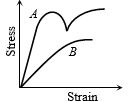
- 8The diagram shows stress v/s strain curve for the materials $A$ and $B$. From the curves we infer thatView Solution
- 9A wire is suspended by one end. At the other end a weight equivalent to $20\, N$ force is applied. If the increase in length is $1.0\, mm,$ the ratio of the increase in energy of the wire to the decrease in gravitational potential energy when load moves downwards by $1\, mm,$ will beView Solution
- 10$K$ is the force constant of a spring. The work done in increasing its extension from ${l_1}$ to ${l_2}$ will beView Solution