MCQ
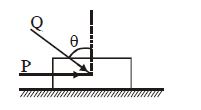
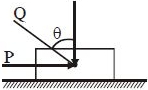
A block of mass $m$ lying on a rough horizontal plane is acted upon by a horizontal force $P$ and another force $Q$ inclined an at an angle $\theta $ to the vertical. The minimum value of coefficient of friction between the block and the surface for which the block will remain in equilibrium is
  • $\frac{{P\, + \,Q\,\sin \,\theta }}{{mg\, + \,Q\,\cos \,\theta }}$
  • B
    $\frac{{P\,\cos \,\theta \, + \,Q\,}}{{mg\, - \,Q\,\sin \,\theta }}$
  • C
    $\frac{{P\, + \,Q\,\cos \,\theta }}{{mg\, + \,Q\,\sin \,\theta }}$
  • D
    $\frac{{P\,sin\,\theta \, - \,Q\,}}{{mg\, - \,Q\,\cos \,\theta }}$
Answer

Correct option: A.
$\frac{{P\, + \,Q\,\sin \,\theta }}{{mg\, + \,Q\,\cos \,\theta }}$
a
$\mathrm{N}=\mathrm{mg}+\mathrm{Q} \cos \theta$

$\mathrm{P}+\mathrm{Q} \sin \theta \leq \mu \mathrm{N}$

$\Rightarrow \mu \geq \frac{\mathrm{P}+\mathrm{Q} \sin \theta}{\mathrm{N}}, \mu \geq \frac{\mathrm{P}+\mathrm{Q} \sin \theta}{\mathrm{mg}+\mathrm{Q} \cos \theta}$

Need a full question paper?

Generate a complete, print-ready paper with questions like this in minutes — across 16+ boards, with answer keys.

Start Generating Free

Similar questions

A block of wood is floating on water at $0^{\circ} C$ with volume $V_0$ above water. When the temperature of water increases from $0$ to $10^{\circ} C$, the change in the volume of the block that is above water is best described schematically by the graph.
A source, approaching with speed $u$ towards the open end of a stationary pipe of length $L$, is emitting a sound of frequency $f_5$. The farther end of the pipe is closed. The speed of sound in air is $v$ and $f_0$ is the fundamental frequency of the pipe. For which of the following combination(s) of $u$ and $f_5$, will the sound reaching the pipe lead to a resonance?

$(A)$ $u=0.8 v$ and $f_5=f_0$

$(B)$ $u=0.8 v$ and $f_5=2 f_0$

$(C)$ $u=0.8 v$ and $f_5=0.5 f_0$

$(D)$ $u=0.5 v$ and $f_5=1.5 f_0$

The escape velocity from the Earth's surface is $v .$ The escape velocity from the surface of another planet having a radius, four times that of Earth and same mass density is :
A $^{238}U$ nucleus decays by emitting an $\alpha$ particle of speed $v\,m{s^{ - 1}}$. The recoil velocity of the residual nucleus is (in $m{s^{ - 1}}$)
The $\text{COM}$ of body in pure rotation does-
Which of the following processes is reversible
A body is moving in a low circular orbit about a planet of mass $M$ and radius $R$. The radius of the orbit can be taken to be $R$ it self. Then the ratio of the speed of this body in the orbit to the escape velocity from the planet is
The velocities of three particles of masses $20\ g$, $30\ g$ and $50\ g$ are $10 \vec i,\,10\vec j,\,{\rm{and}}\,10\vec k$ respectively. The velocity of the centre of mass of the three particles is
Heat is supplied to a diatomic gas at constant pressure. The ratio of $\Delta Q\,:\,\Delta U\,:\,\Delta W$ is
A body starts from rest and moves with uniform acceleration for $3\ s.$ It then decelerates uniformly for $2\ s.$ and stops. If the deceleration is $3 \ ms^{-2}$ the maximum velocity of the body is$. . . ms^{-1}$