MCQ
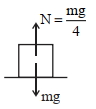
A block of mass $M$ placed inside a box descends vertically with acceleration $'a'$. The block exerts a force equal to one-fourth of its weight on the floor of the box. The value of $'a'$ will be .............
  • A
    $\frac{g}{4}$
  • B
    $\frac{g}{2}$
  • $\frac{3 g }{4}$
  • D
    $g$

Answer

Correct option: C.
$\frac{3 g }{4}$
c
$m g-N=m a$

$a=g-\frac{g}{4}$

$a=\frac{3 g}{4}$

Need a full question paper?

Generate a complete, print-ready paper with questions like this in minutes — across 16+ boards, with answer keys.

Start Generating Free

Similar questions

A particle executes simple harmonic motion according to equation $4 \frac{d^2 x}{d t^2}+320 x=0$. Its time period of oscillation is .........
Two balls $A$ and $B$ are thrown with same velocity $u$ from the top of a tower. Ball $A$ is thrown vertically upwards and the ball $B$ is thrown vertically downwards. If a ball $C$ is thrown with the same velocity but in the horizontal direction from the top of the tower,If $t_A = 6\  s$ and $t_B = 2\ s$ then it will reach the ground in time $t_c$ equal to........$s$
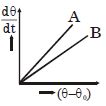
Two circular discs $A$ and $B$ with equal radii and equal mass are blackened. They are heated to same temperature and are cooled under identical conditions.What inference do you draw from their cooling curves ?
A particle moves in a plane with constant acceleration in a direction different from the initial velocity. The path of the particle will be
The lengths and radii of two rods made of same material are in the ratios $1 : 2$ and $2 : 3$ respectively. If the temperature difference between the ends for the two rods be the same, then in the steady state, the amount of heat flowing per second through them will be in the ratio
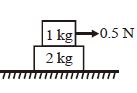
A force of $0.5\ N$ is applied on the upper block as shown in figure. The coefficient of static friction between the two blocks is $0.1$ and that between the lower block and the surface is zero. The work done by the lower block on the upper block for a displacement of $3\ m$ of the upper block is ...... $J$
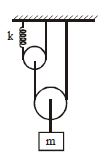
What is the period of small oscillations of the block of mass $m$ if the springs are ideal and pulleys are massless ?
A bullet is fired from a gun at the speed of $280\,ms ^{-1}$ in the direction $30^{\circ}$ above the horizontal. The maximum height attained by the bullet is $........\,m$ $\left(g=9.8\,ms ^{-2}, \sin 30^{\circ}=0.5\right):-$
Graph between power and time is given below. Then which of the following option is correct for work done by force [from $t = 0$ to time $t$]
Consider the situation of the previous problem. The force on the central charge due to the shell is:
  1. Towards left.
  2. Towards right.
  3. Upward.
  4. Zero.