A block of mass $m$ rests on a rough inclined plane. The coefficient of friction between the surface and the block is $\mu$. At what angle of inclination $\theta$ of the plane to the horizontal will the block just start to slide down the plane?
Easy
Download our app for free and get started
The various forces acting on the block are as shown in the figure.
From figure
$\operatorname{mgsin} \theta=\mathrm{f}$ $...(i)$
$\mathrm{mg} \cos \theta=\mathrm{N}$ $...(ii)$
Divide $(i)$ by $( ii),$ we get
$\tan \theta=\frac{\mathrm{f}}{\mathrm{N}}=\frac{\mu \mathrm{N}}{\mathrm{N}}$
or $\theta=\tan ^{-1}(\mu)$

Download our appand get started for free
Experience the future of education. Simply download our apps or reach out to us for more information. Let's shape the future of learning together!No signup needed.*
Similar Questions
- 1A car is moving on a circular path and takes a turn. If ${R_1}$ and ${R_2}$ be the reactions on the inner and outer wheels respectively, thenView Solution
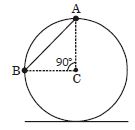
- 2Two beads connected by massless inextensible string are placed over the fixed ring as shown in figure. Mass of each bead is $m$ , and there is no friction between $B$ and ring. Find minimum value of coefficient of friction between $A$ and ring so that system remains in equilibrium. ( $C \to $center of ring, $AC$ line is vertical)View Solution
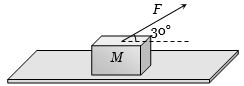
- 3A block of mass $M = 5\,kg$ is resting on a rough horizontal surface for which the coefficient of friction is $0.2$. When a force $F = 40\,\,N$ is applied, the acceleration of the block will be ........ $m/\sec^2$ $(g = 10\,\,m/{\sec^2})$View Solution
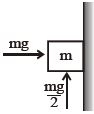
- 4View SolutionA block pressed against the vertical wall is in equilibrium. The minimum coefficient of friction is:-
- 5A body of mass $2 \,kg$ is kept by pressing to a vertical wall by a force of $100\, N$. The coefficient of friction between wall and body is $0.3.$ Then the frictional force is equal to ........ $N$View Solution
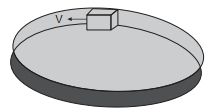
- 6View SolutionA body is revolving with a constant speed along a circle. If its direction of motion is reversed but the speed remains the same, then which of the following statement is true
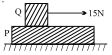
- 7$A$ long plank $P$ of the mass $5\, kg$ is placed on a smooth floor. On $P$ is placed a block $Q$ of mass $2\, kg$. The coefficient of friction between $P$ and $Q$ is $0.5$. If a horizontal force $15N$ is applied to $Q$, as shown, and you may take $g$ as $10N/kg.$View Solution
- 8A block of mass $M$ is being pulled along rough horizontal surface. The coefficient of friction between the block and the surface is $\mu $. If another block of mass $M/2$ is placed on the block and it is again pulled on the surface, the coefficient of friction between the block and the surface will beView Solution
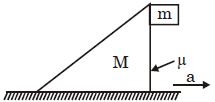
- 9As shown in the figure, block m and wedge $M$ move together with a horizontal acceleration of $20\, m/s^2$. Given $m = 1\, kg$, $\mu = 0.6$ (between $m$ and $M$) and $g = 10\, m/s^2$. Choose the $CORRECT$ alternative :-View Solution
- 10A smooth circular groove has a smooth vertical wall as shown in figure. A block of mass $m$ moves against the wall with a speed $v$. Which of the following curve represents the correct relation between the normal reaction on the block by the wall $( N )$ and speed of the block $(v)$ ?View Solution