A block of volume $V$ and of density $\sigma _b$ is placed in liquid of density $\sigma _l(\sigma _l > \sigma _b)$ , then block is moved upward upto a height $h$ and it is still in liquid. The increase in gravitational potential energy of the system is
Easy
Download our app for free and get started
$\Delta U = mgh$
$\Delta U = \left( {{\sigma _b} - {\sigma _l}} \right)Vgh$

Download our appand get started for free
Experience the future of education. Simply download our apps or reach out to us for more information. Let's shape the future of learning together!No signup needed.*
Similar Questions
- 1Two identical cylindrical vessels are kept on the ground and each contain the same liquid of density $d.$ The area of the base of both vessels is $S$ but the height of liquid in one vessel is $x_{1}$ and in the other, $x_{2}$. When both cylinders are connected through a pipe of negligible volume very close to the bottom, the liquid flows from one vessel to the other until it comes to equilibrium at a new height. The change in energy of the system in the process isView Solution
- 2The total area of cross-section is $0.25\,m^2$. If the blood is flowing at the rate of $100\, cm^3/sec$, then the average velocity of flow of blood through the capillaries is ........ $mm/sec$View Solution
- 3A hosepipe directs a horizontal jet of water moving with velocity of $20\, m/s$ on a vertical wall. The cross-sectional area of jet is $10^{-3}\,m^2$. If density of water is $1000\, kg/m^3$, then force acting on wall is ........... $N$ [Assuming water comes to rest after striking wall]View Solution
- 4Two cubes of size $1.0$ $m$ sides, one of relative density $0.60$ and another of relative density $=$ $1.15$ are connected by weightless wire and placed in a large tank of water. Under equilibrium the lighter cube will project above the water surface to a height of ........ $cm$View Solution
- 5A highly viscous liquid of viscosity coefficient $\eta$ flows through a fixed horiwntal cylindrical tube (fixed from outer surface) of internal radius $r$, thickness $t (t << r)$ and length $l$. Volume of liquid flowing per;second is $Q$ and pressure difference across the tube is $P$. Modulus of rigidity of material of tube is $\beta$. Shear strain in the tube will beView Solution
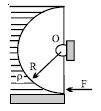
- 6A light semi cylindrical gate of radius $R$ is piovted at its mid point $O$, of the diameter as shown in the figure holding liquid of density $\rho $. The force $F$ required to prevent the rotation of the gate is equal toView Solution
- 7A small spherical ball of radius $0.1 \,mm$ and density $10^{4} \,kg m ^{-3}$ falls freely under gravity through a a distance $h$ before entering a tank of water. If after entering the water the velocity of ball does not change and it continue to fall with same constant velocity inside water, then the value of $h$ wil be $m$. (Given $g =10 \,ms ^{-2}$, viscosity of water $=1.0 \times 10^{-5} \,N - sm ^{-2}$ )View Solution
- 8View SolutionAs the temperature of water increases, its viscosity
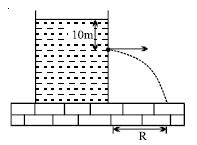
- 9A large tank is filled with water (density $=$ $10^3 $ $kg/m^3$).A small hole is made at a depth $10$ $m$ below water surface. The range of water issuing out of the hole is Ron ground. What extra pressure must be applied on the water surface so that the range becomes $2R $ (take $1$ $atm$ $=$ $10^5$ $Pa$ and $g$ $=$ $10$ $m/s^2):$ ...... $atm$View Solution
- 10Karman line is a theoretical construct that separates the earth's atmosphere from outer space. It is defined to be the height at which the lift on an aircraft flying at the speed of a polar satellite $(8 \,km / s )$ is equal to its weight. Taking a fighter aircraft of wing area $30 \,m ^2$, and mass $7500 \,kg$, the height of the Karman line above the ground will be in the range .............. $km$ (assume the density of air at height $h$ above ground to be $\rho( h )=1.2 e ^{\frac{ h }{10}} \,kg / m ^3$ where $h$ is in $km$ and the lift force to be $\frac{1}{2} \rho v^2 A$, where $v$ is the speed of the aircraft and $A$ its wing area).View Solution