MCQ
A block slides down a smooth inclined plane when released from the top, while another falls freely from the same point
  • A
    sliding block will reach the ground first with greater speed
  • B
    freely falling block will reach the ground first with greater speed
  • C
    both the blocks will reach the ground at the same time but with different speeds
  • both the blocks will reach the ground with same speed but the freely falling block first

Answer

Correct option: D.
both the blocks will reach the ground with same speed but the freely falling block first
d
In case of sliding motion on an inclined plane,

${\mathrm{h}=\mathrm{s}=\frac{1}{2} \mathrm{g} \sin \theta \mathrm{t}^{2}}$

${\text { or } \mathrm{t}=\mathrm{t_s}=\frac{1}{\sin \theta} \sqrt{\frac{2 \mathrm{h}}{\mathrm{g}}}}$

${\text { and } \mathrm{u}_{\mathrm{s}}=\sqrt{2 \mathrm{gh}}=\sqrt{2(\mathrm{g} \sin \theta) \mathrm{s}}}$

while in case of free fall,

$\mathrm{t}_{\mathrm{F}}=\sqrt{\frac{2 \mathrm{h}}{\mathrm{g}}}$ and $\mathrm{u}_{\mathrm{F}}=\sqrt{2 \mathrm{gh}}$

$\frac{\mathrm{t}_{\mathrm{F}}}{\mathrm{t}_{\mathrm{s}}}=\sin \theta<1 \mathrm{i.e.}, \mathrm{t}_{\mathrm{F}}<\mathrm{t}_{\mathrm{s}}$

i.e., falling body reaches the ground first.

Also $\quad \frac{\mathrm{u}_{\mathrm{F}}}{\mathrm{u}_{\mathrm{s}}}=1,$ i.e., $\mathrm{u}_{\mathrm{F}}=\mathrm{u}_{\mathrm{s}}$

i.e., both reach the ground with same speed (not velocity as for falling body direction is vertical while for sliding body along the plane downwards).
Need a full question paper?

Generate a complete, print-ready paper with questions like this in minutes — across 16+ boards, with answer keys.

Start Generating Free

Similar questions

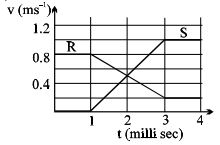
The diagram to the right shows the velocity-time graph for two masses $R$ and $S$ that collided elastically. Which of the following statements is true?

$(I)$ $R$ and $S$ moved in the same direction after the collision.

$(II)$ Kinetic energy of the system $(R$ & $S)$ is minimum at $t = 2$ milli sec.

$(III)$ The mass of $R$ was greater than mass of $S.$

If a source is transmitting electromagnetic wave of frequency $8.2 \times {10^6}Hz$, then wavelength of the electromagnetic waves transmitted from the source will be.....$m$
A particle of mass $m$ and charge $q$ is placed at rest in a uniform electric field $E$ and then released. The kinetic energy attained by the particle after moving a distance $y$ is
A person uses a lens of power $+ 3D $ to normalise vision. Near point of hypermetropic eye is.......$m$
A particle of mass $\mathrm{m}$ is dropped from a height $h$ above the ground. At the same time another particle of the same mass is thrown vertically upwards from the ground with a speed of $\sqrt{2 \mathrm{gh}} .$ If they collide head-on completely inelastically, the time taken for the combined mass to reach the ground, in units of $\sqrt{\frac{\mathrm{h}}{\mathrm{g}}}$ is
One end of a horizontal thick copper wire of length $2 L$ and radius $2 R$ is welded to an end of another horizontal thin copper wire of length $L$ and radius $R$. When the arrangement is stretched by a applying forces at two ends, the ratio of the elongation in the thin wire to that in the thick wire is :
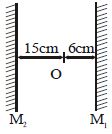
The position of $4^{th}$ image right to mirror $M_1$ is
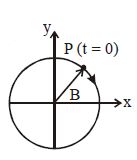
Figure shows the circular motion of a particle. The radius of the circle, the period, sense of revolution and the initial position are indicated on the figure. The simple harmonic motion of the $x-$ projection of the radius vector of the rotating particle $P$ is
The first line in the Lyman series has wavelength $\lambda$. The wavelength of the first line in Balmer series is
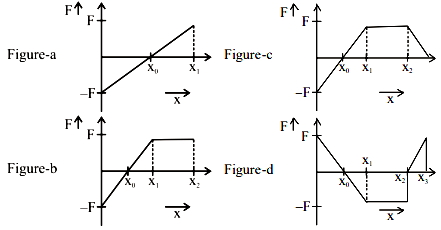
Arrange the four graphs in descending order of total work done; where $W _{1}, W _{2}, W _{3}$ and $W _{4}$ are the work done corresponding to figure $a , b , c$ and d respectively.