MCQ
A blue colouration is not obtained when
- AAmmonium hydroxide dissolves in copper sulphate
- ✓Copper sulphate solution reacts with ${K_4}[Fe{(CN)_6}]$
- CFerric chloride reacts with sodium ferrocyanide
- DAnhydrous $CuS{O_4}$ is dissolved in water
$4N{H_4}OH + CuS{O_4} \to \mathop {[Cu{{(N{H_3})}_4}]}\limits_{{\rm{Deep}}\,{\rm{blue}}} \,S{O_4} + 4{H_2}O$
$\mathop {CuS{O_4}}\limits_{{\rm{Anhydrous}}} + 5{H_2}O \to \mathop {CuS{O_4}}\limits_{{\rm{Blue}}} .5{H_2}O$
$4FeC{{l}_{3}}+3N{{a}_{4}}[Fe{{(CN)}_{6}}]\to \underset{\begin{smallmatrix}
\text{Ferric}\,\text{ferrocyanide} \\
\,\,\,\,\,\text{(Prussian}\,\text{blue)}
\end{smallmatrix}}{\mathop{F{{e}_{4}}[Fe{{(CN)}_{6}}]}}\,+12NaCl$
Generate a complete, print-ready paper with questions like this in minutes — across 16+ boards, with answer keys.
(image)
$[A]$ Attractive intermolecular interactions between $L-L$ in pure liquid $L$ and $M-M$ in pure liquid $M$ are stronger than those between $L-M$ when mixed in solution
$[B]$ The point $Z$ represents vapour pressure of pure liquid $M$ and Raoult's law is obeyed when $x_{L} \rightarrow 0$
$[C]$ The point $Z$ represents vapour pressure of pure liquid $L$ and Raoult's law is obeyed when $x_{\mathrm{L}} \rightarrow 1$
$[D]$ The point $Z$ represents vapour pressure of pure liquid $M$ and Raoult's law is obeyed from $x_{L}=0$ to $x_{L}=1$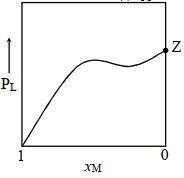


| List $I$ | List $II$ |
| Compound | Structure |
| $(A)$ $ClF_3$ | Square planar |
| $(B)$ $PCl_5$ | Tetrahedral |
| $(C)$ $IF_5$ | Trigonal bipyramidal |
| $(D)$ $CCl_4$ | Square pyramidal |
| $(E)$ $XeF_4$ | $T-$ shaped |
Codes
