A boat at anchor is rocked by waves whose crests are $100\, m$ apart and velocity is $25\, m/sec$. The boat bounces up once in every: ... $sec$
AIIMS 2006, Medium
Download our app for free and get started
Wavelength is distance between two crest.
$\lambda=100 \mathrm{m} ; \quad \mathrm{v}=25$
$\mathrm{n}=\frac{25}{100}$
$\mathrm{T}=\frac{1}{\mathrm{n}}=\frac{100}{25}=4 \mathrm{sec}$

Download our appand get started for free
Experience the future of education. Simply download our apps or reach out to us for more information. Let's shape the future of learning together!No signup needed.*
Similar Questions
- 1A wire of length $30\,cm$, stretched between rigid supports, has it's $n^{\text {th}}$ and $(n+1)^{\text {th}}$ harmonics at $400\,Hz$ and $450\; Hz$, respectively. If tension in the string is $2700\,N$, it's linear mass density is.........$kg/m$.View Solution
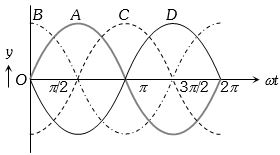
- 2The figure shows four progressive waves $A, B, C$ and $D $ with their phases expressed with respect to the wave $A$. It can be concluded from the figure thatView Solution
- 3View SolutionA closed organ pipe and an open organ pipe have their first overtones identical in frequency. Their length are in the ratio
- 4Speed of a transverse wave on a straight wire (mass $6.0\; \mathrm{g}$, length $60\; \mathrm{cm}$ and area of cross-section $1.0\; \mathrm{mm}^{2}$ ) is $90\; \mathrm{ms}^{-1} .$ If the Young's modulus of wire is $16 \times 10^{11}\; \mathrm{Nm}^{-2},$ the extension of wire over its natural length isView Solution
- 5Equation of a progressive wave is given by $y = 0.2\cos \pi \left( {0.04t + 0.02x - \frac{\pi }{6}} \right)$The distance is expressed in $cm$ and time in second. What will be the minimum distance between two particles having the phase difference of $\pi /2$ ...... $cm$View Solution
- 6Two wires are fixed in a sonometer. Their tensions are in the ratio $8 : 1$. The lengths are in the ratio $36:35.$ The diameters are in the ratio $4 : 1$. Densities of the materials are in the ratio $1 : 2$. If the lower frequency in the setting is $360 Hz.$ the beat frequency when the two wires are sounded together isView Solution
- 7A man stands in front of a hillock and fires a gun. He hears an echo after $1.5\, sec$. The distance of the hillock from the man is ...... $m$ (velocity of sound in air is $330\, m/s$)View Solution
- 8A closed organ pipe of length $1.2 \,\,m$ vibrates in its first overtone mode. The pressure variation is maximum at:View Solution
- 9A spherical source of power $4 W$ and frequency $800 Hz $ is emitting sound waves. The intensity of waves at a distance $200 m$ isView Solution
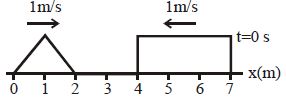
- 10Two pulses on a string approach each other at speeds of $1 m/s$. What is the shape of the string at $t = 3s$ :-View Solution