Question
A bob of mass m suspended by a light string of length L is whirled into a vertical circle as shown in what will be the trajectory of the particle if the string is cut at:
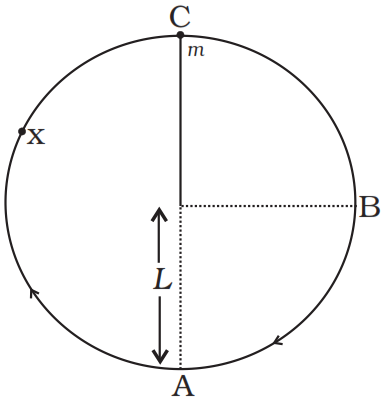
  1. Point B?
  2. Point C?P
  3. oint X?

Answer

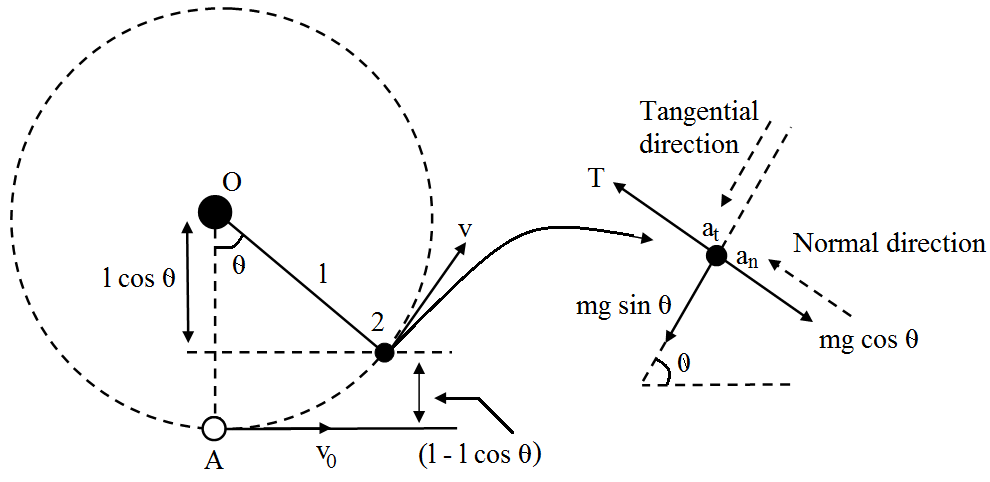
Key concept: According to the situation shown above that a bob of mass m is whirled into a vertical circle, the required centripetal force is obtained from the net force towards center at any point of time in the string. Tension in the string is variable and it is always towards center. But the gravitational force on the bob is always towards center. The speed of the body will be different at different points. So the equations of dynamical equilibrium $(F_c = ma_c, F_t = ma_t)$ must be satisfied at all the points. Let when the string makes an angle 9 with vertical, the speed of mass is v. Apply Newton’s law perpendicular to the string:$\text{Mg}\sin=\text{ma}$
$\Rightarrow\text{a}=\text{g}\sin$
The above equation gives tangential acceleration as a function of angle . At lowest point = 0° and at highest point = 180°. So at both points sin 9 = 0. Hence a, = 0 at both points L and H. At point M, = 90°, then $a_1 = g$. It is the maximum value of $a_t$ Apply Newton’s law along the string:$\text{T}-\text{mg}\cos=\text{ma}$
Or $\text{T}=\text{mg}\cos+\text{m}\frac{\text{v}^2}{\text{r}}\ ...(\text{i})$ As the body goes up, its velocity will go on decreasing and angle $\theta$ will go on increasing. Maximum speed of the body will be at lowest point L and minimum at highest point H. Then from above relation we can find that tension will be maximum at lowest point and minimum at highest point. Tension at lowest point $(\theta=0^\circ,\text{v}=\text{v}_\text{L})$$\text{T}_\text{L}=\text{mg}+\text{m}\frac{\text{v}^2_\text{L}}{\text{r}}\ ...(\text{ii})$
Tension at highest point $(\theta=180^\circ,\text{v}=\text{v}_\text{H})$$\text{T}_\text{H}=-\text{mg}+\text{m}\frac{\text{v}^2_\text{H}}{\text{r}}\ ...(\text{iii})$

When string is cut, tension in string becomes zero and centripetal force is not provided. Hence, bob tends to move in along the direction of its velocity.
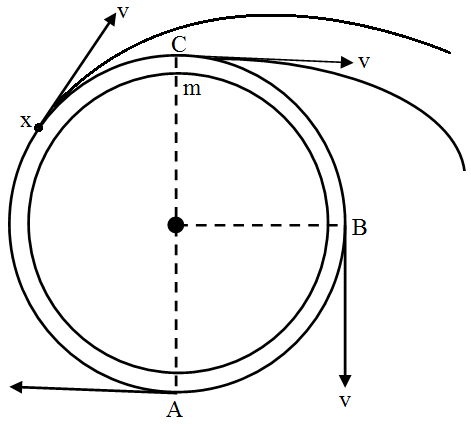
  1. If the string is cut at any point, then velocity of body of mass m is along the tangent to the circle. Tangent at point B is vertically downward so the trajectory of the particle is the straight line.
  2. Tangent at point C is horizontally towards right. So the trajectory of the particle is the parabola.
  3. Tangent at point X makes some angle with the horizontal. Again bob will follow a parabolic path with vertex higher than C.

Need a full question paper?

Generate a complete, print-ready paper with questions like this in minutes — across 16+ boards, with answer keys.
Start Generating Free

Similar questions

An object starts from rest and covers a total distance X in the following manner: It first has a uniform acceleration $a_1$ for some time $t_1$, moves with the speed acquired at the end of $t_1$ for some distance and is then given a uniform retardation $a_2$ so that it is again at rest at the end of the journey. Show that the journey is covered in least time if the body is accelerated for a time of $\Big[\frac{2\text{X a}_2}{\text{a}_1(\text{a}_1+\text{a}_2)}\Big]^{\frac{1}{2}}$ and this minimum time is $\Bigg[2\text{X}\Big(\frac{1}{\text{a}_1}+\frac{1}{\text{a}_2}\Big)\Bigg]^{\frac{1}{2}}.$
An electron and a proton are detected in a cosmic ray experiment, the first with kinetic energy 10keV, and the second with 100keV. Which is faster, the electron or the proton? Obtain the ratio of their speeds. (electron mass = $9.11 \times 10^{-31}kg$, proton mass = $1.67 \times 10^{-27}kg, 1eV = 1.60 \times 10^{-19}J$).
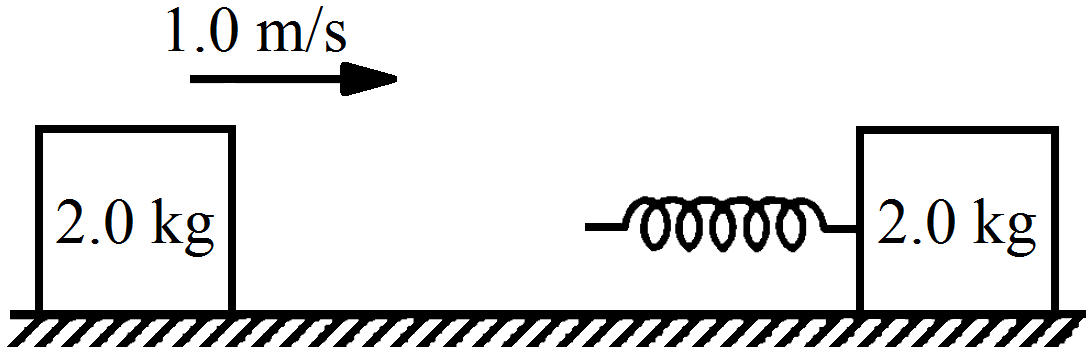
A block of mass 2.0kg is moving on a frictionless horizontal surface with a velocity of 1.0m/s towards another block of equal mass kept at rest. The spring constant of the spring fixed at one end is 100N/m. Find the maximum compression of the spring.
Find the time period of mass M when displaced from its equilibrium positon and then released for the system shown in figure.
Three bulbs, each with a resistance of $180\Omega,$ are connected in parallel to an ideal battery of emf 60V. Find the current delivered by the battery when.
(a) all the bulbs are switched on, (b) two of the bulbs are switched on and (c) only one bulb is switched on.
  1. Derive expression for kinetic energy and potential energies of simple harmonic oscillator. Hence show that the total energy is conserved.
  2. What is the length of a simple pendulum which ticks in one second?
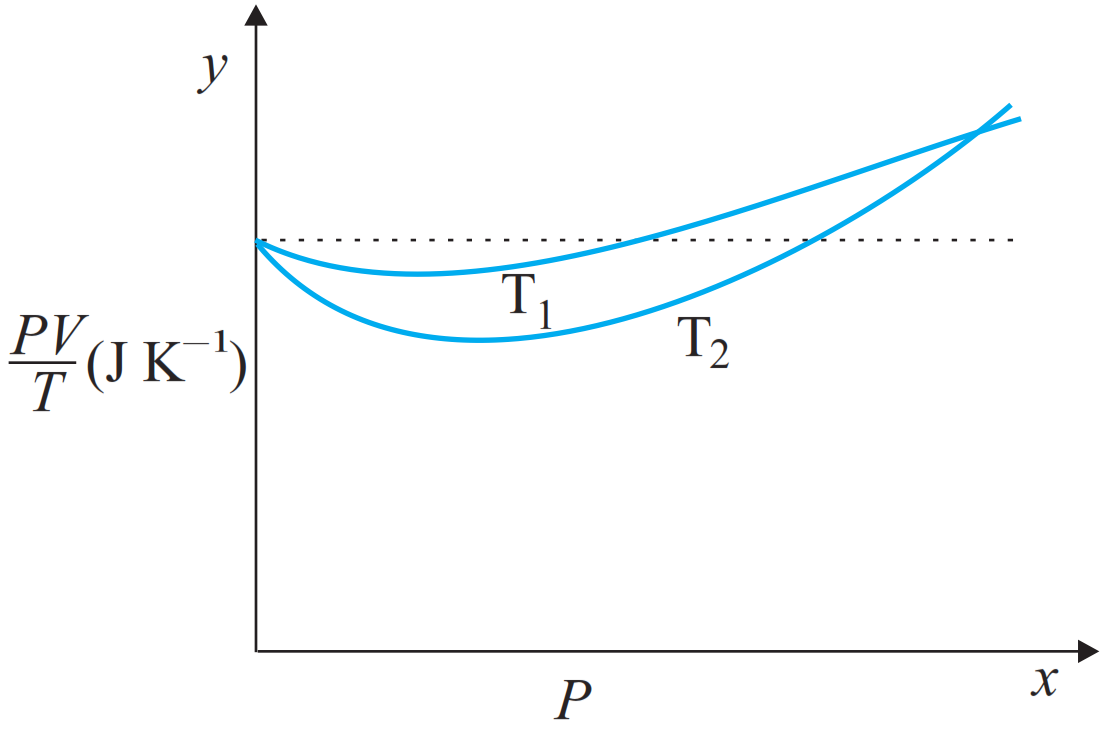
Shows plot of $\frac{\text{PV}}{\text{T}}$ versus P for $1.00 \times 10^{-3}kg$ of oxygen gas at two different temperatures: If we obtained similar plots for $1.00 \times 10^{-3}$kg of hydrogen, would we get the same value of $\frac{\text{PV}}{\text{T}}$ at the point where the curves meet on the y-axis? If not, what mass of hydrogen yields the same value of $\frac{\text{PV}}{\text{T}}$ (for low pressure high temperature region of the plot)? (Molecular mass of $H_2 = 2.02u, of O_2 = 32.0u, R = 8.31J mo1^{-1}K^{-1}$).
A stone of mass m tied to the end of a string revolves in a vertical circle of radius R. The net forces at the lowest and highest points of the circle directed vertically downwards are: [Choose the correct alternative]
 
Lowest Point
Highest Point
(a)
$mg - T_1$
$mg + T_2$
(b)
$mg + T_1$
$mg - T_2$
(c)
$mg + T_1 - (mv_1^2)/R$
$mg - T_2 + (mv_1^2)/R$
(d)
$mg - T_1 - (mv_1^2)/R$
$mg + T_2 + (mv_1^2)/R$
$T_1$ and $v_1$ denote the tension and speed at the lowest point. $T_2$ and $v_2$ denote corresponding values at the highest point.
Consider the arrangement shown in figure. By some mechanism, the separation between the slits $S_3$ and $S_4$​​​​​​​ can be changed. The intensity is measured at the point P which is at the common perpendicular bisector
of $S_1S_2​​​​​​​$​​​​​​​ and $S_3S_4​​​​​​​$​​​​​​​. When $\text{z}=\frac{\text{D}\lambda}{2\text{d}},$ intensity measured at P is I. Find this intensity when z is equal to:
  1. $\frac{\text{D}\lambda}{\text{d}}$
  2. $\frac{3\text{D}\lambda}{2\text{d}}$
  3. $\frac{2\text{D}\lambda}{\text{d}}$
A famous relation in physics relates ‘moving mass’ m to the ‘rest mass’ mo of a particle in terms of its speed v and the speed of light, c. (This relation first arose as a consequence of special relativity due to Albert Einstein). A boy recalls the relation almost correctly but forgets where to put the constant c. He writes:$\text{m}=\frac{\text{m}_0}{(1-\text{v}^2)^{1/2}}.$
Guess where to put the missing c.