MCQ
A body is executing Simple Harmonic Motion. At a displacement $x$ its potential energy is ${E_1}$ and at a displacement y its potential energy is ${E_2}$. The potential energy $E$ at displacement $(x + y)$ is
  • A
    $\sqrt E = \sqrt {{E_1}} - \sqrt {{E_2}} $
  • $\sqrt E = \sqrt {{E_1}} + \sqrt {{E_2}} $
  • C
    $E = {E_1} - {E_2}$
  • D
    $E = {E_1} + {E_2}$

Answer

Correct option: B.
$\sqrt E = \sqrt {{E_1}} + \sqrt {{E_2}} $
b
(b) ${E_1} = \frac{1}{2}K{x^2}$

$\Rightarrow x = \sqrt {\frac{{2{E_1}}}{K}} $, 

${E_2} = \frac{1}{2}K{y^2}$

$\Rightarrow y = \sqrt {\frac{{2{E_2}}}{K}} $ and 

$E = \frac{1}{2}K{(x + y)^2} $

$\Rightarrow x + y = \sqrt {\frac{{2E}}{K}} $ 

$ \Rightarrow \sqrt {\frac{{2{E_1}}}{K}} + \sqrt {\frac{{2{E_2}}}{K}} = \sqrt {\frac{{2E}}{K}} $

$ \Rightarrow \sqrt {{E_1}} + \sqrt {{E_2}} = \sqrt E $

Need a full question paper?

Generate a complete, print-ready paper with questions like this in minutes — across 16+ boards, with answer keys.

Start Generating Free

Similar questions

A charge $Q$ is moving $\overrightarrow{dl}$ distance in the magnetic field $\overrightarrow{ B }$. Find the value of work done by $\overrightarrow{ B }$.
The change in a vector may occur due to .....
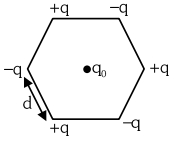
Six charges $+ q ,- q ,+ q ,- q ,+ q$ and $- q$ are fixed at the corners of a hexagon of side $d$ as shown in the figure. The work done in bringing a charge $q _0$ to the centre of the hexagon from infinity is :$\left(\varepsilon_0-\right.$ permittivity of free space)
A hollow metal sphere of radius $5\, cm$ is charged so that the potential on its surface is $10\, V$. The potential at the centre of the sphere is
A body of mass $M$ tied to a string is lowered at a constant acceleration of $(g/4)$ through a vertical distance $h$. The work done by the string will be..............
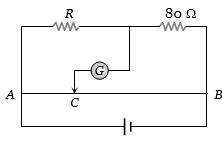
$AB$ is a wire of uniform resistance. The galvanometer $G$ shows no current when the length $AC = 20\,cm$ and $CB = 80\, cm$. The resistance $R$ is equal to .............. $\Omega $
The gravitational potential at a point above the surface of earth is $-5.12 \times 10^7 J / kg$ and the acceleration due to gravity at that point is $6.4 m / s ^2$ Assume that the mean radius of earth to be 6400 km. The height of this point above the earth’s surface is :
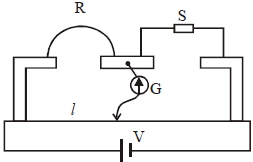
In a meter bridge experiment $\mathrm{S}$ is a standard resistance. $\mathrm{R}$ is a resistance wire. It is found that balancing length is $l=25 \;\mathrm{cm} .$ If $\mathrm{R}$ is replaced by a wire of half length and half diameter that of $\mathrm{R}$ of same material, then the balancing distance $\left.l^{\prime} \text { (in } \mathrm{cm}\right)$ will now be
A particle undergoes uniform circular motion. About which point in the plane of the circle, will the angular momentum of the particle remain conserved?
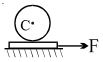
In the following problems, indicate the correct direction of friction force acting on the cylinder, which is pulled on a rough surface by a constant force $F$. $A$ cylinder is placed on a rough plank which in turn is placed on a smooth surface. The plank is pulled with a constant force $F$. The friction force can be given by which of the following diagrams