MCQ
A body is executing simple harmonic motion with an angular frequency $2\,rad/s$. The velocity of the body at $20\, mm$ displacement, when the amplitude of motion is $60\, mm$, is ...... $mm/s$
  • A
    $40$
  • B
    $60$
  • $113$
  • D
    $120$

Answer

Correct option: C.
$113$
c
(c) $v = \omega \sqrt {({a^2} - {y^2})} = 2\sqrt {{{60}^2} - {{20}^2}}  = 113\,mm/s$.

Need a full question paper?

Generate a complete, print-ready paper with questions like this in minutes — across 16+ boards, with answer keys.
Start Generating Free

Similar questions

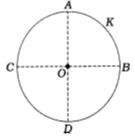
A thin conducting ring of radius $R$ is given a charge $+Q.$ The electric field at the centre $O$ of the ring due to the charge on the part $AKB$ of the ring is $E.$ The electric field at the centre due to the charge on the part $ACDB$ of the ring is 
Source of Sun's energy is
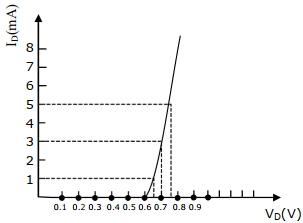
For the forward biased diode characteristics shown in the figure, the dynamic resistance at ${I}_{{D}}=3 \,{mA}$ will be $.....\,\Omega$
The acceleration of a moving body can be found from
A nucleus $^A _Z X$ has mass represented by $M(A,Z)$ . If $M_p$ and $M_n$ denote the mass of proton and neutron respectively and $B.E$ the binding energy in $Mev$ then
$A$ wall has two layers $A$ and $B$ made of different materials. The thickness of both the layers is the same. The thermal conductivity of $A$ and $B$ are $K_A$ and $K_B$ such that $K_A = 3K_B$. The temperature across the wall is $20°C$ . In thermal equilibrium
Given below are two statements

Statement $-I$ : A point charge is brought in an electric field. The value of electric field at a point near to the charge may increase if the charge is positive.

Statement $-II$ : An electric dipole is placed in a non-uniform electric field. The net electric force on the dipole will not be zero.

Choose the correct answer from the options given below 
If a man at the equator would weigh $(3/5)^{th}$ of his weight, the angular speed of the earth is
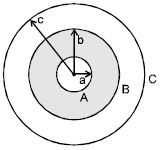
$A$ and $C$ are concentric conducting spherical shells of radius $a$ and $c$ respectively. $A$ is surrounded by a concentric dielectric of inner radius $a$, outer radius $b$ and dielectric constant $k$. If sphere $A$ is given a charge $Q$, the potential at the outer surface of the dielectric is.
The electromagnetic waves do not transport