MCQ
A body is initially at rest. It undergoes one-dimensional motion with constant acceleration. The power delivered to it at time t is proportional to:
  • A
    $\text{t}^{\frac{1}{2}}$
  • B
    $\text{t}$
  • C
    $\text{t}^\frac{3}{2}$
  • D
    $\text{t}^2$

Answer

  1. t.

Solution:

From,

V = u + at

V = 0 + at = at

As power, P = F × V

$\therefore$ P = (ma) × at = ma2t

As m and a are constants, therefore, $\text{P}\propto\text{t}$

Hence, right choice is (ii) t.

Need a full question paper?

Generate a complete, print-ready paper with questions like this in minutes — across 16+ boards, with answer keys.
Start Generating Free

Similar questions

The thickness of a metallic plate is $0.4 cm$ . The temperature between its two surfaces is ${20^o}C$. The quantity of heat flowing per second is $50$ calories from $5c{m^2}$ area. In $CGS$ system, the coefficient of thermal conductivity will be
The dimension of $\frac{1}{{\sqrt {{\varepsilon _0}{\mu _0}} }}$ is that of
Which one of the following plots represents the variation of gravitational field on a particle with distance $r$ due to a thin spherical sheel of radius $R$ ? ($r$ is measured from the centre of the spherical shell )
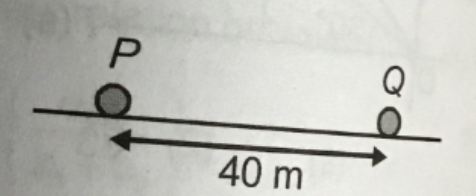
Two particle P and Q are initially 40m apart P behind Q. Particle P starts moving with a uniform velocity 10m/ s towards Q. Particle Q starting from rest has an acceleration 2ms2 in the direction of velocity of P. Then the minimum distance between P and Q will be:

If vibrations of a string are to be increased by a factor of two, then tension in the string must be made
The speed of a transverse wave passing through a string of length $50 \;cm$ and mass $10\,g$ is $60\,ms ^{-1}$. The area of cross-section of the wire is $2.0\,mm ^{2}$ and its Young's modulus is $1.2 \times 10^{11}\,Nm ^{-2}$. The extension of the wire over its natural length due to its tension will be $x \times 10^{-5}\; m$. The value of $x$ is $...$
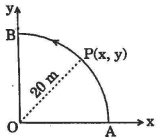
A point $P$ moves in counter-clockwise direction on a circular path as shown in the figure. The movement of '$P$' is such that it sweeps out a length  $s = t^3+5$, where s is in metres and $t$ is in seconds. The radius of the path is $20\ m$. The acceleration of '$P$' when $t = 2\ s$ is nearly ..........  $m/s^2$
What is the velocity of wave in monoatomic gas having pressure $1$ kilopascal and density $2.6\,kg/{m^3}$
Angular momentum of a single particle moving with constant speed along circular path:
A solid at temperature T1 is kept in an evacuated chamber at temperature $\text{T}_2>\text{T}1.$ The rate of increase of temperature of the body is proportional to:

  1. $\text{T}_2-\text{T}_1$

  2. $\text{T}_2^2-\text{T}_1^2$

  3. $\text{T}_2^3-\text{T}_1^3$

  4. $\text{T}_2^4-\text{T}_1^4$