MCQ
A body is moving along a rough horizontal surface with an initial velocity $6\,\,m/s.$ If the body comes to rest after travelling $9\, m$, then the coefficient of sliding friction will be
  • A
    $0.4$
  • $0.2$
  • C
    $0.6$
  • D
    $0.8$

Answer

Correct option: B.
$0.2$
b
(b) We know $s = \frac{{{u^2}}}{{2\mu \;g}}$

$\therefore \mu = \frac{{{u^2}}}{{2gs}} = \frac{{{{(6)}^2}}}{{2 \times 10 \times 9}} = 0.2$

Need a full question paper?

Generate a complete, print-ready paper with questions like this in minutes — across 16+ boards, with answer keys.
Start Generating Free

Similar questions

The escape velocity for a body of mass $1\, kg$ from the earth surface is $11.2\,\,km{s^{ - 1}}.$ The escape velocity for a body of mass $100\, kg$ would be
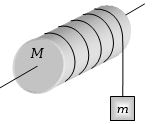
A mass $M$ is supported by a mass less string would wound a uniform cylinder of mass $M$ and radius $R$. On releasing the mass from rest, it will fall with acceleration
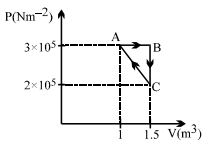
Considere the thermodynamics cycle shown on $PV$ diagram. The process $A \rightarrow B$ is isobaric, $B \rightarrow C$ is isochoric and $C \rightarrow A$ is a straight line process. The following internal energy and heat are given $: \Delta U_{A \rightarrow B} = + 400\,\, kJ$ and $Q_{B \rightarrow C} = - 500\,\, kJ$ The heat flow in the process $Q_{C \rightarrow A}$ is  ...... $kJ$
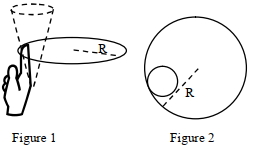
One twirls a circular ring (of mass $M$ and radius $R$ ) near the tip of one's finger as shown in Figure $1$ . In the process the finger never loses contact with the inner rim of the ring. The finger traces out the surface of a cone, shown by the dotted line. The radius of the path traced out by the point where the ring and the finger is in contact is $\mathrm{r}$. The finger rotates with an angular velocity $\omega_0$. The rotating ring rolls without slipping on the outside of a smaller circle described by the point where the ring and the finger is in contact (Figure $2$). The coefficient of friction between the ring and the finger is $\mu$ and the acceleration due to gravity is $g$.

(IMAGE)

($1$) The total kinetic energy of the ring is

$[A]$ $\mathrm{M} \omega_0^2 \mathrm{R}^2$   $[B]$ $\frac{1}{2} \mathrm{M} \omega_0^2(\mathrm{R}-\mathrm{r})^2$   $[C]$ $\mathrm{M \omega}_0^2(\mathrm{R}-\mathrm{r})^2$   $[D]$ $\frac{3}{2} \mathrm{M} \omega_0^2(\mathrm{R}-\mathrm{r})^2$

($2$) The minimum value of $\omega_0$ below which the ring will drop down is

$[A]$ $\sqrt{\frac{g}{\mu(R-r)}}$  $[B]$ $\sqrt{\frac{2 g}{\mu(R-r)}}$  $[C]$ $\sqrt{\frac{3 g}{2 \mu(R-r)}}$    $[D]$ $\sqrt{\frac{g}{2 \mu(R-r)}}$

Givin the answer quetion ($1$) and ($2$)
A force vector applied on a mass is represented as $\vec F = 6\hat i - 8\hat j + 10\hat k$ and accelerates with $1\,m/{s^2}$. What will be the mass of the body
A cracker rocket is ejecting gases at a rate of $0.05 \,kg / s$ with a velocity $400 \,m / s$. The accelerating force on the rocket is
A wave on a string is travelling and the displacement of particles on it is given by $x = A\, sin\, (2t -0.1\, x)$. Then the wavelength of the wave is
A gas at initial temperature $T$ undergoes sudden expansion from volume $V$ to $2 \,V$. Then,
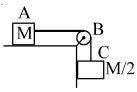
A block of mass $M$ on a horizontal smooth surface is pulled by a load of mass $M/2$ by means of a rope $AB$ and string $BC$ as shown in the figure. The length & mass of the rope $AB$ are $L$ and $M/2$ respectively. As the block is pulled from $AB = L$ to $AB = 0$ its acceleration changes from $3g$
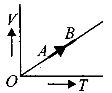
The volume $( V)$ of a monatomic gas varies with its temperature $(T)$ , as shown in the graph. The ratio of work done by the gas , to the heat absorbed by it, when it undergoes a change from state $A$ to state $B$ , is