MCQ
A body is moving forwards and backward. Change in frequency observed of source is 2%. What is velocity of the body? (Speed of sound is 300 m/s)
  • A
    3 m/s
  • B
    2.5 m/s
  • C
    2 m/s
  • D
    6 m/s

Answer

$3 m / s$
Explanation: When the source is moving forward towards the observer, the apparent frequency is $f_1=\frac{v}{v-v_{ s }} \times f$
When source moves backwards $f_2=\frac{v}{v+v_s} \times f$
$
f_2-f_1=f v\left[\frac{1}{v+v_s}-\frac{1}{v-v_s}\right]=f v\left[\frac{-2 v_s}{v^2-v_s^2}\right]
$
As $v_{ s }<< v$, so
$
\begin{aligned}
& \frac{f_2-f_1}{f}=\left|\frac{2 v_s}{v}\right|=\frac{2}{100} \\
& v_s=\frac{v}{100}=\frac{300}{100}=3 m / s
\end{aligned}
$

Need a full question paper?

Generate a complete, print-ready paper with questions like this in minutes — across 16+ boards, with answer keys.

Start Generating Free

Similar questions

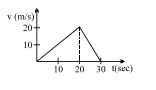
$v-t$ graph of an object of mass $1\,\, kg$ is shown
The circular scale of a micrometer has $200$ divisions and pitch of $2\,mm$ . Find the measured value of thickness of a thin sheet .......... $mm$
A travelling harmonic wave is represented by the equation $y(x, t) = 10^{-3}\,sin\,(50t + 2x)$, where $x$ and $y$ are in meter and $t$ is in seconds. Which of the following is a correct statement about the wave?
In a thermally isolated system, two boxes filled with an ideal gas are connected by a valve. When the valve is in closed position, states of the box $1$ and $2$ respectively, are ( $1 \,atm , V, T)$ and $(0.5 \,atm , 4 V, T)$. When the valve is opened, then the final pressure of the system is approximately ............... $atm$
Join details of Column$-II$ with given information in Column$-I$ appropriately

Column $-I$  Column $-II$ 

$(a)$ Stress is proportional to strain.

$(i)$ Elastic limit
$(b)$ When the load of the wire is removed, the body does regain its original dimension. $(ii)$ Limit of pro-portionality
  $(iii)$ Plastic deformation
A vibratory motion is represented by $x = 2\,A\,\cos \,\omega t + A\,\cos \,\left( {\omega t + \frac{\pi }{2}} \right) + A\,\cos \,\left( {\omega t + \pi } \right) + \frac{A}{2}\,\cos \,\left( {\omega t + \frac{{3\pi }}{2}} \right)$ The resultant amplitude of motion is
The workdone by a gas molecule in an isolated system is given by, $W =\alpha \beta^{2} e ^{-\frac{ x ^{2}}{\alpha kT }},$ where $x$ is the displacement, $k$ is the Boltzmann constant and $T$ is the temperature, $\alpha$ and $\beta$ are constants. Then the dimension of $\beta$ will be
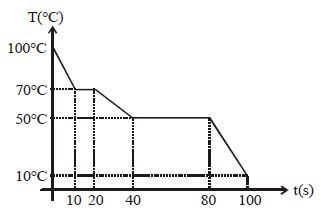
A substance is cooled at a constant power. Its temperature vs time graph is shown. The value of $S_{solid} : S_{liquid} : S_{gas}$
A  refrigerator works between $4^o C$ and $30^o C.$  It is required to remove $600$ calories of heat every second in order to keep the temperature of the refrigerated space constant. The power required is ....... $W$ (Take $1\, cal \,=\, 4.2\, Joules\,)$ 
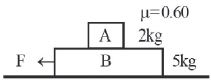
Two block $(A)\,2\,kg$ and $(B)\,5\,kg$ rest one over the other on a smooth horizontal plane. The cofficient of static and dynamic friction between $(A)$ and $(B)$ is the same and equal to $0.60$. The maximum horizontal force that can be applied to $(B)$ in order that both $(A)$ and $(B)$ do not have any relative motion : $(g = 10\,m/s^2)$