A body is moving in a room with a velocity of $20\, m / s$ perpendicular to the two walls separated by $5$ meters. There is no friction and the collisions with the walls are elastic. The motion of the body is
Easy
Download our app for free and get started
(b) Body collides elastically with walls of room. So, there will be no loss in its energy and it will remain colliding with walls of room, so it’s motion will be periodic.
There is no change in energy of the body, hence there is no acceleration, so it’s motion is not $SHM.$
There is no change in energy of the body, hence there is no acceleration, so it’s motion is not $SHM.$

Download our appand get started for free
Experience the future of education. Simply download our apps or reach out to us for more information. Let's shape the future of learning together!No signup needed.*
Similar Questions
- 1The displacement of a damped harmonic oscillator is given by $x\left( t \right) = {e^{ - 0.1\,t}}\,\cos \left( {10\pi t + \varphi } \right)$ The time taken for its amplitude of vibration to drop to half of its initial value is close to .... $s$View Solution
- 2Two $SHM$ are represented by equations, $y_1 = 6\cos \left( {6\pi t + \frac{\pi }{6}} \right)\,,{y_2} = 3\left( {\sqrt 3 \sin 3\pi t + \cos 3\pi t} \right)$View Solution
- 3A man is swinging on a swing made of $2$ ropes of equal length $L$ and in direction perpendicular to the plane of paper. The time period of the small oscillations about the mean position isView Solution

- 4Three simple harmonic motions of equal amplitudes $A$ and equal time periods in the same direction combine. The phase of the second motion is $60^o$ ahead of the first and the phase of the third motion is $60^o$ ahead of the second. Find the amplitude of the resultant motionView Solution
- 5Kinetic energy of a particle executing simple harmonic motion in straight line is $pv^2$ and potential energy is $qx^2$, where $v$ is speed at distance $x$ from the mean position. It time period is given by the expressionView Solution
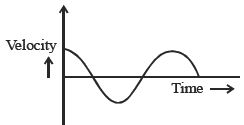
- 6View SolutionThe graph in figure represents
- 7A uniform disc of mass $M$ and radius $R$ is suspended in vertical plane from a point on its periphery. Its time period of oscillation is ........View Solution
- 8The displacement $x$ (in metres) of a particle performing simple harmonic motion is related to time $t$ (in seconds) as $x = 0.05\cos \left( {4\,\pi \,t + \frac{\pi }{4}} \right)$. The frequency of the motion will be ..... $Hz$View Solution
- 9If a spring extends by $x$ on loading, then energy stored by the spring is (if $T$ is the tension in the spring and $K$ is the spring constant)View Solution
- 10If a particle under S.H.M. has time period 0.1 sec and amplitude $2 \times 10^{-3}$. It has maximum velocityView Solution