MCQ
A body is positively charged, it implies that:
  • A
    There is only positive charge in the body.
  • There is positive as well as negative charge in the body, but the positive charge is more than negative charge.
  • C
    There is equal positive and negative charge in the body, but the positive charge lies in the outer regions.
  • D
    Negative charge is displaced from its position.
Answer

Correct option: B.
There is positive as well as negative charge in the body, but the positive charge is more than negative charge.

Need a full question paper?

Generate a complete, print-ready paper with questions like this in minutes — across 16+ boards, with answer keys.

Start Generating Free

Similar questions

The radius of two metallic spheres A and B are $r_1$ and $r_2$ respectively $\left(r_1>r_2\right)$. They are connected by a thin wire and the system is given a certain charge. The charge will be greater
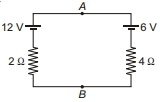
Potential difference across $A B$ i.e., $V_A-V_B$ is ......... $V$
A copper ball of radius $1\, cm$ and work function $4.47\,eV$ is irradiated with ultraviolet radiation of wavelength $2500\mathop A\limits^o $. The effect of irradiation results in the emission of electrons from the ball. Further the ball will acquire charge and due to this there will be a finite value of the potential on the ball. The charge acquired by the ball is
Assertion : In Hertz experiment, the electric vector of radiation produced by the source gap is parallel to the gap.
Reason : Production of sparks between the detector gap is maximum when it is placed perpendicular to the source gap.
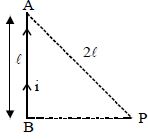
The magnetic field at point, point $P$ will be :-
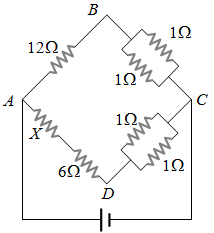
For what value of unknown resistance X, the potential difference between B and D will be zero in the circuit shown in the figure
Two coherent sources of intensity ratio $1 : 4$ produce an interference pattern. The fringe visibility will be
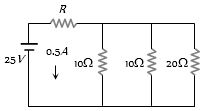
In the circuit as shown in figure the
A magnetic needle suspended horizontally by an unspun silk fibre, oscillates in the horizontal plane because of the restoring force originating mainly from
The refractive index ofa glass is $1.520$ for red light and $1.525$ for blue light. Let $D_1$ and $D_2$ be angles of minimum deviation for red and blue light respectively in a prism of this glass. Then,