MCQ
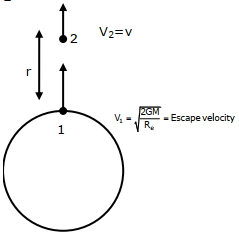
A body is projected vertically upwards from the surface of earth with a velocity sufficient enough to carry it to infinity. The time taken by it to reach height $h$ is $....\,S.$
  • $\frac{1}{3} \sqrt{\frac{2 R_{e}}{g}}\left[\left(1+\frac{h}{R_{e}}\right)^{3 / 2}-1\right]$
  • B
    $\sqrt{\frac{2 R_{e}}{g}}\left[\left(1+\frac{h}{R_{e}}\right)^{3 / 2}-1\right]$
  • C
    $\frac{1}{3} \sqrt{\frac{R_{e}}{g}}\left[\left(1+\frac{h}{R_{e}}\right)^{3 / 2}-1\right]$
  • D
    $\sqrt{\frac{R_{e}}{g}}\left[\left(1+\frac{h}{R_{e}}\right)^{3 / 2}-1\right]$

Answer

Correct option: A.
$\frac{1}{3} \sqrt{\frac{2 R_{e}}{g}}\left[\left(1+\frac{h}{R_{e}}\right)^{3 / 2}-1\right]$
a
Applying energy conservation from $(1)$ to $(2)$

$\frac{1}{2} m_{.}\left(\frac{2 G M}{R_{e}}\right)-\frac{G M m}{R_{e}}=\frac{1}{2} m v^{2}-\frac{G M m}{R+r}$

$\Rightarrow \frac{1}{2} m v^{2}=\frac{G M m}{R+r}$

$\Rightarrow v=\sqrt{\frac{2 G M}{R+r}}=\frac{d r}{d t}$

$\Rightarrow \sqrt{2 G M} \int_{0}^{t} d t=\int_{R_{e}}^{R_{e}+h}(\sqrt{R+r}) d r$

$\sqrt{2 G M} \cdot t=\frac{2}{3}\left[(R+r)^{3 / 2}\right]_{R_{e}}^{R_{e}+h}$

$t=\frac{2}{3} \sqrt{\frac{R_{e}^{3}}{2 G M}}\left[\left(1+\frac{h}{R_{e}}\right)^{3 / 2}-1\right]$

$\frac{G M}{R_{e}^{2}}=g$

$t=\frac{1}{3} \sqrt{\frac{2 R_{e}}{g}}\left[\left(1+\frac{h}{R_{e}}\right)^{3 / 2}-1\right]$

Need a full question paper?

Generate a complete, print-ready paper with questions like this in minutes — across 16+ boards, with answer keys.

Start Generating Free

Similar questions

A given object takes $n$ times the time to slide down $45^{\circ}$ rough inclined plane as it takes the time to slide down an identical perfectly smooth $45^{\circ}$ inclined plane. The coefficient of kinetic friction between the object and the surface of inclined plane is :
An $AC$ source producing emf $\in=\in_{0}\Big[\cos\big(100\pi\text{s}^{-1}\big)\text{t}+\cos\big(500\pi\text{s}^{-1}\big)\text{t}\Big]$ is connected in series with a capacitor and a resistor. The steady$-$state current in the circuit is found to be $\text{i}=\text{i}_1\cos\Big[\big(100\pi\text{s}^{-1}\big)\text{t}+\phi_1\Big]+\text{i}_2\cos\Big[\big(500\pi\text{s}^{-1}\big)\text{t}+\phi_2\Big].$
A truck of mass $10,000\, kg$ moves up an inclined plane rising $1$ in $50$ with a speed of $36\, km/h$. Find the power of engine .................. $\mathrm{kW}$  $(g = 10\, m/s^2$)
If the kinetic energy of two objects is equal and the ratio of their masses is $1: 2$ then the ratio of their linear moment will be :
Two bodies are thrown up at angles of $45^o $ and $60^o $, respectively, with the horizontal. If both bodies attain same vertical height, then the ratio of velocities with which these are thrown is
A boy carries a fish in one hand and a bucket(not full) of water in the other hand . If he places the fish in the bucket , the weight now carried by him (assume that water does not spill) :
In the Young’s experiment, If length of wire and radius both are doubled then the value of $Y$ will become
A ball is thrown upwards with a velocity of $25\ m/s.$ What is the time taken by the ball to return to the thrower $(g = 10\ m/s^2)$
An aeroplane flying at a constant velocity releases a bomb.As the bomb drops down from the aeroplane,
In the musical octave ‘Sa’, ‘Re’, ‘Ga’