Question
A body is projected with velocity $u$ at an angle $\theta_0$ upward from horizontal. Deduce the expression for :
  1. Horizontal range.
  2. Maximum height attained.

Answer

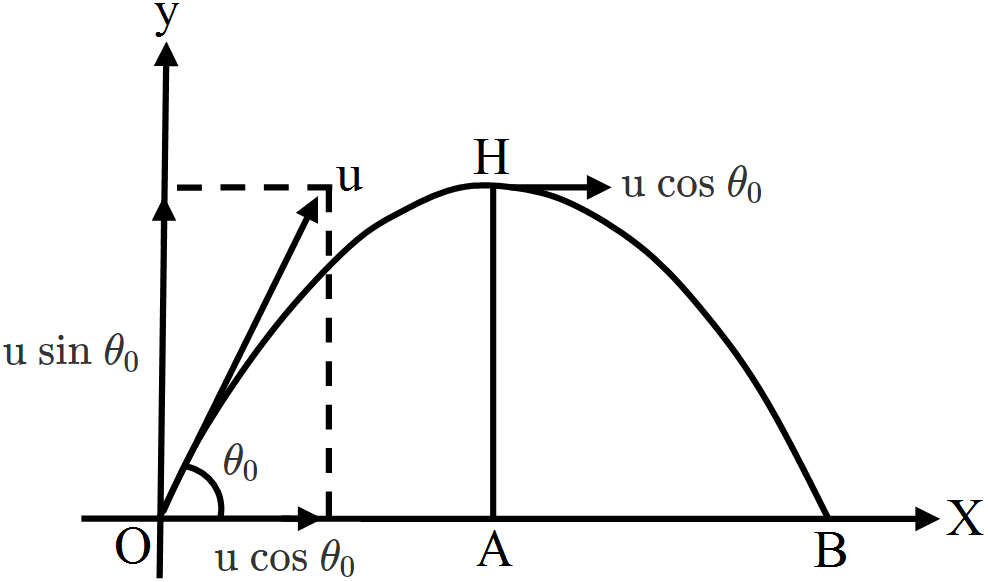
Consider a body is projected with velocity $u$ at an angle $\theta_0.$ The horizontal and vertical components initially with velocity are $\text{u}\cos\theta_0$ and $\text{u}\sin\theta_0$ respectively.
  1. Horizontal range: It is the horizontal distance covered by the body between its point of projection and the point of hitting the ground, when both points are on same horizontal plane. It is denoted by $R$.
$\therefore\ \text{R}=\text{u}\cos\theta_0\times$ Total time of flight $(T)$
$=\text{u}\cos\theta_0\times\frac{2\text{u}\sin\theta_0}{\text{g}}$
$=\frac{\text{u}^2}{\text{g}}2\sin\theta_0\cos\theta_0$
$=\frac{\text{u}^2}{\text{g}}\sin2\theta_0$
$\text{R}=\frac{\text{u}^2\sin2\theta_0}{\text{g}}$
  1. Maximum height : Maximum height ($h_{max}$) is the maximum vertical height attained by the body above the point of projection during its flight.
Here, $AH$ is referred as the maximum height attained against gravity. At highest point vertical component of velocity become zero.
Using, $v^2 = u^2 + 2as$, we have
$0=\text{u}^2\sin^2\theta_0-2\text{gh}_\text{max}$
$\Rightarrow\ \text{h}_\text{max}=\frac{\text{u}^2\sin^2\theta_0}{2\text{g}}$

Need a full question paper?

Generate a complete, print-ready paper with questions like this in minutes — across 16+ boards, with answer keys.
Start Generating Free

Similar questions

A coil of inductance $5.0\ mH$ and negligible resistance is connected to the oscillator of the previous problem. Find the peak currents in the circuit for $\omega=100\text{s}^{-1},500\text{s}^{-1},1000\text{s}^{-1}.$
A car start from rest and accelerates to attains a velocity of $30 m / s$ in 12 sec . Then find (i) acceleration of that car, (ii) total distance covered, (iii) velocity after 7 sec
Find the angle between force $\vec{\text{F}}=(3\vec{\text{i}}+4\vec{\text{j}}-5\vec{\text{k}})$ unit and displacement $\vec{\text{d}}=(5\vec{\text{i}}+4\vec{\text{j}}+3\vec{\text{k}})$ unit. Also find the projection of $\vec{\text{F}}$ on $\vec{\text{d}}.$
Define thermal conduction. Briefly explain its molecular mechanism.
Though the statement quoted above may be disputed, most physicists do have a feeling that the great laws of physics are at once simple and beautiful. Some of the notable physicists, besides Dirac, who have articulated this feeling, are: Einstein, Bohr, Heisenberg, Chandrasekhar and Feynman. You are urged to make special efforts to get access to the general books and writings by these and other great masters of physics. (See the Bibliography at the end of this book.) Their writings are truly inspiring!
Can any of the rectangular components of a given vector have magnitude greater than the vector itself? Explain.
A motor car is travelling at $30m/ s$ on a circular road of radius $500m$. It is increasing its speed at the rate of $2ms^2$. What is the acceleration?
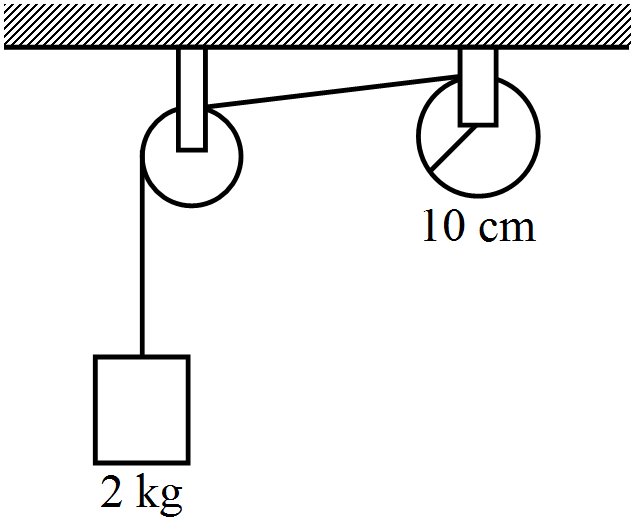
A string is wrapped on a wheel of moment of inertia $0.20kg-m^2$ and radius 10cm and goes through a light pulley to support a block of mass $2.0kg$ as shown in figure. Find the acceleration of the block.
For a glass prism of refracting angle 60°, the minimum angle of deviation $D_m$ is found to be 36° with a maximum error of 1.05°. When a beam of parallel light is incident on the prism, find the range of experimental value of refractive index $'μ'.$ It is known that the refractive index $'μ'$ of the material of the prism is given by: $\mu=\frac{\sin\Big(\frac{\text{A}+\text{D}_\text{m}}{2}\Big)}{\sin\frac{\text{A}}{2}}$
A vessel contains water upto a height of 20cm and above it an oil upto another 20cm. The refractive indices of the water and the oil are 1.33 and 1.30 respectively. Find the apparent depth of the vessel when viewed from above.