MCQ
A body is projected with velocity $u$ making an angle $\alpha$ with the horizontal. Its velocity when it is perpendicular to the initial velocity vector $u$ is
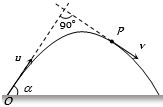
  • A
    $u \,tan\alpha$
  • $u\, cot\alpha$
  • C
    $u\, cosec\alpha$
  • D
    $u \,sec\alpha$

Answer

Correct option: B.
$u\, cot\alpha$
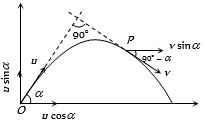
b
$'O' = u\cos \alpha $

$'P' = v\sin \alpha $

$v\sin \alpha = u\cos \alpha $

$\Rightarrow \,v = u\cot \alpha $
Need a full question paper?

Generate a complete, print-ready paper with questions like this in minutes — across 16+ boards, with answer keys.
Start Generating Free

Similar questions

The trajectory of a projectile near the surface of the earth is given as $ y = 2x -9x^2$. If it were launched at an angle $\theta_0$ with speed $v_0$ then $(g = 10\, ms^{-2})$
Half life of radioactive element is $12.5\; Hour$ and its quantity is $256\; gm$. After how much time (in $Hours$) its quantity will remain $1 \;gm$
Three particles $A,B$ and $C$ are thrown from the top of a tower with the same speed. $A$ is thrown up, $B$ is thrown down and $C$ is horizontally. They hit the ground with speeds $V_A, V_B$ and $V_C$ respectively, then
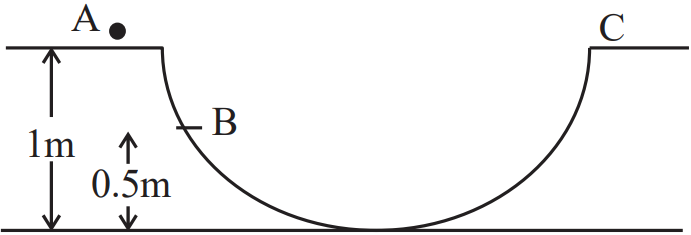
A particle is placed at the point $A$ of a frictionless track $\text{ABC}$ as shown in figure. It is gently pushed toward right. The speed of the particle when it reaches the point $B$ is : $\left(\right.$ Take $\left.g =10 m / s ^2\right)$.

Image
Ionized hydrogen atoms and $\alpha$ -particles with same momenta enters perpendicular to a constant magnetic field $B$. The ratio of their radii of their paths $\mathrm{r}_{\mathrm{H}}: \mathrm{r}_{\alpha}$ will be
A vector has magnitude same as that of $\overrightarrow{\mathrm{A}}-=3 \hat{\mathrm{j}}+4 \hat{\mathrm{j}}$ and is parallel to $\overrightarrow{\mathrm{B}}=4 \hat{\mathrm{i}}+3 \hat{\mathrm{j}}$. The $\mathrm{x}$ and $y$ components of this vector in first quadrant are $\mathrm{x}$ and $3$ respectively where  $X$=_____.
The escape velocity of a body depends upon mass as 
Dimensional formula $M{L^{ - 1}}{T^{ - 2}}$ does not represent the physical quantity
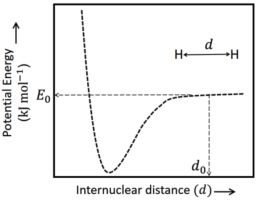
The figure below is the plot of potential energy versus internuclear distance $(d)$ of $H _2$ molecule in the electronic ground state. What is the value of the net potential energy $E_0$ (as indicated in the figure) in $kJ mol ^{-1}$, for $d=d_0$ at which the electron-electron repulsion and the nucleus-nucleus repulsion energies are absent? As reference, the potential energy of $H$ atom is taken as zero when its electron and the nucleus are infinitely far apart.

Use Avogadro constant as $6.023 \times 10^{23} mol ^{-1}$.
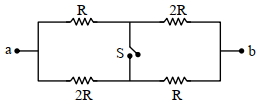
The ratio of the equivalent resistance of the network (shown in figure) between the points $a$ and ${b}$ when switch is open and switch is closed is ${x}: 8 .$ The value of ${x}$ is ..... .