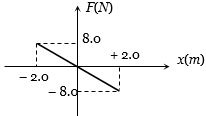
A body of mass $0.01 kg$ executes simple harmonic motion $(S.H.M.)$ about $x = 0$ under the influence of a force shown below : The period of the $S.H.M.$ is .... $s$
Medium
Download our app for free and get started
(d) From graph, slope $K = \frac{F}{x} = \frac{8}{2} = 4$
$T = 2\pi \sqrt {\frac{m}{K}} \Rightarrow T = 2\pi \sqrt {\frac{{0.01}}{4}} = 0.3\sec $
$T = 2\pi \sqrt {\frac{m}{K}} \Rightarrow T = 2\pi \sqrt {\frac{{0.01}}{4}} = 0.3\sec $

Download our appand get started for free
Experience the future of education. Simply download our apps or reach out to us for more information. Let's shape the future of learning together!No signup needed.*
Similar Questions
- 1$Assertion :$ Resonance is a special case of forced vibration in which the natural frequency of vibration of the body is the same as the impressed frequency of external periodic force and the amplitude of forced vibration is maximum.View Solution
$Reason :$ The amplitude of forced vibrations of a body increases with an increase in the frequency of the externally impressed periodic force. - 2The potential energy of a simple harmonic oscillator when the particle is half way to its end point is (where $E$ is the total energy)View Solution
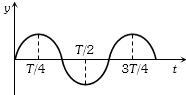
- 3View SolutionThe graph shows the variation of displacement of a particle executing S.H.M. with time. We infer from this graph that
- 4If the length of the simple pendulum is increased by $44\%$, then what is the change in time period of pendulum ..... $\%$View Solution
- 5If $< E >$ and $< U >$ denote the average kinetic and the average potential energies respectively of mass describing a simple harmonic motion, over one period, then the correct relation isView Solution
- 6The function ${\sin ^2}(\omega t)$ representsView Solution
- 7The maximum velocity of a simple harmonic motion represented by $y = 3\sin \,\left( {100\,t + \frac{\pi }{6}} \right)$is given byView Solution
- 8On a planet a freely falling body takes $2 \,sec$ when it is dropped from a height of $8 \,m$, the time period of simple pendulum of length $1\, m$ on that planet is ..... $\sec$View Solution
- 9When a mass $m$ is hung from the lower end of a spring of neglibgible mass, an extension $x$ is produced in the spring. The time period of oscillation isView Solution
- 10The displacement $y(t) = A\,\sin \,(\omega t + \phi )$ of a pendulum for $\phi = \frac {2\pi }{3}$ is correctly represented byView Solution