MCQ
A body of moment of inertia of $3\ kg-m^2$ rotating with an angular velocity of $2\ rad/sec$ has the same kinetic energy as a mass of $12\ kg$ moving with a velocity of .......... $m/s$
  • A
    $8$
  • B
    $0.5$
  • C
    $2$
  • $1$

Answer

Correct option: D.
$1$
d
Rotational kinetic energy of the body = $\frac{1}{2}I{\omega ^2}$ and translatory kinetic energy $ = \frac{1}{2}m{v^2}$

 According to problem $ = \frac{1}{2}I{\omega ^2} = \frac{1}{2}m{v^2}$ Þ  $\frac{1}{2} \times 3 \times {(2)^2}$

$= \frac{1}{2} \times 12 \times {v^2}$ $⇒$ $v = 1\,m/s$.

Need a full question paper?

Generate a complete, print-ready paper with questions like this in minutes — across 16+ boards, with answer keys.
Start Generating Free

Similar questions

At $23^{\circ} C$, a pipe open at both ends resonates at a frequency of $450 \,Hz$. At what frequency does the same pipe resonate on a hot day when the speed of sound is $4 \%$ higher than it would be at $23^{\circ} C$ ?
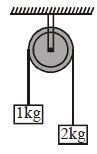
Two unequal masses are connected on two sides of light string passing over a light and smooth pulley as shown in the figure. The system is released from rest. The larger mass is stopped $1\, sec$ after the system is set into motion and then released. The time elapsed before the string is tight again $(g = 10\, m/sec^2)$
A $140\,g$ ball, in horizontal flight with a speed of $39.0\,m/s$, is struck by a bat. After leaving the bat, the ball travels in the opposite direction with speed $39.0\,m/s$. If the impact time $\Delta t$ for the ball-bat collision is $1.20\,ms$, ............ $N$ average force acts on the ball .
A projectile has initially the same horizontal velocity as it would acquire if it had moved from rest with uniform acceleration of $3\, ms^{-2}$ for $ 0.5\, minutes$. If the maximum height reached by it is $80\, m$, then the angle of projection is (Take $g = 10\, ms^{-2}$)
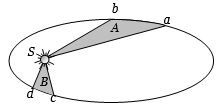
The figure shows the motion of a planet around the sun in an elliptical orbit with sun at the focus. The shaded areas $A$ and $B$ are also shown in the figure which can be assumed to be equal. If ${t_1}$ and ${t_2}$ represent the time for the planet to move from $a$ to $b$ and $d$ to $c$ respectively, then
A swimmer can swim in still water with speed $v$ and the river is flowing with velocity $v/2$. To cross the river in shortest distance, he should swim making angle $\theta$ with the upstream. What is the ratio of the time taken to swim across the shortest time to that is swimming across over shortest distance
Using dimensional analysis, the resistivity in terms of fundamental constants $h, m_{e}, c, e, \varepsilon_{0}$ can be expressed as
A horizontal force of $5 \,N$ is required to maintain a velocity of $2 \,m/s$ for a block of $10 \,kg$ mass sliding over a rough surface. The work done by this force in one minute is....$J$
The average kinetic energy of a monatomic molecule is $0.414 \mathrm{eV}$ at temperature :

(Use $\mathrm{K}_{\mathrm{B}}=1.38 \times 10^{-23} \mathrm{~J} / \mathrm{mol}-\mathrm{K}$ )

The value of $g $ at a place decreases by $ 2\%.$ The barometric height of mercury