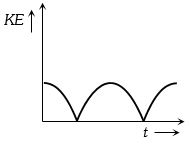
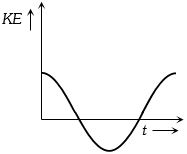
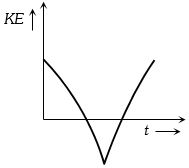
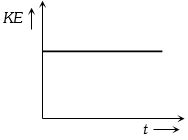
A body performs $S.H.M.$ Its kinetic energy $K$ varies with time $t$ as indicated by graph
  • A

  • B

  • C

  • D

Medium
art

Download our app
and get started for free

Experience the future of education. Simply download our apps or reach out to us for more information. Let's shape the future of learning together!No signup needed.*

Similar Questions

  • 1
    A $5\, kg$ collar is attached to a spring of spring constant $500\, Nm^{-1}$. It slides without friction over a horizontal rod. The collar is displaced from its equillibrium position by $10\, cm$ and released. The time period of oscillation is
    View Solution
  • 2
    Abody performs simple harmonic oscillations along the straight line $ABCDE$ with $C$ as the midpoint of $AE.$ Its kinetic energies at $B$ and $D$ are each one fourth of its maximum value. If $AE = 2R,$ the distance between $B$ and $D$ is
    View Solution
  • 3
    A weightless spring which has a force constant oscillates with frequency $n$ when a mass $m$ is suspended from it. The spring is cut into two equal halves and a mass $2m $ is suspended from it. The frequency of oscillation will now become
    View Solution
  • 4
    Two masses $m_1$ and $m_2$ are supended together by a massless spring of constant $k$. When the masses are in equilibrium, $m_1$ is removed without disturbing the system; the amplitude of vibration is
    View Solution
  • 5
    The potential energy of a particle of mass $1\, kg$ in motion along the $x-$ axis is given by $U = 4\,(1 -cos\,2x)$, where $x$ is in $metres$ . The period of small oscillation (in $second$ ) is
    View Solution
  • 6
    For a particle showing motion under the force $F=-5(x-2)$, the motion is ...........
    View Solution
  • 7
    A simple pendulum of length $ l$ has a brass bob attached at its lower end. Its period is $T$. If a steel bob of same size, having density $ x$ times that of brass, replaces the brass bob and its length is changed so that period becomes $2T$, then new length is
    View Solution
  • 8
    The displacement time graph of a particle executing $S.H.M.$ is given in figure: (sketch is schematic and not to scale) Which of the following statements is are true for this motion?

    $(A)$ The force is zero $t=\frac{3 T}{4}$

    $(B)$ The acceleration is maximum at $t=T$

    $(C)$ The speed is maximum at $t =\frac{ T }{4}$

    $(D)$ The $P.E.$ is equal to $K.E.$ of the oscillation at $t=\frac{T}{2}$

    View Solution
  • 9
    The displacement of simple harmonic oscillator after $3$ seconds starting from its mean position is equal to half of its amplitude. The time period of harmonic motion is $\dots \; s$
    View Solution
  • 10
    The equation of motion of a particle is $x = a\,cos (\alpha\, t)$ . The motion is
    View Solution