Question
A body performs simple harmonic motion according to the following equation :
$
x=6 \sin \left(3 \pi t+\frac{\pi}{3}\right)
$
Find out : (i) amplitude (ii) period (iii) initial art (iv) displacement, velocity and acceleration at time $t = 2$.
Answer

Given equation :
$x=6 \sin \left(3 \pi t+\frac{\pi}{3}\right)$
The general equation of simple harmonic motion is as follows :
$x=A \sin (\omega t+\phi)$
Comparing it with the given equation
(i) Dimension $A =6 m$
(ii) $\omega=3 \pi$
$\begin{aligned}\text {But}\quad\omega & =\frac{2 \pi}{T} \\T & =\frac{2 \pi}{\omega}=\frac{2 \pi}{3 \pi}=\frac{2}{3} sec \\T & =0 \cdot 666 sec .\end{aligned}$
(iii) Initial phase $=\frac{\pi}{3}$ radian
(iv) $x=6 \sin \left(3 \pi t +\frac{\pi}{3}\right)$ by keeping $t=2$ in
$\begin{aligned}x & =6 \sin \left(3 \pi \times 2+\frac{\pi}{3}\right) \\& =6 \sin \frac{\pi}{3}=6 \times \frac{\sqrt{3}}{2}=3 \sqrt{3}\end{aligned}$
Displacement $=3 \sqrt{3} m$.
$A =6$ and $\omega=3 \pi$ putting these values in the equation of velocity,
$\begin{array}{l}v= 3 \pi\left[(6)^2-(3 \sqrt{3})^2\right]^{\frac{1}{2}} \\\quad\left(\because v=\omega \sqrt{A^2-x^2}\right) \\=3 \pi(36-27)^{\frac{1}{2}}=3 \pi \times 3=9 \pi\end{array}$
Acceleration $a=\omega^2 x=(3 \pi)^2 \times 3 \sqrt{3}$
$=9 \pi^2 \times 3 \sqrt{3}=27 \sqrt{3} \pi^2$
Amplitude $=6$, period $=0.666 sec$.
Initial phase $=\frac{\pi}{3}$, displacement $=3 \sqrt{3} m / s$
Velocity $=9 \pi m / s$ and acceleration
$=27 \sqrt{3} \pi^2 m / s^2$

Need a full question paper?

Generate a complete, print-ready paper with questions like this in minutes — across 16+ boards, with answer keys.

Start Generating Free

Similar questions

State and explain Newton's law of cooling. Calculate the increase in the temperature of water which falls from a height of $100m$. Assume that $90\%$ of the energy due to fall is converted into heat and is retained by water. $J = 4.2J/ Cal^{-1}$.
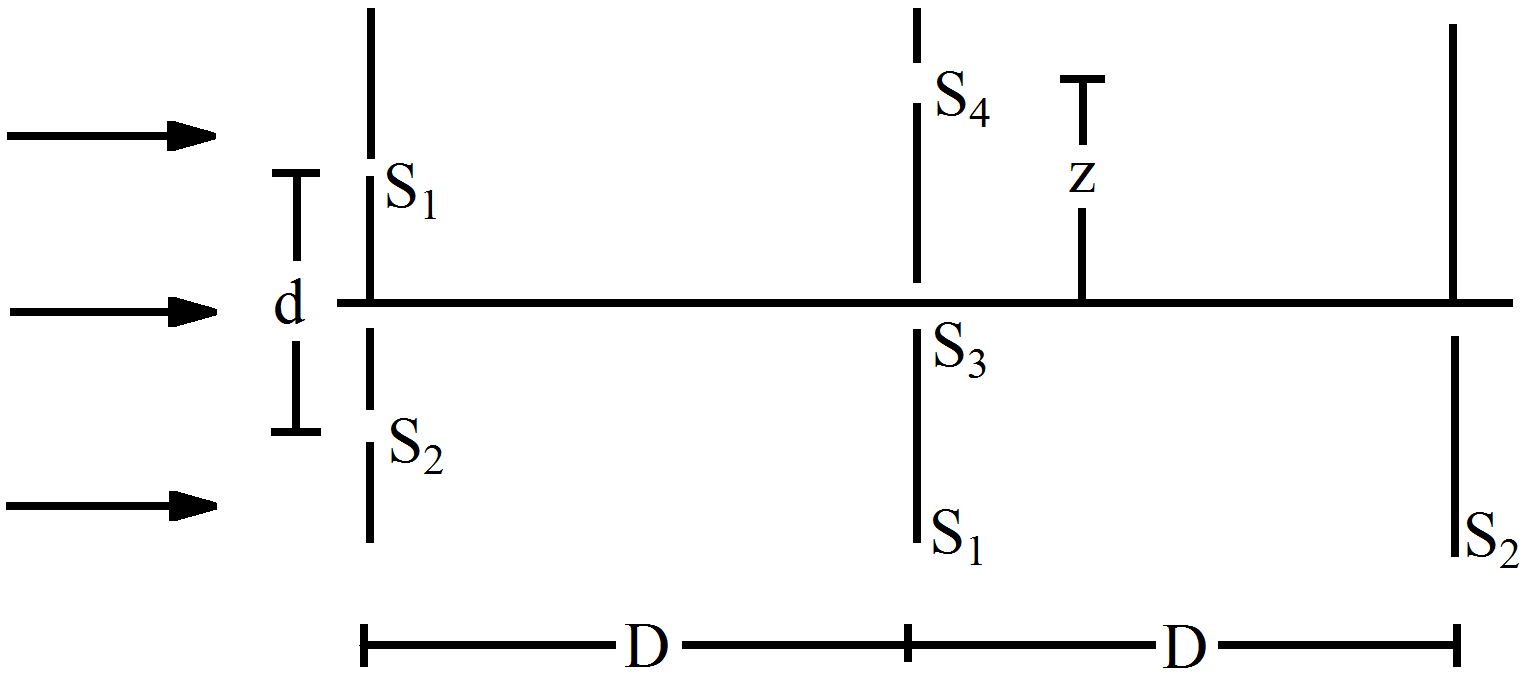
Consider the situation shown in figure (17-E6). The two slits $S_1$ and $S_2$ p laced symmetrically around the central line are illuminated by a monochromatic light of wavelength $\lambda.$ The separation between the slits is d. The light transmitted by the slits falls on a screen $E_1$ placed at a distance D from the slits. The slit $S_3$ is at the central line and the slit $S_4$ is at a distance z from $S_3$. Another screen $\sum_2$ is placed a further distance D away from $\sum_1$. Find the ratio of the maximum to minimum intensity observed on $\sum_2$, if z is equal to,
  1. $\text{z}=\frac{\lambda\text{D}}{2\text{d}}$
  2. $\frac{\lambda\text{D}}{\text{d}}$
  3. $\frac{\lambda\text{D}}{4\text{d}}$
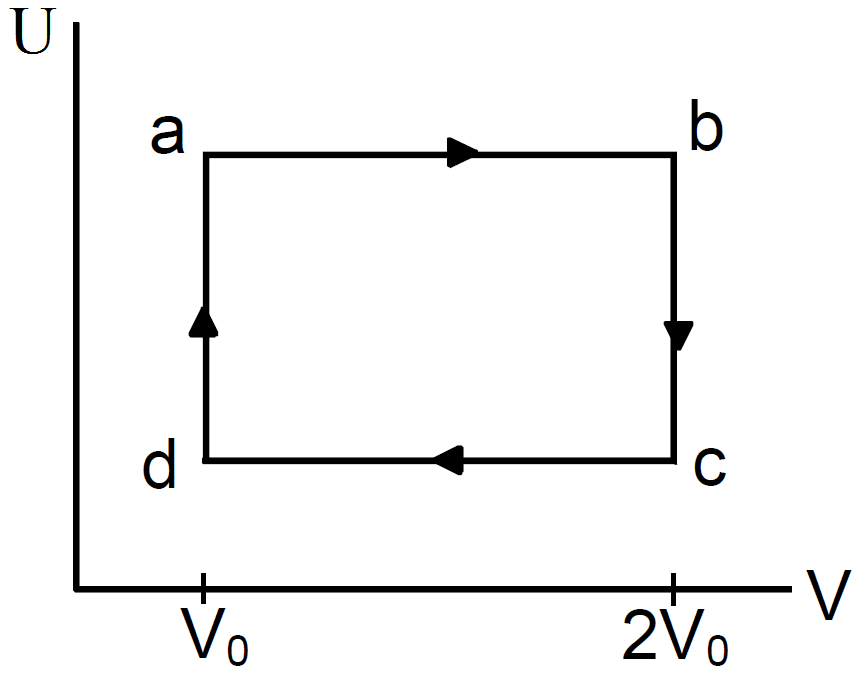
Figure. shows the variation in the internal energy U with the volume V of $2.0mol$ of an ideal gas in a cyclic process abcda. The temperatures of the gas at b and c are $500K$ and $300K$ respectively. Calculate the heat absorbed by the gas during the process.
Give example of a motion where x > 0, v < 0, a > 0 at a particular instant.
Three vessels of equal capacity have gases at the same temperature and pressure. The first vessel contains neon (monatomic), the second contains chlorine (diatomic), and the third contains uranium hexafluoride (polyatomic). Do the vessels contain equal number of respective molecules? Is the root mean square speed of molecules the same in the three cases? If not, in which case is vrms the largest?
One mole of an ideal gas at standard temperature and pressure occupies $22.4 L$ (molar volume). What is the ratio of molar volume to the atomic volume of a mole of hydrogen? (Take the size of hydrogen molecule to be about $1\mathring{\text{A}}$). Why is this ratio so large?
The electrical resistance in ohms of a certain thermometer varies with temperature according to the approximate law:
$\text{R}=\text{R}_0[1+\alpha(\text{T}-\text{T}_0)]$
The resistance is $101.6W$ at the triple-point of water $273.16K$, and $165.5W$ at the normal melting point of lead $(600.5K)$. What is the temperature when the resistance is $123.4W$?
A gas mixture consists of molecules of $A, B$ and $C$ with masses $m_A > m_B > m_c$. Rank the three types of molecules in decreasing order of (a) average KE, (b) rms speeds.
Write Newton's formula for the speed of sound in air. What was wrong with this formula? What correction was made by Laplace in this formula?
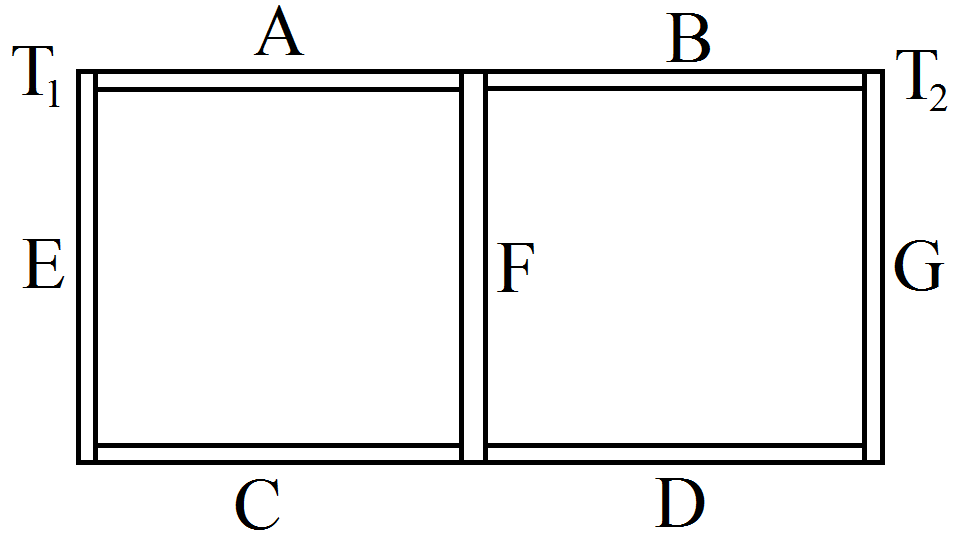
Seven rods $A, B, C, D, E, F$ and $G$ are joined as shown in figure. All the rods have equal cross-sectional area A and length l. The thermal conductivities of the rods are $K_A = K_c = K_0, K_B = K_D = 2K_0, K_E= 3K_0, K_F = 4K_0$, and $K_G = 5K_0$. The rod E is kept at a constant temperature $T_2$ and the rod G is kept at a constant temperature $T_2(T_2 > T_1)$.
  1. Show that the rod F has a uniform temperature $\text{T}=\frac{(\text{T}_1+2\text{T}_2)}{3}.$
  2. Find the rate of heat flowing from the source which maintains the temperature $T_2$.