Question
A body rotates about a fixed axis with an angular acceleration of one radian/ second/ second. Through what angle does it rotate during the time in which its angular velocity increases from 5rad/s to 15rad/s.

Answer

$\alpha=1\text{rad/s}^2,\ \omega_0=5\text{rad/s};\ \omega=15\text{rad/s}$$\therefore\text{w}=\text{w}_0+\alpha\text{t}$
$\Rightarrow\text{t}=\frac{(\omega-\omega_0)}{\alpha}=\frac{(15-5)}{1}=10\text{sec}$
Also, $\theta=\omega_0\text{t}+\frac{1}{2}\alpha\text{t}^2$
$=5\times10+\frac{1}{2}\times1\times100=100\text{rad}$

Need a full question paper?

Generate a complete, print-ready paper with questions like this in minutes — across 16+ boards, with answer keys.
Start Generating Free

Similar questions

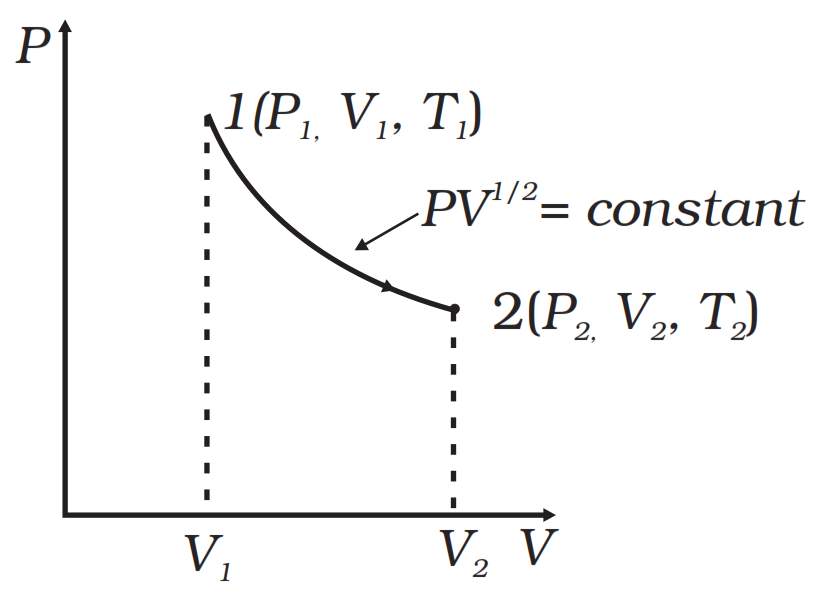
Consider a P-V diagram in which the path followed by one mole of perfect gas in a cylindrical container is shown in Fig. What is the ratio of temperature $\frac{\text{T}_1}{\text{T}_2},\text{if}\text{V}_2=2\text{V}_1?$
Find the fundamental, first overtone and second overtone frequencies of an open organ pipe of length 20cm. Speed of sound in air is 340m/s.
It is heard sometime that mercury is used in defining the temperature scale because it expands uniformly with temperature. If the temperature scale is not yet defined, is it logical to say that a substance expands uniformly with temperature?
The volume of a given mass of a gas at 27°C, 1 atm is 100cc. What will be its volume at 327°C?
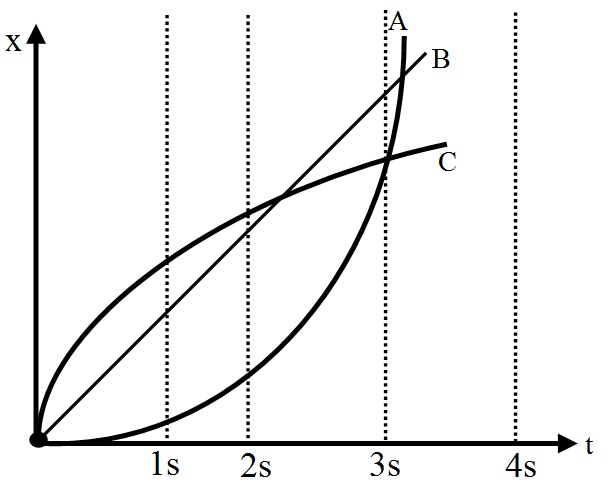
The position$-$time$-$graph in figure depicts the journey of three bodies $A, B$ and $C.$
  1. At $1s$, which has the greatest velocity?
  2. At $2s$, which has travelled the farthest?
  3. When $A$ meets $C,$ is $B$ moving faster or slower than $A?$
  4. Is there any time at which the velocity of $A$ is equal to that of $B?$
Can a flight of a bird, an example of composition of vectors. Why?
State the impulse-momentum theorem.
How does the elasticity of material change on:
  1. Increasing the temperature.
  2. On heating and cooling gradually.
  3. On hammering.
The electric force experienced by a charge of $1.0 \times 10^{-6} \mathrm{C}$ is $1.5 \times 10^{-3} \mathrm{~N}$. Find the magnitude of the electric field at the position of the charge.
Find the maximum angular speed of the electron of a hydrogen atom in a stationary orbit.