Question
A body rotating at 20rad/s is acted upon by a constant torque providing it a deceleration of $2rad/s^2$. At what time will the body have kinetic energy same as the initial value if the torque continues to act?

Answer

Initial angular velocity = 20rad/s Therefore $\alpha=2\text{rad/s}^2$$\Rightarrow\text{t}_1=\frac{\omega_2}{\alpha_1}=\frac{20}{2}=10\text{sec}$
Therefore 10sec it will come to rest. Since the same torque is continues to act on the body it will produce same angular acceleration and since the initial kinetic energy = the kinetic energy at a instant. So initial angular velocity = angular velocity at that instant Therefore time require to come to that angular velocity,$\Rightarrow\text{t}_2=\frac{\omega}{\alpha_2}=\frac{20}{2}=10\text{sec}$
therefore time required = $t_1 + t_2 = 20sec$.

Need a full question paper?

Generate a complete, print-ready paper with questions like this in minutes — across 16+ boards, with answer keys.

Start Generating Free

Similar questions

Consider the bodies of mass $m _1$ and $m _2$ in contact placed on a frictionless table as shown. When force F is applied on mass $m_1$, calculate the acceleration produced, and the force of contact between the bodies. What will be the force of contact when the force $F$ is applied on mass $m_2$ ?
A capacitor of capacitance $100\mu\text{F}$ is connected to a battery of 20 volts for a long time and then disconnected from it. It is now connected across a long solenoid having 4000 turns per metre. It is found that the potential difference across the capacitor drops to 90% of its maximum value in 2.0 seconds. Estimate the average magnetic field produced at the centre of the solenofd during this period.
A block of mass 2 kg is pulled up on a smooth incline of angle $30^{\circ}$ with horizontal. If the block moves with an acceleration of $1 m /$ $s^2$, find the power delivered by the pulling force at a time 4 seconds after motion starts. What is the/ frac delivered during these four seconds after the motion starts?
State ideal gas equation. Draw graph to check whether a real gas obeys this equation. What is the conclusion drawn?
A boy throws a ball in air at 60° to the horizontal along a road with a speed of 10m/ s (36km/ h). Another boy sitting in a passing by car observes the ball. Sketch the motion of the ball as observed by the boy in the car, if car has a speed of (18km/ h). Give explanation to support your diagram.
A convex lens produces a double size real image when an object is placed at a distance of 18cm from it. Where should the object be placed to produce a triple size real image?
What is the meaning of the components of vectors along $X, Y, Z$ axes and prove that $\cos ^2 \alpha+\cos ^2$ $\beta+\cos ^2 r=1$.
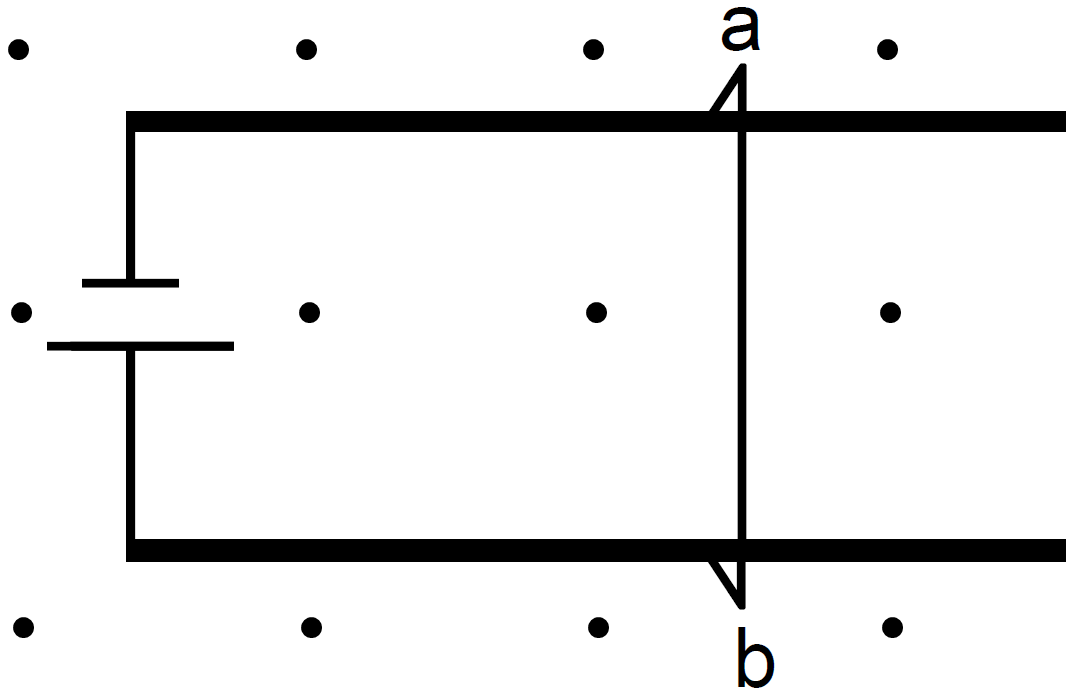
Figure shows a smooth pair of thick metallic rails connected across a battery of $\text{emf} \in$ having a negligible internal resistance. A wire $ab$ of length $l$ and resistance $r$ can slide smoothly on the rails. The entire system lies in a horizontal plane and is immersed in a uniform vertical magnetic field $B.$ At an instant $t,$ the wire is given a small velocity $u$ towards right.
  1. Find the current in it at this instant. What is the direction of the current?
  2. What is the force acting on the wire at this instant?
  3. Show that after some time the wire $ab$ will slide with a constant velocity. Find this velocity.
Out of aphelion and perihelion, where is the speed of the earth more and why?
Artificial diamond crystals have been manufactured by subjecting carbon in the form of graphite to a pressure of $1.55 \times 10^{10} \mathrm{Nm}^{-2}$ at a high temperature. Assuming that natural dimonds were formed at similar high pressures within the earth, what must have been the original volume o the Kohinoor diamond, whose mass before cutting was about 175 g ? The density of the diamond $=3.5 \mathrm{~g} / \mathrm{cm}^{-3}$ and its bulk modulus $=62 \times 10^{10} \mathrm{Nm}^{-2}$.