MCQ
A body sliding on a smooth inclined plane requires $4$ seconds to reach the bottom starting from rest at the top. How much time does it take to cover one-fourth distance starting from rest at the top.............$s$
  • A
    $1$
  • $2$
  • C
    $4$
  • D
    $16$

Answer

Correct option: B.
$2$
b
(b) $S = ut + \frac{1}{2}a{t^2} = 0 + \frac{1}{2}a{t^2}$

Hence $t \propto \sqrt S $

i.e., if $S$ becomes one-fourth then $t$ will become half i.e., $2 \,sec$

Need a full question paper?

Generate a complete, print-ready paper with questions like this in minutes — across 16+ boards, with answer keys.
Start Generating Free

Similar questions

$A$ body kept on a smooth horizontal surface is pulled by a constant horizontal force applied at the top point of the body. If the body rolls purely on the surface, its shape can be : 
If the terminal speed of a sphere of gold ( density $= 19.5 kg/m^3$) is $0.2\ m/s$ in a viscous liquid (density $= 1.5\ kg/m^3$ ), find the terminal speed (in $m/s$) of a sphere of silver (density $= 10.5\ kg/m^3$) of the same size in the same liquid ...... $m/s$
A particle of mass m is hanging vertically by an ideal spring of force constant K. If the mass is made to oscillate vertically, its total energy is
The quantities of heat required to raise the temperature of two solid copper spheres of radil $r _{1}$ and $r _{2}\left( r _{1}=1.5 r _{2}\right)$ through $1\;K$ are in the ratio
Consider two containers $A$ and $B$ containing identical gases at the same pressure, volume and temperature. The gas in container $A$ is compressed to half of its original volume isothermally while the gas in container $B$ is compressed to half of its original value adiabatically. The ratio of final pressure of gas in $B$ to that of gas in $A$ is
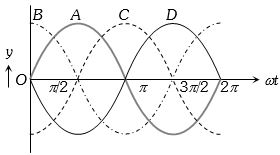
The figure shows four progressive waves $A, B, C$ and $D $ with their phases expressed with respect to the wave $A$. It can be concluded from the figure that
A spherical ball of density $\rho$ and radius $0.003$ $m$ is dropped into a tube containing a viscous fluid filled up to the $0$ $ cm$ mark as shown in the figure. Viscosity of the fluid $=$ $1.260$ $N.m^{-2}$ and its density $\rho_L=\rho/2$ $=$ $1260$ $kg.m^{-3}$. Assume the ball reaches a terminal speed by the $10$ $cm$ mark. The time taken by the ball to traverse the distance between the $10$ $cm$ and $20$ $cm$ mark is

( $g$ $ =$ acceleration due to gravity $= 10$ $ ms^{^{-2}} )$
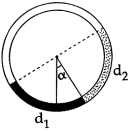
There is a circular tube in a vertical plane. Two liquids which do not mix and of densities $d_1$ and $d_2$ are filled in the tube. Each liquid subtends $90^o$ angle at centre. Radius joining their interface makes an angle $\alpha$ with vertical. Ratio $\frac{{{d_1}}}{{{d_2}}}$ is
A truck requires $3\text{Hrs,}$ to complete a journey of $150\ km,$ what is the average speed?
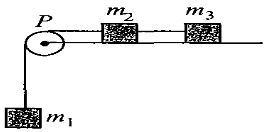
A system consists of three masses $m_1 , m_2$ and $m_3$ connected by a string passing over a pulley $P.$ The mass $m_1$ hangs freely and $m_2$ and $m_3$ are on a rough horizontal table (the coefficient of friction $= \mu ).$ The pulley is frictionless and of negligible mass. The downward acceleration of mass $m_1$ is $(Assume\, m = m_2 = m_3 = m)$