MCQ
A body starts from rest from the origin with an acceleration of $6 \;m / s^2$ along the $x$-axis and $8\; m / s^2$ along the $y$-axis. Its distance from the origin after $4\; seconds$ will be
  • A
    $56 $
  • B
    $64$
  • $80$
  • D
    $128 $

Answer

Correct option: C.
$80$
c
$x = {u_x}t + \frac{1}{2}{a_x}{t^2} = \frac{1}{2} \times 6 \times {(4)^2} = 48\,m$

$y = {u_y}t + \frac{1}{2}{a_y}{t^2} = \frac{1}{2} \times 8 \times {(4)^2} = 64\,m$

$d = \sqrt {{x^2} + {y^2}} = \sqrt {{{(48)}^2} + {{(64)}^2}} = 80\,m$

Need a full question paper?

Generate a complete, print-ready paper with questions like this in minutes — across 16+ boards, with answer keys.
Start Generating Free

Similar questions

For ordinary terrestrial experiments, which of the following observers below are inertial.
The distance covered by a body of mass $5\,g$ having linear momentum $0.3\,kg\,m / s$ in $5\,s$ is $..........\,m$
If a metallic sphere gets cooled from ${62^o}C$ to ${50^o}C$ in ${40^o}C$and in the next $10\;\min utes$gets cooled to ${42^o}C$, then the temperature of the surroundings is ......... $^oC$
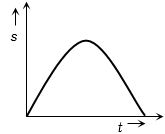
The graph of displacement v/s time is given below Its corresponding velocity-time graph will be
If we can throw a ball upto a maximum height $H$, the maximum horizontal distance to which we can throw it is
The displacement of a particle is represented by the following equation $s = 2t^3 + 7t^2 + 5t + 8$ where $s$ is in metres and $t$ in seconds. The acceleration of the particle at $t = 1\ s$ is:
A spherical body of mass $100 \mathrm{~g}$ is dropped from a height of $10 \mathrm{~m}$ from the ground. After hitting the ground, the body rebounds to a height of $5 \mathrm{~m}$. The impulse of force imparted by the ground to the body is given by : (given $\mathrm{g}=9.8 \mathrm{~m} / \mathrm{s}^2$ )
In making an alloy, a substance of specific gravity ${s_1}$ and mass ${m_1}$ is mixed with another substance of specific gravity ${s_2}$ and mass ${m_2}$; then the specific gravity of the alloy is
When a pressure of $100$ atmosphere is applied on a spherical ball of rubber, then its volume reduces to $0.01\%.$ The bulk modulus of the material of the rubber in dyne $cm^{-2}$ is:
For a constant volume gas thermometer, one should fill the gas at: